Note
Access to this page requires authorization. You can try signing in or changing directories.
Access to this page requires authorization. You can try changing directories.
Configure data queries and model settings for your Agentic Retrieval chat solution to optimize your chat results. Adjust search types, tune model parameters, and refine your chat experience in the Agentic Retrieval developer portal.
Important
Agentic Retrieval in Foundry Local is currently in PREVIEW. See the Supplemental Terms of Use for Microsoft Azure Previews for legal terms that apply to Azure features that are in beta, preview, or otherwise not yet released into general availability.
Prerequisites
Before you begin:
- Make sure you are in Knowledge-based chat mode.
- Review Search types to understand the available search types and when to use them.
- Review Knowledge layer configuration to plan for data ingestion and choose the right prompt and model parameters.
- Add data source for the chat solution
- To access the developer portal, you must have both the "EdgeRAGDeveloper" and "EdgeRAGEndUser" roles in Microsoft Entra.
Configure inference model settings
To get started, configure the inference model settings for your chat solution.
Go to the local portal using the domain name provided at deployment and app registration. For example,
https://arcrag.contoso.com.Sign in with developer credentials that have both "EdgeRAGDeveloper" and "EdgeRAGEndUser" roles assigned. If you have the right access configured, you're automatically redirected to the developer portal.
Select the Chat tab to get to the Chat playground.
In the Data inferencing pane, under Model parameters, adjust the model parameters for Temperature and Top P as needed.
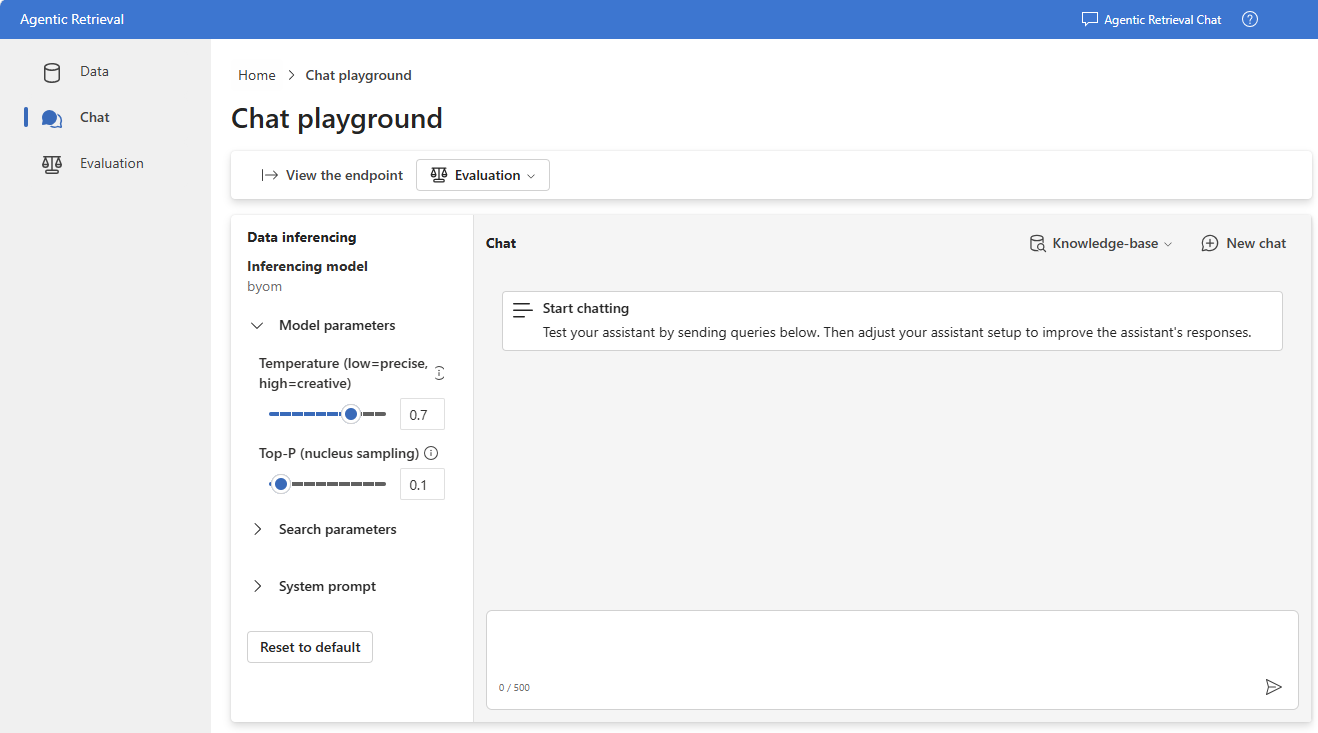
Select the Search parameters section.
Select the Type of search you want to use.
Search type Description Hybrid text search Combines keyword (text) search and vector (contextual) search. Text search Looks for exact words or phrases in documents. Vector search Looks for contextual similarity rather than exact keyword matching. Hybrid multimodal search (Preview, BYOM-only) Combines multiple modalities of text and image search simultaneously. Under Parameters, adjust the model parameters for Top-N documents and Text strictness as needed.
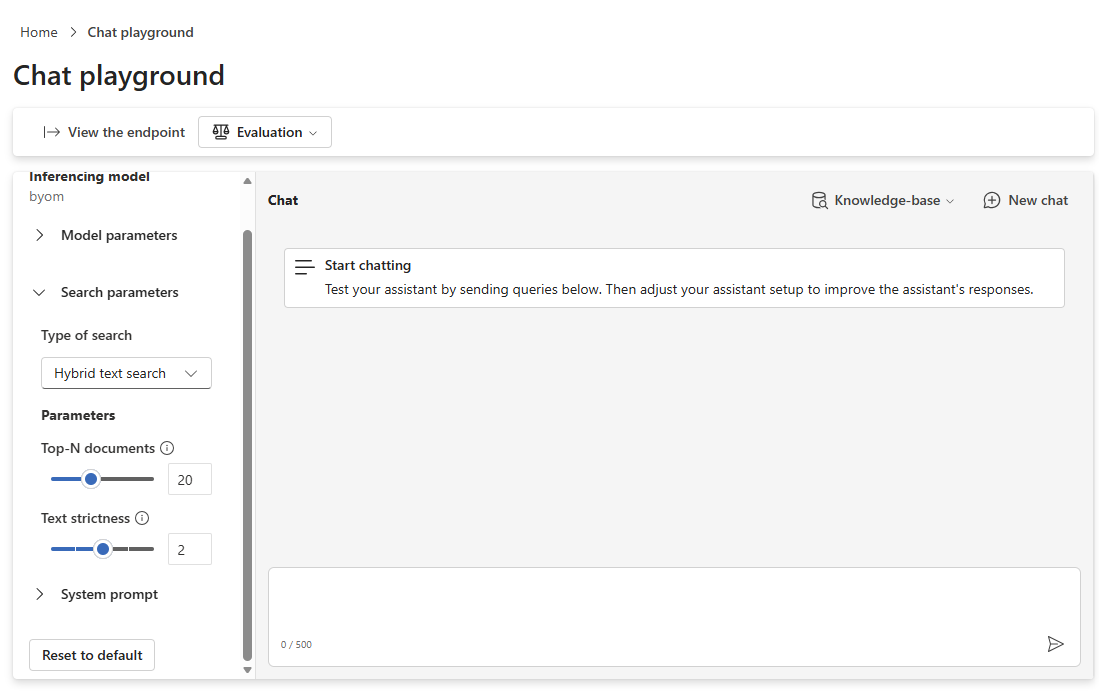
Select the System prompt section. Review and update the prompt as needed for your solution.
Any changes that you make are applied when you submit a new question in the chat.
Test chat results
Next, test the chat endpoint.
In the chat window, enter a question that uses a simple question and answer format. Queries that require summarization across multiple documents might not return accurate answers.
Be aware that with Agentic Retrieval extension version 0.1.5 and later each question is answered based on retrieved content only. The answer doesn't include the context of the chat history. Chat history isn't saved between questions. Treat each question as a new chat.
(Optional) To see how the language model responds without using your ingested data, switch the chat mode to Model-only and enter your question. Switch back to Knowledge-base chat to keep refining your solution with your ingested data.
(Optional) Test the end user experience by using the chat solution app for Agentic Retrieval.
View details to refine settings
Use the chat response details to analyze and fine-tune your model and search parameters to optimize your chat responses.
Under the chat response, select View details.
Use the chat details to understand the impact of the inferencing parameters on the language model's response to your question.
Field Description LLM response Response from the large language model (LLM) for the corresponding question. User question Question asked by user. Search type The method used to find relevant information for your question, such as hybrid, text, vector, or hybrid multimodal search. Parameters Parameters that are used to search content and generate LLM response. System prompt The custom instructions set by the developer to guide the language model\u2019s responses. Reranked chunks Shows search IDs by reranking score. LLM Input chunks Relevant chunks passed to LLM as retrieved content; the chunks are selected based on text strictness and image strictness. Search details Shows search details. Results from text search Results from textual search for a query; each result shows reranking score, search distance, text, file path, chunk ID, and last modified date. Results from vector search Results from semantic search for a query; each result shows reranking score, search distance, text, file path, chunk ID, and last modified date. Results from image search Results from image search for a query, each result shows reranking score, file path, last modified date. To analyze the Details, select Copy to paste a JSON version of the text into a text editor.
Tune the inferencing parameters to get the type of responses that you want for your ingested data.
Get the API endpoint
When you're satisfied with the solution, select on View the endpoint to get the API endpoint to use in your downstream applications.