Note
Access to this page requires authorization. You can try signing in or changing directories.
Access to this page requires authorization. You can try changing directories.
Conditional statements let you perform calculations based on specified conditions. These functions evaluate expressions and return different values depending on whether the conditions are true or false. They are commonly used to apply business logic, categorize data, filter results, and handle exceptions.
Important
This feature is in preview.
In plan (preview), conditional statements help you create dynamic calculations that adapt to different scenarios, such as applying thresholds, categorizing data, or managing error conditions.
AVERAGEIF
The AVERAGEIF function returns the average of values in a list that meet a specified condition.
Syntax
AVERAGEIF(list, condition)
Arguments
list: The list of values to evaluate.condition: The condition used to filter the values.
Return value
Returns the average of the values that satisfy the given condition.
Example
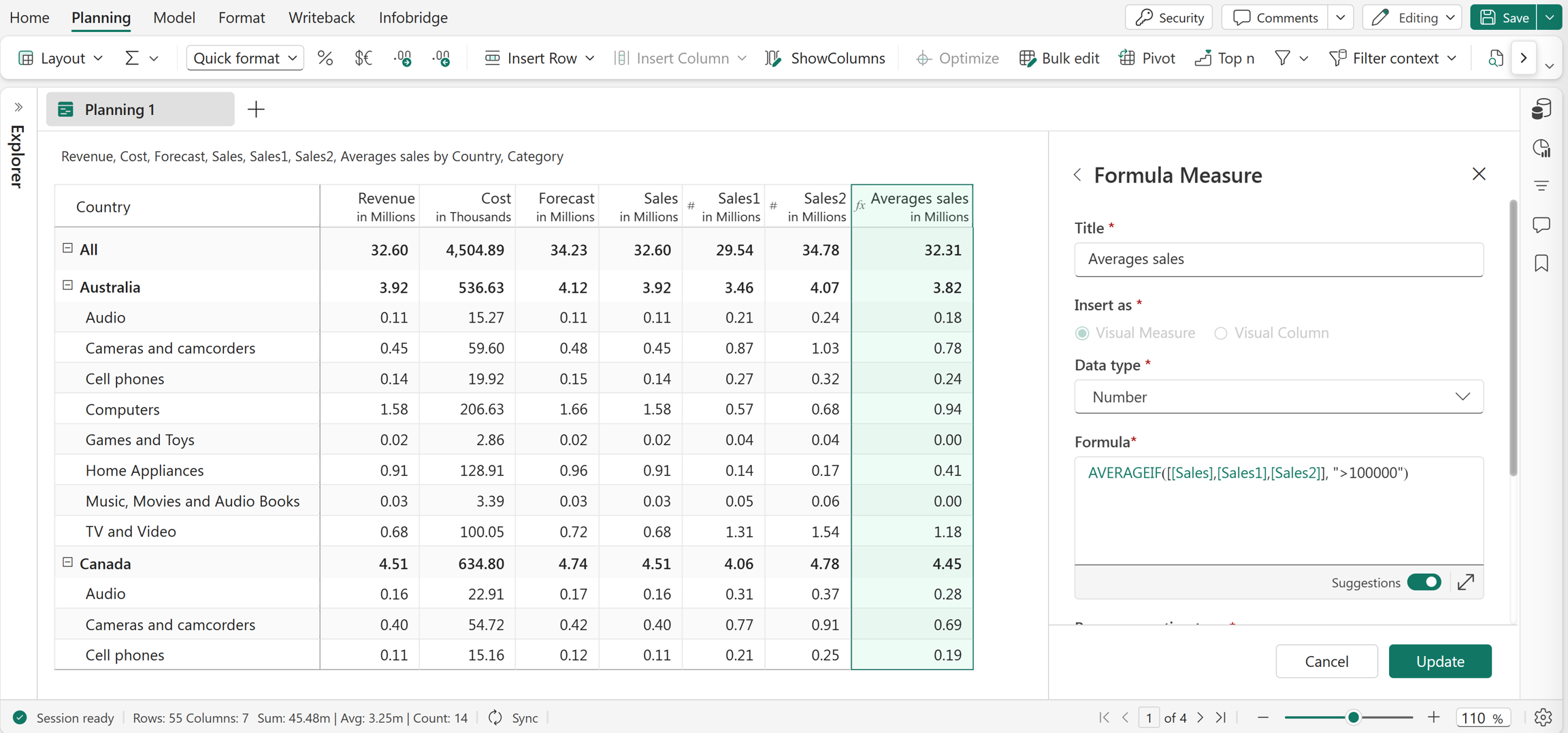
AVERAGEIF([Sales,Sales1,Sales2], ">0.1m")
Returns the average of Sales, Sales1, and Sales2 column values when they are greater than 0.1 million.
Excel equivalent
COUNTIF
The COUNTIF function returns the count of values that match a specified condition.
Syntax
COUNTIF(list, condition)
Arguments
list: The list of values to evaluate.condition: The condition used to filter the values.
Return value
Returns the number of values that satisfy the given condition.
Example
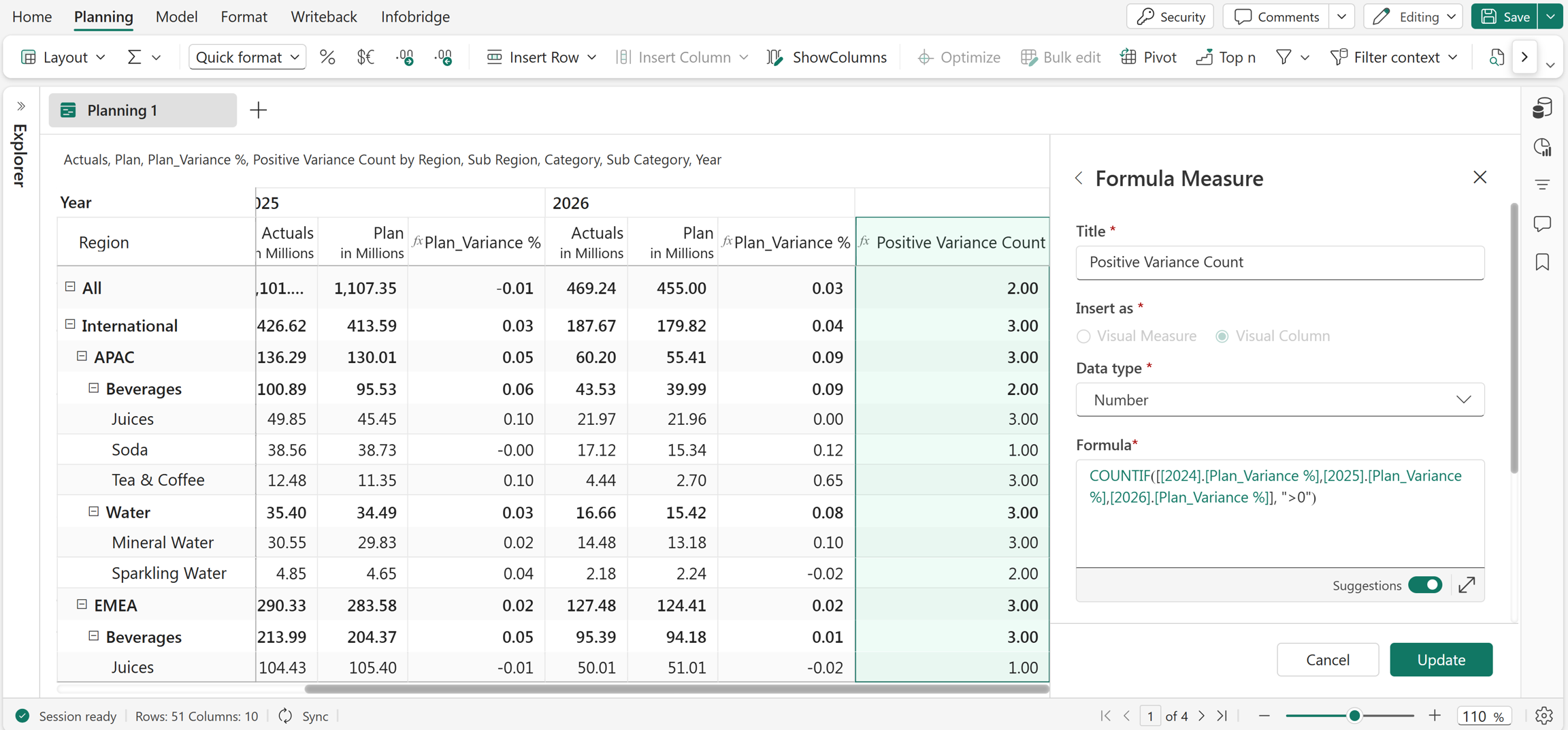
COUNTIF([[2024.Plan_Variance %], [2025.Plan_Variance %], [2026.Plan_Variance %]], ">0")
Returns the count of Plan Variance % values across 2024, 2025, and 2026 that are greater than 0.
Excel equivalent
FILTERIF
The FILTERIF function filters a list of values based on a specified condition and returns the filtered results as an array.
Because it returns an array, it is typically used with aggregate functions such as SUM or AVERAGE. It can also be used to populate a calculated row.
Syntax
FILTERIF(list, condition)
Arguments
list: The list of values to evaluate.condition: The condition used to filter the values.
Return value
Returns an array of values that meet the specified condition.
Example
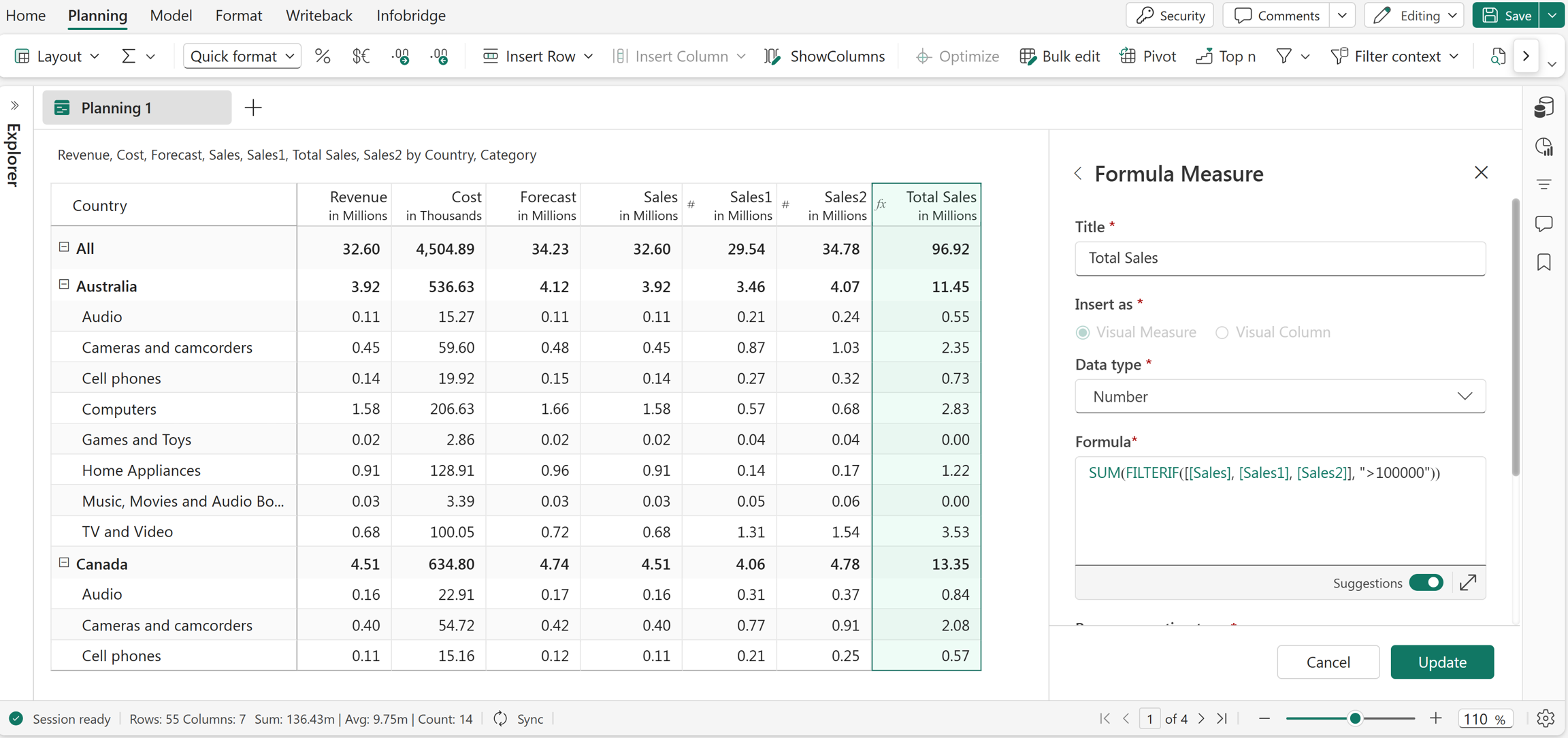
SUM(FILTERIF([[Sales], [Sales1], [Sales2]], ">0.1m"))
Filters values from Sales, Sales1, and Sales2 that are greater than 0.1 million and returns their sum.
IF
The IF function returns one value if a condition is true and another value if it is false.
Syntax
IF(logical_test, value_if_true, value_if_false )
Arguments
logical_test: The condition to evaluate.value_if_true: The value returned if the condition is true.value_if_false: The value returned if the condition is false.
Return value
Returns either value_if_true or value_if_false based on the result of the condition.
Example
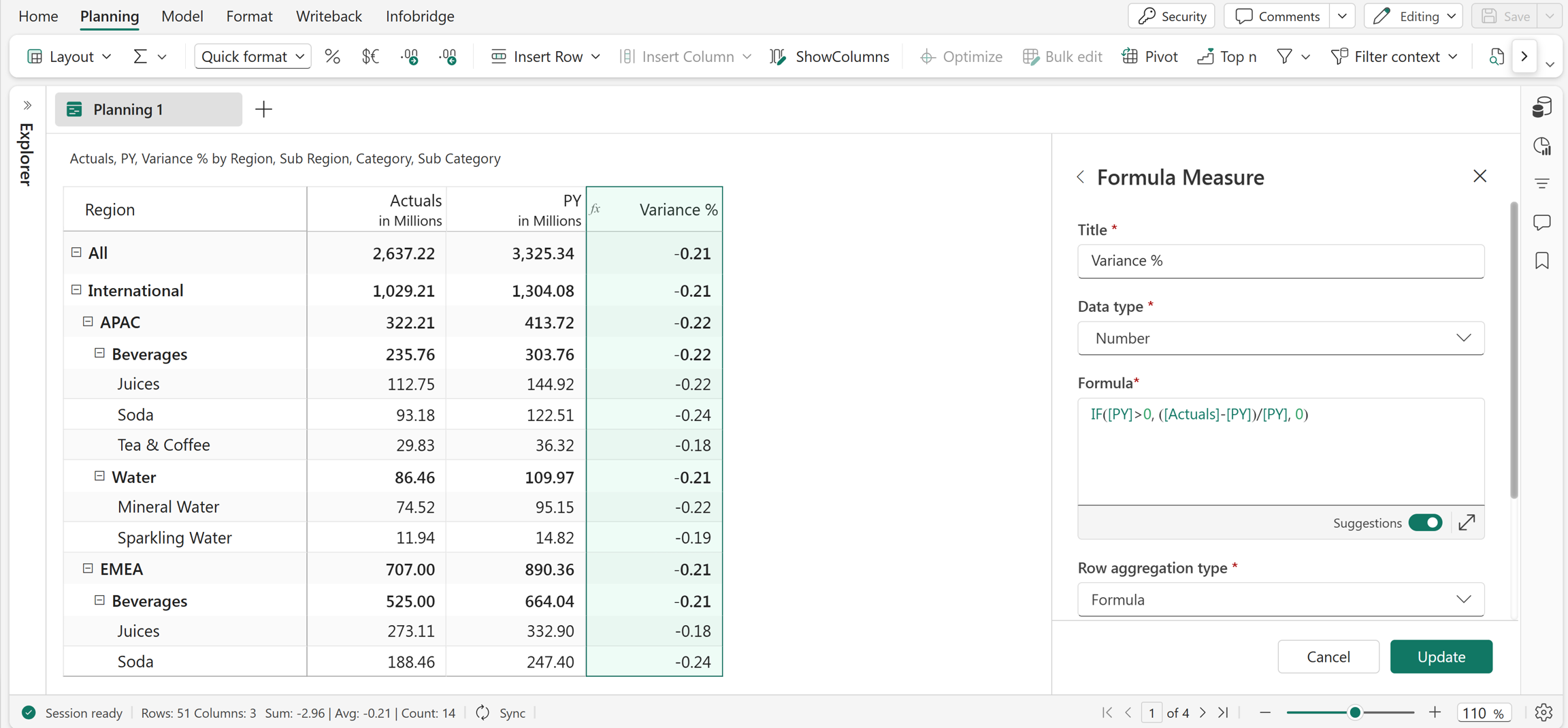
IF(PY > 0, (AC - PY) / PY, 0)
Returns (AC - PY) / PY if PY is greater than 0; otherwise, returns 0.
Excel equivalent
IFNA
The IFNA function returns the specified value if an expression results in the #N/A error; otherwise, it returns the result of that expression.
Syntax
IFNA(value, value_if_na)
Arguments
value: The expression to evaluate for the #N/A error.value_if_na: The value to return if the expression results in the #N/A error.
Return value
Returns either the result of the value or value_if_na if the #N/A error occurs.
Example
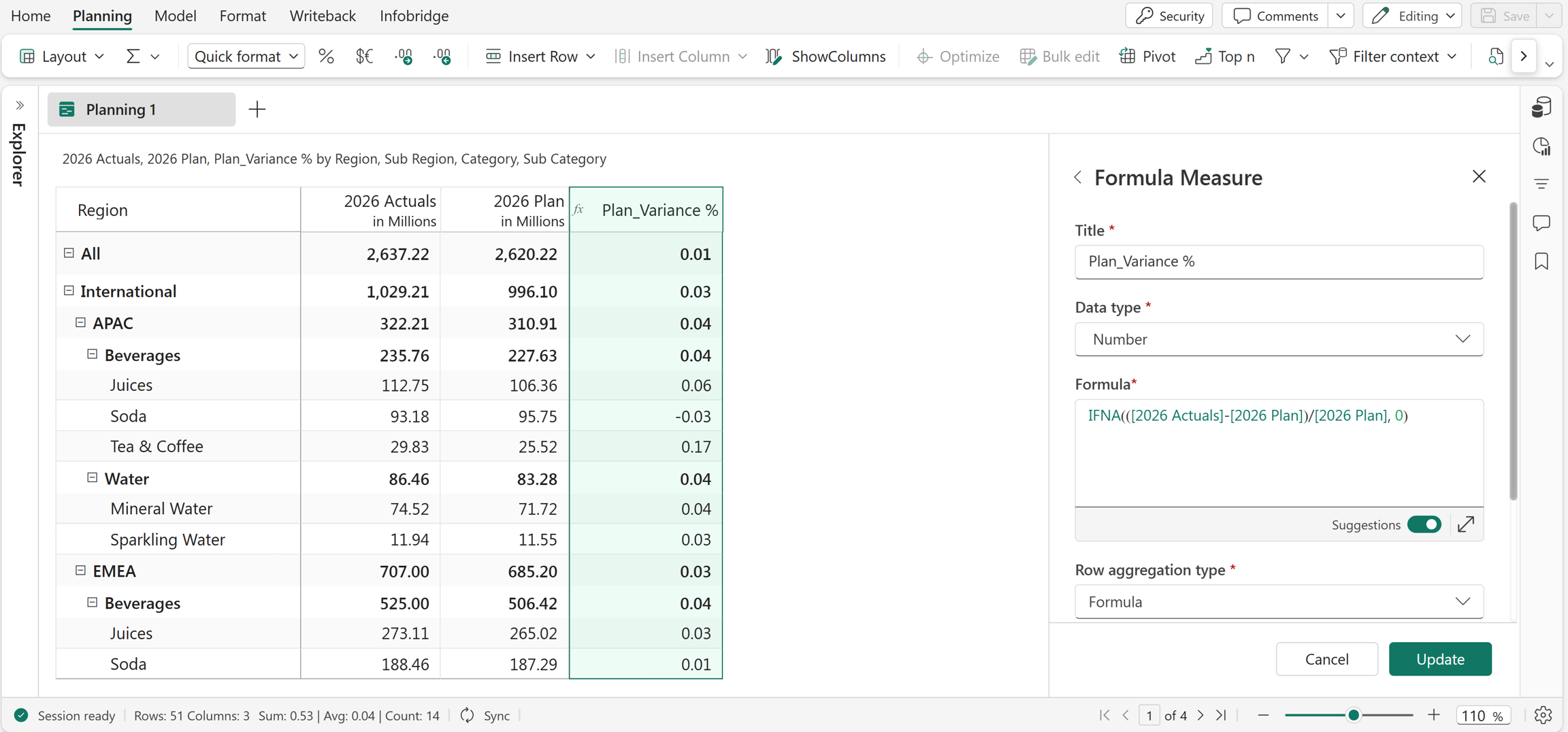
IFNA((Actuals - Plan) / Plan, 0)
Returns (Actuals - Plan) / Plan if the expression evaluates successfully; otherwise, returns 0 if the #N/A error occurs.
Excel equivalent
SUMIF
The SUMIF function returns the sum of values in a list that satisfy a specified condition.
Syntax
SUMIF(list, condition, [range])
Arguments
list: The list of values to evaluate.condition: The condition used to filter values in the list.range(optional): The list of values to sum if the values in thelistmeet the condition. If not specified, the values in the originallistare summed.
Return value
Returns the sum of values that satisfy the condition.
Example
Without range
SUMIF([10, 20, 30, 40], ">20")
In this example, the SUMIF function returns the sum of values greater than 20 from the list and returns 70 (30 + 40).
With range
SUMIF([10, 20, 30, 40], ">20", [1, 2, 3, 4])
The SUMIF function evaluates the values in the first list and returns the sum of corresponding values from the second list where the condition is met. In this example, the result is 7 (3 + 4).
SWITCH
The SWITCH function evaluates an expression against a list of values and returns the result corresponding to the first matching value. If no match is found, an optional default value is returned.
Syntax
SWITCH(expression, val1, res1, val2, res2, ..., val_n, res_n, default)
Arguments
expression: The expression to evaluate.val1, val2, ... val_n: The values to compare against the expression.res1, res2, ... res_n: The result to return for each matching value.default(optional): The value to return if no match is found.
Return value
Returns the result corresponding to the first matching value. If no match is found, returns the default value (if specified).
Example
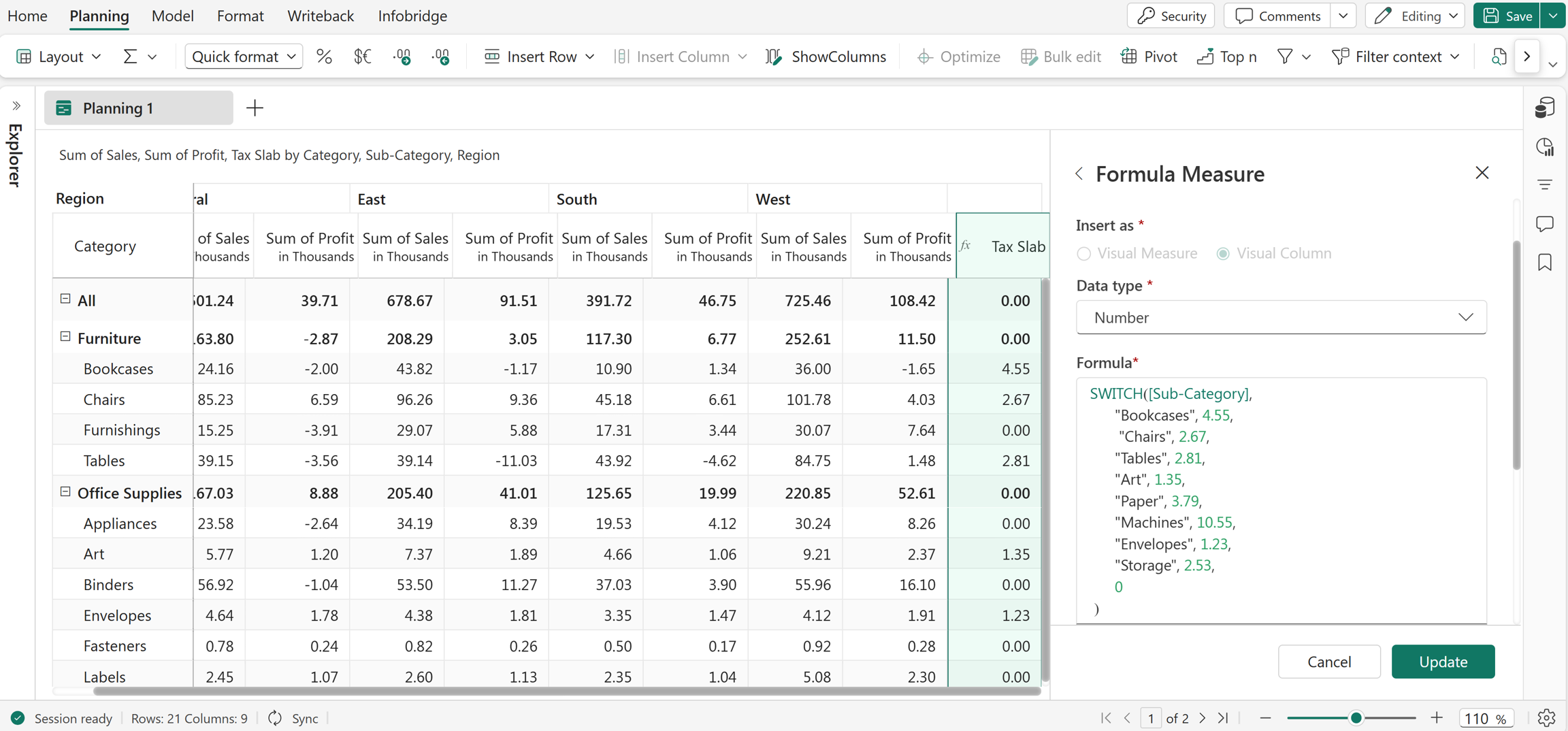
SWITCH(Sub-Category, "Bookcases", 4.55, "Chairs", 2.67, "Tables", 2.81, "Art", 1.35, "Paper", 3.79, "Machines", 10.55, "Envelopes", 1.23, "Storage", 2.53, 0)
Evaluates the Sub-Category value and returns the corresponding numeric value for each match; if no match is found, returns 0.