Note
Access to this page requires authorization. You can try signing in or changing directories.
Access to this page requires authorization. You can try changing directories.
Fabric Maps can visualize real-time geospatial data by connecting to eventhouse datasets that are continuously updated through Eventstream ingestion.
Unlike static scenarios that use files stored in a Lakehouse, this tutorial demonstrates a streaming, event-driven architecture where:
- Events are ingested into an eventhouse
- Data is queried using Kusto Query Language (KQL)
- A map dynamically refreshes as new data arrives
This tutorial focuses on automating the end-to-end workflow using Fabric REST APIs and Python, so you can provision resources and configure a real-time map experience programmatically. For static data scenarios using Lakehouse files, see Create a static map using REST APIs and Python.
In this tutorial, you learn how to build and automate a real-time geospatial solution in Microsoft Fabric using Eventstream, Eventhouse, and KQL.
Using the Fabric REST API, you:
- Create an eventhouse and KQL database
- Create an eventstream to ingest data into the eventhouse
- Create a map with an inline definition that references eventhouse data
- Configure a map layer with periodic refresh for real-time updates
- Seed initial events so the map displays data immediately
To simulate continuous streaming and watch the map update in near real time, complete this tutorial first, then continue with the follow-up Tutorial: Simulate real-time data ingestion for a map using REST APIs and Python, which builds directly on the eventhouse, eventstream, KQL function, and map you create here.
Scenario overview: Real-time asset tracking
This tutorial is based on a real-time asset tracking scenario, similar to the fleet tracking scenario used in the original Fabric Maps Tutorial: Build real-time work order routing with Fabric Maps.
In this scenario:
- Vehicles periodically emit location updates
- Location events are ingested into an eventhouse
- A map displays the latest vehicle positions and updates automatically as new events arrive
This pattern is representative of common real-time operational use cases, such as:
- Fleet tracking
- Work order dispatching
- Asset and equipment monitoring
Microsoft Fabric uses Eventstream and Eventhouse to ingest, process, and analyze streaming data in near real time, making it possible to visualize live operational data directly on a map.
This tutorial follows a common automation pattern in Fabric: create infrastructure → ingest stream → validate ingestion → render map.
Prerequisites
- Python 3.10 or later
- Azure CLI
- Fabric workspace ID
- Permissions to call Fabric REST APIs, such as:
Item.ReadWrite.All
Note
Delegated scopes such as Item.ReadWrite.All are granted to the signed-in identity through its workspace role. Make sure the identity you use with az login is assigned the Contributor, Member, or Admin role on the target Fabric workspace before running the script.
Authentication
This tutorial uses DefaultAzureCredential, which can authenticate using several local/dev credentials sources. For first-time readers, the simplest approach is Azure CLI sign-in.
Authenticate locally (recommended for first run)
- Open a terminal.
- Run:
az login
DefaultAzureCredential can use your signed-in identity to acquire access tokens for:
- Fabric REST APIs (resource:
https://api.fabric.microsoft.com/.default) - Kusto (KQL) data-plane queries against the eventhouse (resource:
https://api.kusto.windows.net/.default) - Power BI / Fabric REST endpoints used for long-running operation polling (resource:
https://analysis.windows.net/powerbi/api/.default)
Tip
About https://api.fabric.microsoft.com/.default
This value is a token request scope, not a URL that you call directly. It tells Microsoft Entra that the access token should be issued for the Microsoft Fabric REST API and should include all Fabric permissions that are already granted to the authenticated identity (such as Item.ReadWrite.All or Workspace.ReadWrite.All).
The .default scope is used only during token acquisition and is never sent to Fabric REST API endpoints.
For more information about how the .default scope works in the Microsoft identity platform, see Scopes and permissions in the Microsoft identity platform.
Sign in to Microsoft Fabric (recommended)
Before you run this tutorial, we recommend signing in to Microsoft Fabric at least once:
https://app.fabric.microsoft.com
Signing in ensures that your Fabric identity, workspace role membership, and capacity assignments are fully provisioned before acquiring a Microsoft Entra access token programmatically.
This step is especially helpful if:
- You're new to Microsoft Fabric
- The workspace was recently created
- Your role assignment was added recently
Note
This tutorial authenticates using Microsoft Entra ID via DefaultAzureCredential. Fabric REST APIs don't require a browser session, but signing in to the Fabric web experience can prevent first‑run authorization issues caused by delayed role provisioning.
Create the seed data file (initial map data)
To ensure the map displays data immediately after provisioning, the script sends a small set of seed events to the eventstream.
- Create a new file in the same directory as your Python script: vehicle_locations_seed.csv
- Paste the following content:
VehicleId,Latitude,Longitude,EventTime
V-001,47.6101,-122.3344,2026-01-01T10:00:00Z
V-002,47.6150,-122.3200,2026-01-01T10:00:00Z
V-003,47.6205,-122.3493,2026-01-01T10:00:00Z
V-004,47.6050,-122.3300,2026-01-01T10:00:00Z
Step 1—Create a new Python project file
In this step, you create a blank Python file that you build up section-by-section.
Create a new file named:
create_realtime_map.py
Open the file in your editor.
Step 2—Install required libraries and add required import statements
In this step, you install the dependencies and add the imports your script uses.
Install required libraries
In the terminal window you just opened, run the following command:
pip install httpx azure-identity azure-eventhub
What each library is for
- httpx: makes HTTP requests to the Fabric REST APIs.
- azure-identity: provides
DefaultAzureCredentialfor Microsoft Entra authentication. - azure-eventhub: sends seed events to the Eventstream's Event Hub-compatible endpoint to populate the eventhouse.
Add import statements to your .py file
At the top of create_realtime_map.py, add:
import base64
import csv
import json
import os
import time
import uuid

import httpx
from azure.eventhub import EventData, EventHubProducerClient
from azure.eventhub.exceptions import EventHubError
from azure.identity import DefaultAzureCredential
Note
EventHubError is imported here but not used until later in the script. The seed_eventstream_from_csv helper catches it (alongside ConnectionError and TimeoutError) in its retry loop so that transient Event Hub send failures—such as the custom endpoint not yet being ready—trigger a retry instead of aborting the script.
Step 3—Add a configuration section
In this step, you define the variables your application uses, including the workspace ID and resource names.
Centralizing configuration in a single Config class — rather than scattering hard-coded values across functions — gives you three concrete advantages:
- Environment portability: Workspace IDs, resource names, and other settings live in one place, so you can rerun the script against a different workspace or machine by changing a few lines (or an environment variable) instead of hunting through the code.
- Cleaner function signatures: Step functions accept a single
cfgobject instead of long parameter lists, which keeps the orchestration inmain()easy to read. - Safer secrets handling: Sensitive values such as the workspace ID are loaded from environment variables, so they're never committed alongside the script.
Add the following below the import statements:
# =========================================================
# Configuration (centralized)
# =========================================================

class Config:
    """
    Central configuration: workspace ID, resource display names, and
    ingestion settings. A single instance is built in main() and passed
    to each step function.
    """
    def __init__(self):
        # Workspace
        self.workspace_id = os.environ.get("FABRIC_WORKSPACE_ID", "")
        if not self.workspace_id:
            raise RuntimeError("Set FABRIC_WORKSPACE_ID environment variable before running the script.")

        # Resource display names / descriptions
        self.eventhouse_display_name = "eh_realtime_locations"
        self.eventhouse_description = "Stores streaming location events for a Fabric Maps real-time tutorial"

        self.eventhouse_table_name = "VehicleLocations"
        self.kql_function_name = "LatestVehicleLocations"

        self.eventstream_display_name = "es_realtime_locations"
        self.eventstream_description = "Streams events into an eventhouse table (created via Eventstream REST API)"

        self.map_display_name = "My Real-Time Fabric Map"
        self.map_description = "Created using Fabric Maps REST API (Eventhouse + Eventstream + Kusto function)"

        # Map refresh
        self.refresh_interval_ms = 5000

        # Seed data (initial map data)
        self.seed_csv_path = os.path.join(os.path.dirname(__file__), "vehicle_locations_seed.csv")

        # Will be provided interactively after eventstream is created
        self.eventhub_connection_string = os.environ.get("EVENTHUB_CONNECTION_STRING", "")
Set the workspace ID using an environment variable
Instead of hardcoding the workspace ID directly in the script, this tutorial reads it from an environment variable. This keeps environment-specific values out of source code and lets you reuse the script across workspaces or machines without editing it.
Before running the script, create an environment variable named FABRIC_WORKSPACE_ID.
Important
An environment variable set from a terminal exists only inside that single terminal session. It isn't shared with other terminal windows, with a different shell type, or with processes launched outside that terminal—including scripts started from VS Code's run button, which often spawns its own terminal. If the script can't find the variable, it fails with Set FABRIC_WORKSPACE_ID environment variable before running the script.
To avoid this, either run the script from the same terminal session where you set the variable, or set it persistently (see the Windows and macOS/Linux sections that follow) so every new terminal session picks it up automatically.
Set the environment variable on Windows
On Windows, you can set the variable from any terminal that supports environment variables—PowerShell, Windows PowerShell, the PowerShell or Command Prompt windows built into Visual Studio and Visual Studio Code, Windows Terminal, and most other shells.
Run the following in PowerShell or the VS Code integrated terminal:
$env:FABRIC_WORKSPACE_ID="<WORKSPACE_ID>"
To confirm the variable is set:
echo $env:FABRIC_WORKSPACE_ID
This sets the variable for the current terminal session only.
Set a persistent environment variable (Windows)
To make the variable available in future sessions, use either of the following:
- PowerShell (one-liner): Run
setx FABRIC_WORKSPACE_ID "<WORKSPACE_ID>". Thesetxcommand writes to the user environment but doesn't update the current terminal—close and reopen the terminal (or open a new one) before running the script. - GUI:
- Open System Properties.
- Select Advanced system settings.
- Choose Environment Variables.
- Under User variables, select New.
- Enter:
- Name:
FABRIC_WORKSPACE_ID - Value: your workspace ID
- Name:
- Select OK to save.
- Close and reopen your terminal before running the script again.
Set the environment variable on macOS or Linux
On macOS and Linux, you can set the variable from any shell that supports export—Bash, Zsh (the default on modern macOS), Fish (with a slightly different syntax), and the integrated terminals in Visual Studio Code and other editors.
Run:
export FABRIC_WORKSPACE_ID="<WORKSPACE_ID>"
To confirm the variable is set:
echo $FABRIC_WORKSPACE_ID
This sets the variable for the current shell session only.
Set a persistent environment variable (macOS or Linux)
To make the variable available in future sessions, add the export line to your shell profile:
- Zsh (default on macOS):
~/.zshrc - Bash:
~/.bashrc(Linux) or~/.bash_profile(macOS) - Fish: run
set -Ux FABRIC_WORKSPACE_ID "<WORKSPACE_ID>"instead of editing a file
After updating the profile, either open a new terminal or run source ~/.zshrc (or the appropriate file) so the change takes effect.
Step 4—Add helper functions
In this step, you factor out cross-cutting concerns—authentication, header construction, long-running operation polling, and retry logic—into a small set of reusable helpers that every step function can call.
Centralizing these concerns in helpers — rather than inlining them at every call site — gives you three concrete advantages:
- Single source of truth for cross-cutting concerns: Authentication, headers, and LRO polling are needed by nearly every API call. Centralizing them keeps each step function focused on its own resource instead of re-implementing token acquisition and retry logic.
- Resilience without clutter: Helpers absorb transient conditions—asynchronous provisioning, backend propagation delay, retryable send failures—so step functions stay short and read like a checklist.
- Easier to teach and modify: Each helper is introduced once and reused. If Fabric changes an LRO pattern or an auth scope, you fix it in one place.
The helpers you add in this step are:
- Auth helpers: build headers for Fabric REST APIs (and Power BI cluster LRO endpoints)
- FabricClient: lightweight wrapper for consistent API calls
- LRO handler: poll long-running operations using
Location/x-ms-operation-id/Retry-After, including200-with-Runningresponses, Power BI cluster endpoints, and status-only completion payloads (resolves bydisplayName) - Definition payload helper: base64-encode
map.jsonfor inline definitions - Eventstream connection helper: prompts for the custom endpoint connection string
- Seed helper: sends initial events with retry logic to ensure ingestion succeeds
- KQL database readiness helper: waits for the KQL database to become available to Fabric Maps
Note
This tutorial spans two planes:
- Control plane (Fabric REST APIs): create Eventhouse, Eventstream, and Map resources
- Data/query plane (Kusto management API): create and manage KQL tables and functions inside the eventhouse
Create authentication helper functions
Every Fabric REST call this tutorial makes carries a Microsoft Entra access token (bearer token) in the Authorization header. Rather than acquiring tokens ad hoc, this step wraps DefaultAzureCredential in a small TokenProvider and exposes an audience-specific header builder for each endpoint family the script calls.
Centralizing token acquisition and header construction in helpers — rather than acquiring tokens at every call site — gives you three concrete advantages:
- Centralized credential: A single
DefaultAzureCredentialis wrapped inTokenProviderand reused for every API call, so identity discovery (Azure CLI, VS Code, managed identity, etc.) happens once. - Audience-aware tokens: Fabric, Kusto, and Power BI cluster endpoints reject tokens issued for the wrong audience. A separate header builder per audience keeps the correct scope right next to the call site, so it's obvious which endpoint each function is targeting.
- Fresh on every request: Header builders construct the
Authorizationheader on demand rather than caching the token themselves. The underlying credential refreshes transparently, so call sites never have to think about expiry.
This tutorial calls Fabric REST APIs using delegated scopes such as Item.ReadWrite.All.
Add the following after the Config class:
# =========================================================
# Auth helpers
#
# Authentication utilities built on `DefaultAzureCredential` that acquire and
# construct Authorization headers for calling Fabric REST APIs.
# =========================================================

class TokenProvider:
    """
    Thin wrapper around `DefaultAzureCredential` that acquires Entra access
    tokens. `_fabric_headers()` and `_pbi_headers()` call `get()` per
    request so the Authorization header is always fresh; the underlying
    credential refreshes transparently.
    """
    def __init__(self):
        self._cred = DefaultAzureCredential()

    def get(self, scope: str) -> str:
        return self._cred.get_token(scope).token


_tokens = TokenProvider()


def _fabric_headers() -> dict[str, str]:
    """
    Build headers for Fabric REST API calls.

    This function is called each time we make a Fabric REST call so the token is fresh.
    """
    return {
        "Authorization": f"Bearer {_tokens.get('https://api.fabric.microsoft.com/.default')}",
        "Content-Type": "application/json"
    }


def _kusto_headers() -> dict[str, str]:
    """
    Build headers for Kusto (Eventhouse `queryServiceUri`) management and query calls.
    """
    return {
        "Authorization": f"Bearer {_tokens.get('https://api.kusto.windows.net/.default')}",
        "Content-Type": "application/json",
        "Accept": "application/json"
    }


def _pbi_headers() -> dict[str, str]:
    """
    Build headers for polling Power BI cluster LRO endpoints
    (e.g., df-*.analysis.windows.net) that require a Power BI audience token.
    """
    return {
        "Authorization": f"Bearer {_tokens.get('https://analysis.windows.net/powerbi/api/.default')}",
        "Content-Type": "application/json"
    }
Note
Some Fabric long-running operations (LROs) are hosted on Power BI cluster endpoints (*.analysis.windows.net) rather than on api.fabric.microsoft.com. Those endpoints require a Power BI audience token, so the LRO helper switches to _pbi_headers() automatically when it detects that polling URL.
Create a Fabric client wrapper
Most Fabric REST calls in this tutorial send the same Authorization and Content-Type headers. Rather than repeating them at every call site, this tutorial wraps httpx.Client in a small FabricClient that attaches the headers automatically while still returning the raw httpx.Response so each caller can inspect status codes (for example, to distinguish 201 from 202).
Wrapping httpx.Client like this — rather than passing headers=_fabric_headers() at every call site — gives you two concrete advantages:
- Headers in one place: Every call site picks up the latest
_fabric_headers()automatically, so a new request can't accidentally be sent without theAuthorizationheader. - Status codes stay visible:
request()returns the rawhttpx.Responseinstead of decoded JSON, so call sites can still branch on status (201vs202) and inspect headers likeLocationorRetry-Afterfor LRO handling.
Add the following after the authentication helper functions:
# =========================================================
# FabricClient (minimal wrapper so call sites stay clean)
# =========================================================

class FabricClient:
    """
    Small wrapper around httpx.Client so we don't repeat headers everywhere.

    Keeps the tutorial behavior:
    - request() returns the raw httpx.Response so the caller can handle 201 vs 202.
    """
    def __init__(self, http_client: httpx.Client):
        self._http = http_client

    def request(self, method: str, url: str, *, json_body=None) -> httpx.Response:
        return self._http.request(method, url, headers=_fabric_headers(), json=json_body)
Create an LRO helper function
Several Fabric REST APIs used in this tutorial — such as Create Eventhouse, Create Eventstream, and Create Map — support long-running operations (LROs).
These APIs can return responses in several patterns:
201 Createdwith the resource body inline (synchronous)202 Acceptedwith aLocationheader pointing at an operation status URL (asynchronous)202 Acceptedwith anx-ms-operation-idheader instead ofLocation(asynchronous, alternate form)200 OKwithstatus: "Running"orstatus: "NotStarted"while polling (still in progress)200 OKwithstatus: "Succeeded"but no resource ID in the body (succeeded; resolve by listing and matchingdisplayName)
To handle all of these consistently, you create a single helper function that:
- Returns the resource ID immediately if the initial response already contains it.
- Otherwise polls the operation URL (built from either
Locationorx-ms-operation-id) usingRetry-After. - Treats
200 OKwithstatus: "Running"/"NotStarted"as still in progress and continues polling. - On success, returns the resource ID from the body, or falls back to listing resources and matching by
displayName(with retries) when the body is status-only. - Uses
_pbi_headers()when the polling URL is on a Power BI cluster (*.analysis.windows.net), and Fabric headers otherwise.
This single helper replaces the need for per-resource "resolve by name" helpers — every create_* function in this tutorial calls _handle_lro with the appropriate list_url and match_display_name.
Add the following after the FabricClient class:
# =========================================================
# LRO handler
# =========================================================

def _handle_lro(
    client: httpx.Client,
    initial_response: httpx.Response,
    *,
    list_url: str | None = None,
    match_display_name: str | None = None,
    id_field: str = "id",
    max_attempts: int = 10,
    delay: int = 5,
) -> str:
    """
    Handle a Fabric long-running operation (LRO) and return the resource id.

    Supports the response patterns used by Fabric REST APIs:
    - 200/201 with the resource body inline (synchronous).
    - 202 with a `Location` header or `x-ms-operation-id` (asynchronous).
    - 200 with `status: "Running"` / `"NotStarted"` while polling.
    - 200 with `status: "Succeeded"` but no id (resolve by listing and matching `displayName`).

    Polling uses `Retry-After` and switches to a Power BI audience token when
    the operation URL is on `*.analysis.windows.net`.
    """
    # Sync 200/201 with body: return the id immediately.
    if initial_response.status_code in (200, 201):
        try:
            body = initial_response.json() if initial_response.content else {}
        except ValueError:
            body = {}
        if isinstance(body, dict) and body.get(id_field):
            return body[id_field]

    # Location header, with x-ms-operation-id fallback.
    op_url = initial_response.headers.get("Location")
    if not op_url:
        op_id = initial_response.headers.get("x-ms-operation-id")
        if op_id:
            op_url = f"https://api.fabric.microsoft.com/v1/operations/{op_id}"
        else:
            raise RuntimeError(
                f"Missing LRO Location/x-ms-operation-id. "
                f"status={initial_response.status_code} body={initial_response.text[:500]!r}"
            )

    # Audience-aware polling: Power BI cluster endpoints need a different token.
    poll_headers = _pbi_headers() if "analysis.windows.net" in op_url else _fabric_headers()
    retry_after = int(initial_response.headers.get("Retry-After", "5"))

    while True:
        time.sleep(retry_after)
        poll = client.get(op_url, headers=poll_headers)

        if poll.status_code == 202:
            retry_after = int(poll.headers.get("Retry-After", "5"))
            continue

        poll.raise_for_status()
        body = poll.json() if poll.content else {}
        status = body.get("status") if isinstance(body, dict) else None

        if status in ("Running", "NotStarted"):
            retry_after = int(poll.headers.get("Retry-After", "5"))
            continue
        if status == "Failed":
            raise RuntimeError(f"LRO failed. Body: {body}")

        if isinstance(body, dict) and body.get(id_field):
            return body[id_field]

        # Status-only success: list and match by displayName, with retries.
        if status == "Succeeded" and list_url and match_display_name:
            for attempt in range(max_attempts):
                r = client.get(list_url, headers=_fabric_headers())
                r.raise_for_status()
                match = next(
                    (i for i in r.json().get("value", []) if i.get("displayName") == match_display_name),
                    None,
                )
                if match and match.get(id_field):
                    return match[id_field]
                time.sleep(delay)
            raise RuntimeError(
                f"LRO succeeded but resource not visible after retries. "
                f"match_display_name={match_display_name!r}"
            )

        raise RuntimeError(f"LRO completed but no resource id was returned. Body: {body}")
Note
Newly created resources might not appear immediately when calling list APIs because of backend propagation delays. The helper function automatically retries until the resource becomes visible.
Definition payload helper
When you create a map with a public definition, the Create map REST API expects each part in definition.parts to carry a base64-encoded payload with "payloadType": "InlineBase64". The _json_to_b64 helper encodes a Python dict (your map.json) into that format so create_map can drop it straight into the request body.
Add the following after the _handle_lro function:
# =========================================================
# Definition payload helper
#
# Encodes map.json as base64 for inline Create map payloads.
# =========================================================

def _json_to_b64(obj: dict) -> str:
    """
    Convert a Python dict to base64-encoded JSON text.

    Fabric Map "Create Map with definition inline" requires:
    - definition.parts[].payloadType = InlineBase64
    - definition.parts[].payload     = base64(json(map_json))
    """
    return base64.b64encode(json.dumps(obj).encode("utf-8")).decode("utf-8")
Create helper to provide eventstream connection string
To send events to the eventstream's custom endpoint, the script needs a connection string for that endpoint.
Unlike the Fabric REST APIs you've been calling so far (which are control-plane operations for creating and managing resources), eventstream ingestion uses an Event Hubs-compatible data-plane endpoint, and that endpoint authenticates with a SAS-based connection string rather than a Microsoft Entra token. The connection string is created when you add the custom endpoint source and isn't exposed by the Fabric REST API, so it has to be copied from the Fabric portal.
get_eventhub_connection_string_interactive either reuses a value from the EVENTHUB_CONNECTION_STRING environment variable (handy on repeat runs) or prompts you for it at runtime, then caches it on cfg so later steps can reuse it without prompting again.
Add the following after the _json_to_b64 function:
def get_eventhub_connection_string_interactive(cfg: Config) -> str:
    """
    Prompt for (or read) the eventstream custom endpoint connection string.

    The connection string is created when the custom endpoint source is added
    to the eventstream and isn't exposed by the Fabric REST API, so we read it
    from the `EVENTHUB_CONNECTION_STRING` environment variable when set, or
    prompt interactively otherwise. The value is cached on `cfg` for reuse.
    """
    if getattr(cfg, "eventhub_connection_string", None):
        return cfg.eventhub_connection_string

    print("\n=== Eventstream connection string required ===")
    print("In the Fabric portal:")
    print("  1) Open the eventstream you just created")
    print("  2) Select the custom endpoint source")
    print("  3) Select SAS Key Authentication")
    print("  4) Copy Connection string-primary key\n")

    cfg.eventhub_connection_string = input("Paste connection string here: ").strip()

    if not cfg.eventhub_connection_string:
        raise RuntimeError("Connection string cannot be empty.")

    return cfg.eventhub_connection_string
Note
The connection string is separate from the Microsoft Entra access token used for Fabric REST APIs. The REST API token is used for resource management, whereas the eventstream connection string is used for streaming data ingestion.
Create helper to seed initial events from CSV
To ensure the map displays data immediately after it's created, the script sends a small set of seed events into the eventstream before creating the map.
Without this step, the Eventhouse table may not yet contain any data, and the map could appear empty on first load.
This helper function reads data from a local CSV file and sends each row as a JSON event to the eventstream using the EventHub protocol.
Because Eventstream resources are provisioned asynchronously, the custom endpoint may not be immediately ready to accept events after creation. To handle this, the helper function includes built-in retry logic that automatically attempts to send events until the endpoint is available. This ensures the initialization process is reliable and repeatable and doesn't require manual timing adjustments.
This approach mirrors real-world ingestion patterns:
- Data is produced externally (for example, IoT devices or applications)
- Events are streamed into Eventstream
- Eventstream delivers data to Eventhouse for querying and visualization
By seeding initial events, you simulate this ingestion flow and ensure that:
- The destination table is populated
- The KQL function has data to return
- The map renders immediately after creation
Add the following code after the get_eventhub_connection_string_interactive() function:
def seed_eventstream_from_csv(cfg: Config, max_attempts: int = 10, delay: int = 3) -> int:
    """
    Send seed events from a CSV with retries to handle eventstream readiness delay.
    """
    conn_str = get_eventhub_connection_string_interactive(cfg)

    last_error = None
    for attempt in range(1, max_attempts + 1):
        print(f"Seeding attempt {attempt}/{max_attempts}...")
        try:
            sent = 0
            producer = EventHubProducerClient.from_connection_string(conn_str=conn_str)
            try:
                with open(cfg.seed_csv_path, newline="", encoding="utf-8") as f:
                    reader = csv.DictReader(f)
                    batch = producer.create_batch()
                    batch_count = 0
                    for row in reader:
                        event = {
                            "VehicleId": row["VehicleId"],
                            "Latitude": float(row["Latitude"]),
                            "Longitude": float(row["Longitude"]),
                            "EventTime": row["EventTime"],
                        }
                        data = EventData(json.dumps(event))
                        try:
                            batch.add(data)
                            batch_count += 1
                        except ValueError:
                            producer.send_batch(batch)
                            sent += batch_count
                            batch = producer.create_batch()
                            batch.add(data)
                            batch_count = 1
                    if batch_count > 0:
                        producer.send_batch(batch)
                        sent += batch_count
                print(f"Seed events sent: {sent}")
                return sent
            finally:
                producer.close()
        except (EventHubError, ConnectionError, TimeoutError) as exc:
            last_error = exc
            print(f"Seeding failed (attempt {attempt}): {exc}. Retrying in {delay}s...")
            time.sleep(delay)

    raise RuntimeError(f"Seeding failed after {max_attempts} attempts. Last error: {last_error}")
Note
This step introduces a small amount of static data into the streaming pipeline.
In a production scenario, events would typically be generated continuously by external systems rather than loaded from a file.
Wait for KQL database availability
Once the eventhouse, its KQL database, and the KQL function exist, the KQL database might still not be immediately resolvable from other Fabric REST endpoints. Fabric services run on distributed backends, so a newly created resource can take a short time to propagate across them.
If you call Create Map immediately after the KQL function is in place, Create Map might fail to resolve the data source and return an error such as Kusto database not found.
wait_for_kql_database_ready polls the Fabric REST endpoint for the KQL database and returns as soon as it responds 200 OK. It's a best-effort gate — a successful response on this control-plane endpoint is a strong proxy that Maps can also resolve the database — and it raises RuntimeError after max_attempts if the database never becomes visible.
Add the following after the seed_eventstream_from_csv function:
# =========================================================
# KQL database readiness helper
#
# Polls the KQL database's Fabric REST endpoint until it
# responds 200, as a best-effort gate before Create Map
# references it as a data source.
# =========================================================

def wait_for_kql_database_ready(
    client: httpx.Client,
    cfg: Config,
    kql_database_item_id: str,
    max_attempts: int = 10,
    delay: int = 3,
) -> None:
    """
    Poll the Fabric REST endpoint for a KQL database until it returns 200.

    Acts as a best-effort readiness gate before calling Create Map with the
    KQL database as a data source. Retries `max_attempts` times with `delay`
    seconds between attempts, then raises `RuntimeError` if the database
    never becomes visible.
    """
    url = f"https://api.fabric.microsoft.com/v1/workspaces/{cfg.workspace_id}/kqlDatabases/{kql_database_item_id}"
    for attempt in range(1, max_attempts + 1):
        resp = client.get(url, headers=_fabric_headers())
        if resp.status_code == 200:
            print("KQL database is available to Fabric Maps")
            return
        print(
            f"Waiting for KQL database availability "
            f"(attempt {attempt}/{max_attempts}, status={resp.status_code})..."
        )
        time.sleep(delay)

    raise RuntimeError(
        f"KQL database {kql_database_item_id!r} did not become available after {max_attempts} attempts."
    )
Create primary functions
Next, you add the primary functions that define the workflow. These are all called from main().
The functions are added in the order they're defined in code. main() calls them in a slightly different order so the KQL table exists before the eventstream binds to it, and so seeded data is available before verification runs.
- Create an eventhouse
- Create the KQL table
- Verify ingestion (called after seeding)
- Create an eventstream
- Create a KQL function
- Build the map definition (
map.json) - Build the platform metadata (
.platform) - Create the map
Create an eventhouse
create_eventhouse creates an eventhouse in the workspace and returns its item ID. The Create Eventhouse REST API can answer the same call in three different ways:
201 Createdwith the eventhouse ID inline (synchronous).202 Acceptedwith an LRO operation URL (asynchronous).409 Conflictwithx-ms-public-api-error-codeset to eitherItemDisplayNameNotAvailableYet(the previous name is still reserved on the backend) orItemDisplayNameAlreadyInUse(an eventhouse with that name already exists in the workspace).
To handle all three reliably, create_eventhouse:
- Delegates
201and202responses to_handle_lro, which already covers synchronous and asynchronous completion uniformly. - Honors
Retry-Afterand retries (up to five attempts) onItemDisplayNameNotAvailableYet. - Reuses the existing eventhouse on
ItemDisplayNameAlreadyInUseby listing eventhouses in the workspace and matching bydisplayName. - Falls back to a uniquified display name (suffixed with a short UUID) if the name never becomes available after the retry budget is exhausted, so the script can still make forward progress.
Add the following after the wait_for_kql_database_ready function:
# =========================================================
# Create an eventhouse
# =========================================================

def create_eventhouse(client: httpx.Client, fabric: FabricClient, cfg: Config) -> str:
    """
    Create an eventhouse in the workspace and return its item ID.

    Handles the three response patterns Create Eventhouse can return:
    - 201/202: delegate to `_handle_lro` (synchronous body or LRO completion).
    - 409 `ItemDisplayNameNotAvailableYet`: honor `Retry-After` and retry.
    - 409 `ItemDisplayNameAlreadyInUse`: list eventhouses and reuse the one
      whose `displayName` matches `cfg.eventhouse_display_name`.

    If the name remains unavailable after the retry budget, falls back to a
    uniquified display name (suffixed with a short UUID) so the script can
    still make forward progress.
    """
    eventhouse_url = f"https://api.fabric.microsoft.com/v1/workspaces/{cfg.workspace_id}/eventhouses"
    eventhouse_payload = {
        "displayName": cfg.eventhouse_display_name,
        "description": cfg.eventhouse_description
    }

    # Retry loop to handle transient "name not available yet"
    for attempt in range(1, 6):
        eh_resp = fabric.request("POST", eventhouse_url, json_body=eventhouse_payload)

        print("Create eventhouse status:", eh_resp.status_code)
        print("Create eventhouse headers:", dict(eh_resp.headers))

        # 201/202: success or LRO — _handle_lro handles both.
        if eh_resp.status_code in (201, 202):
            eventhouse_id = _handle_lro(
                client, eh_resp,
                list_url=eventhouse_url,
                match_display_name=cfg.eventhouse_display_name,
            )
            print("Eventhouse created. Eventhouse ID:", eventhouse_id)
            return eventhouse_id

        # 409: name issues
        if eh_resp.status_code == 409:
            api_code = eh_resp.headers.get("x-ms-public-api-error-code")

            # Name reserved temporarily: wait and retry
            if api_code == "ItemDisplayNameNotAvailableYet":
                wait_s = int(eh_resp.headers.get("retry-after", "20"))
                print(f"Name not available yet (attempt {attempt}/5). Waiting {wait_s}s then retrying...")
                time.sleep(wait_s)
                continue

            # Name already exists: reuse existing eventhouse by displayName
            if api_code == "ItemDisplayNameAlreadyInUse":
                print(f"Eventhouse {cfg.eventhouse_display_name!r} already exists. Reusing it...")
                r = client.get(eventhouse_url, headers=_fabric_headers())
                r.raise_for_status()
                match = next(
                    (i for i in r.json().get("value", []) if i.get("displayName") == cfg.eventhouse_display_name),
                    None,
                )
                if match and match.get("id"):
                    return match["id"]
                raise RuntimeError(
                    f"Eventhouse {cfg.eventhouse_display_name!r} reported as existing but not found in list."
                )

        # Anything else: fail fast with details
        raise RuntimeError(f"Create eventhouse failed: {eh_resp.status_code} {eh_resp.text}")

    # If the name never becomes available, last-resort: pick a unique name and try once
    cfg.eventhouse_display_name = f"{cfg.eventhouse_display_name}-{uuid.uuid4().hex[:8]}"
    print(f"Name still not available; switching to unique name: {cfg.eventhouse_display_name}")
    eh_resp = fabric.request("POST", eventhouse_url, json_body={
        "displayName": cfg.eventhouse_display_name,
        "description": cfg.eventhouse_description
    })
    eh_resp.raise_for_status()
    return eh_resp.json()["id"]
Create KQL table
create_kql_table_if_missing ensures the destination table exists in the KQL database before the eventstream starts writing to it. The eventstream destination you create later is configured with ProcessedIngestion and a fixed tableName, so the table must already exist when events arrive — otherwise ingestion fails.
The function issues a .create-merge table command against the eventhouse's Kusto management endpoint (queryServiceUri + /v1/rest/mgmt). .create-merge is idempotent: it creates the table if it doesn't exist, and merges the schema if it does. That makes it safe to call on every run.
Before issuing the command, the function reads the eventhouse properties to get queryServiceUri and the KQL database item ID, then resolves the database's displayName so the mgmt payload references it by name rather than by ID.
Add the following after the create_eventhouse function:
# =========================================================
# Create the KQL table (idempotent)
# =========================================================

def create_kql_table_if_missing(client: httpx.Client, fabric: FabricClient, cfg: Config, eventhouse_id: str) -> None:
    """
    Create or merge the destination table in the eventhouse's KQL database.

    Reads the eventhouse properties to discover `queryServiceUri` and the KQL
    database item ID, resolves the database's `displayName`, then issues a
    `.create-merge table` command against the Kusto management endpoint.
    `.create-merge` is idempotent: it creates the table if missing and merges
    the schema if it already exists.
    """
    # Get queryServiceUri + KQL database item id
    get_eventhouse_url = f"https://api.fabric.microsoft.com/v1/workspaces/{cfg.workspace_id}/eventhouses/{eventhouse_id}"
    eh = fabric.request("GET", get_eventhouse_url)
    eh.raise_for_status()

    props = eh.json().get("properties") or {}
    query_service_uri = props.get("queryServiceUri")
    databases_item_ids = props.get("databasesItemIds") or []
    if not query_service_uri or not databases_item_ids:
        raise RuntimeError("Eventhouse missing queryServiceUri or databasesItemIds")

    kql_database_item_id = databases_item_ids[0]

    # Resolve actual DB displayName (don't rely on cfg.kql_database_name)
    get_db_url = f"https://api.fabric.microsoft.com/v1/workspaces/{cfg.workspace_id}/kqlDatabases/{kql_database_item_id}"
    db_resp = fabric.request("GET", get_db_url)
    db_resp.raise_for_status()
    kql_database_name = db_resp.json().get("displayName")
    if not kql_database_name:
        raise RuntimeError("KQL database response did not include displayName")

    # Create (or merge) the table schema
    # (Schema matches what your CSV sends: VehicleId, Latitude, Longitude, EventTime)
    csl = f""".create-merge table {cfg.eventhouse_table_name} (
        VehicleId: string,
        Latitude: real,
        Longitude: real,
        EventTime: datetime
    )"""

    mgmt_url = f"{query_service_uri}/v1/rest/mgmt"
    mgmt_payload = {"db": kql_database_name, "csl": csl}
    resp = client.post(mgmt_url, headers=_kusto_headers(), json=mgmt_payload)
    if resp.status_code >= 400:
        raise RuntimeError(f"Create table failed: {resp.status_code}\n{resp.text}")

    print(f"Ensured table exists: {cfg.eventhouse_table_name}")
Verify data ingestion
verify_eventhouse_data confirms that events seeded into the eventstream actually landed in the eventhouse table. It polls a <table> | count query against the eventhouse's Kusto query endpoint (queryServiceUri + /v1/rest/query) until the returned count is greater than zero, or fails after a timeout. Eventstream ingestion takes a few seconds to flow from the custom endpoint into the table, so polling — rather than a single query — is what gives a confident pass/fail signal.
It's defined next to create_kql_table_if_missing because both helpers look up the same eventhouse properties (queryServiceUri, databasesItemIds) and resolve the KQL database's displayName. It's called from main() after seed_eventstream_from_csv so the seeded events have a chance to flow through the eventstream and reach the table before the count runs.
Running this check up front catches ingestion misconfiguration early — for example, an eventstream destination wired to the wrong table name — instead of letting it surface later as an empty map.
Add the following after the create_kql_table_if_missing function:
# =========================================================
# Verify data ingestion (called after seeding)
# =========================================================

def verify_eventhouse_data(client: httpx.Client, fabric: FabricClient, cfg: Config, eventhouse_id: str):
    """
    Poll a count query against the eventhouse table until rows arrive.

    Reads the eventhouse properties to get `queryServiceUri` and the KQL
    database item ID, resolves the database's `displayName`, then polls
    `<table> | count` against the Kusto query endpoint
    (`queryServiceUri` + `/v1/rest/query`) until the count is greater than
    zero or the timeout elapses. Eventstream ingestion is asynchronous, so
    polling avoids a false negative when the query runs before seeded
    events have landed in the table.
    """

    # Reuse your existing pattern to get KQL DB info
    eh = fabric.request("GET", f"https://api.fabric.microsoft.com/v1/workspaces/{cfg.workspace_id}/eventhouses/{eventhouse_id}")
    eh.raise_for_status()

    props = eh.json().get("properties") or {}
    db_ids = props.get("databasesItemIds") or []
    query_service_uri = props.get("queryServiceUri")

    if not db_ids or not query_service_uri:
        raise RuntimeError("Missing eventhouse properties for verification")

    db_id = db_ids[0]

    db_resp = fabric.request("GET", f"https://api.fabric.microsoft.com/v1/workspaces/{cfg.workspace_id}/kqlDatabases/{db_id}")
    db_resp.raise_for_status()

    db_name = db_resp.json().get("displayName")

    # Simple count query
    csl = f"{cfg.eventhouse_table_name} | count"
    query_url = f"{query_service_uri}/v1/rest/query"

    max_attempts = 12
    delay_seconds = 5

    for attempt in range(1, max_attempts + 1):
        resp = client.post(
            query_url,
            headers=_kusto_headers(),
            json={"db": db_name, "csl": csl}
        )

        if resp.status_code >= 400:
            raise RuntimeError(f"Verification query failed: {resp.text}")

        # Kusto v1 query response: Tables[0].Rows[0][0] holds the count.
        count = resp.json()["Tables"][0]["Rows"][0][0]
        print(f"Data verification attempt {attempt}/{max_attempts}: count = {count}")

        if count > 0:
            print(f"Data ingestion verified: {count} row(s) in {cfg.eventhouse_table_name}")
            return

        if attempt < max_attempts:
            time.sleep(delay_seconds)

    raise RuntimeError(
        f"Data verification failed: no rows in {cfg.eventhouse_table_name} after "
        f"{max_attempts * delay_seconds}s"
    )
Create eventstream with definition
create_eventstream_with_definition creates an eventstream in the workspace with its full topology baked into the request, then returns the eventstream's item ID. Using a public definition lets you provision the eventstream and wire up its sources, streams, and destinations in a single call, instead of creating the eventstream first and then patching its definition.
Before sending the request, the function reads the eventhouse properties to get the KQL database item ID and resolves the database's displayName so the destination references it by name rather than by ID. It then builds an eventstream graph with a CustomEndpoint source, a DefaultStream, and an Eventhouse destination configured with ProcessedIngestion and the fixed tableName from cfg, base64-encodes the graph as the eventstream.json part, and POSTs it to Create Eventstream.
The Create Eventstream REST API can answer with 201 Created (synchronous, body inline), 202 Accepted (asynchronous LRO via Location or x-ms-operation-id), or 200 OK with a status-only completion payload where the eventstream isn't yet visible in the List Eventstreams response because of backend propagation delay. _handle_lro covers all of these cases — including listing and matching by displayName — so this function delegates the full response handling to it in a single call.
Add the following after the verify_eventhouse_data function:
# =========================================================
# Create eventstream with definition
# =========================================================

def create_eventstream_with_definition(client: httpx.Client, fabric: FabricClient, cfg: Config, eventhouse_id: str) -> str:
    """
    Create an eventstream with a public definition and return its item ID.

    Reads the eventhouse properties to discover the KQL database item ID and
    resolves the database's `displayName`, then builds an eventstream graph
    with a `CustomEndpoint` source, a `DefaultStream`, and an `Eventhouse`
    destination configured with `ProcessedIngestion` and the table name from
    `cfg`. Base64-encodes the graph as the `eventstream.json` part, POSTs it
    to Create Eventstream, and delegates response handling to `_handle_lro`.
    """
    eventstream_url = f"https://api.fabric.microsoft.com/v1/workspaces/{cfg.workspace_id}/eventstreams"

    source_name = "CustomEndpointSource"
    stream_name = "DefaultStream"
    destination_name = "EventhouseDestination"

    # Resolve the KQL database item ID from the Eventhouse
    get_eventhouse_url = f"https://api.fabric.microsoft.com/v1/workspaces/{cfg.workspace_id}/eventhouses/{eventhouse_id}"
    eh = fabric.request("GET", get_eventhouse_url)
    eh.raise_for_status()

    props = (eh.json().get("properties") or {})
    databases_item_ids = props.get("databasesItemIds") or []
    if not databases_item_ids:
        raise RuntimeError("Eventhouse properties did not include databasesItemIds.")

    kql_database_item_id = databases_item_ids[0]

    # Resolve the actual KQL database *name* (displayName) to avoid name drift
    get_db_url = f"https://api.fabric.microsoft.com/v1/workspaces/{cfg.workspace_id}/kqlDatabases/{kql_database_item_id}"
    db_resp = fabric.request("GET", get_db_url)
    db_resp.raise_for_status()
    kql_database_name = db_resp.json().get("displayName")
    if not kql_database_name:
        raise RuntimeError("KQL database response did not include displayName.")

    print("Eventhouse ID:", eventhouse_id)
    print("KQL database item ID:", kql_database_item_id)
    print("KQL database name:", kql_database_name)

    eventstream_json = {
        "sources": [
            {
                "name": source_name,
                "type": "CustomEndpoint",
                "properties": {
                    "inputSerialization": {"type": "Json", "properties": {"encoding": "UTF8"}}
                }
            }
        ],
        "streams": [
            {
                "name": stream_name,
                "type": "DefaultStream",
                "properties": {},
                "inputNodes": [{"name": source_name}]
            }
        ],
        "operators": [],
        "destinations": [
            {
                "name": destination_name,
                "type": "Eventhouse",
                "properties": {
                    "dataIngestionMode": "ProcessedIngestion",
                    "workspaceId": cfg.workspace_id,
                    "itemId": kql_database_item_id,
                    "databaseName": kql_database_name,
                    "tableName": cfg.eventhouse_table_name,
                    "inputSerialization": {"type": "Json", "properties": {"encoding": "UTF8"}}
                },
                "inputNodes": [{"name": stream_name}]
            }
        ],
        "compatibilityLevel": "1.1"
    }

    eventstream_payload = {
        "displayName": cfg.eventstream_display_name,
        "description": cfg.eventstream_description,
        "definition": {
            "parts": [
                {
                    "path": "eventstream.json",
                    "payload": _json_to_b64(eventstream_json),
                    "payloadType": "InlineBase64"
                }
            ]
        }
    }

    es_resp = fabric.request("POST", eventstream_url, json_body=eventstream_payload)

    eventstream_id = _handle_lro(
        client,
        es_resp,
        list_url=eventstream_url,
        match_display_name=cfg.eventstream_display_name,
    )

    print("Eventstream created. Eventstream ID:", eventstream_id)
    return eventstream_id
Create KQL function
create_kql_function creates (or updates) a stored Kusto function in the eventhouse's KQL database and returns the KQL database's item ID so the caller can wire the map's data source to it. The function — LatestVehicleLocations by default — returns the most recent row per VehicleId via arg_max(EventTime, *), projecting Latitude, Longitude, VehicleId, and EventTime so Fabric Maps can bind the layer's latitude and longitude columns.
Like create_kql_table_if_missing, this helper runs against the eventhouse's Kusto management endpoint (queryServiceUri + /v1/rest/mgmt) and is idempotent: .create-or-alter function creates the function if it doesn't exist and replaces its body if it does, so the helper is safe to call on every run.
The command is sent with skipvalidation=true because the function body references the destination table through table("<name>") rather than as a bare identifier. The table() form defers name resolution to query time, so validation at creation time would otherwise fail if the table hasn't yet received any data and its schema isn't fully visible to the validator. Pairing skipvalidation=true with table("...") lets the function be created before ingestion has populated the table, which is the order this tutorial runs in.
Add the following after the create_eventstream_with_definition function:
# =========================================================
# Create KQL function
# =========================================================

def create_kql_function(client: httpx.Client, fabric: FabricClient, cfg: Config, eventhouse_id: str) -> str:
    """
    Create or update the stored Kusto function used by the map layer.

    Reads the eventhouse properties to discover `queryServiceUri` and the
    KQL database item ID, resolves the database's `displayName`, then
    issues a `.create-or-alter function` command against the Kusto
    management endpoint with `skipvalidation=true` and a `table("...")`
    reference so the function can be created before the destination table
    has any data. Returns the KQL database item ID so the caller can wire
    the map's data source to it.
    """
    # Get eventhouse properties (queryServiceUri + databasesItemIds)
    get_eventhouse_url = f"https://api.fabric.microsoft.com/v1/workspaces/{cfg.workspace_id}/eventhouses/{eventhouse_id}"
    eh = fabric.request("GET", get_eventhouse_url)
    eh.raise_for_status()

    props = (eh.json().get("properties") or {})
    query_service_uri = props.get("queryServiceUri")
    databases_item_ids = props.get("databasesItemIds") or []

    if not query_service_uri:
        raise RuntimeError("Eventhouse properties did not include queryServiceUri.")
    if not databases_item_ids:
        raise RuntimeError("Eventhouse properties did not include databasesItemIds.")

    # We'll return this so the caller can wire the map to the correct KQL database item id.
    kql_database_item_id = databases_item_ids[0]

    # Resolve actual KQL database name (displayName)
    get_db_url = f"https://api.fabric.microsoft.com/v1/workspaces/{cfg.workspace_id}/kqlDatabases/{kql_database_item_id}"
    db_resp = fabric.request("GET", get_db_url)
    db_resp.raise_for_status()

    kql_database_name = db_resp.json().get("displayName")
    if not kql_database_name:
        raise RuntimeError("KQL database response did not include displayName.")

    # Create the function that returns the latest location per vehicle.
    # Keep columns explicit so the map config can bind Latitude/Longitude.
    kql = f""".create-or-alter function with (skipvalidation=true) {cfg.kql_function_name}() {{
    table("{cfg.eventhouse_table_name}")
    | summarize arg_max(EventTime, *) by VehicleId
    | project Latitude, Longitude, VehicleId, EventTime
    }}"""

    mgmt_url = f"{query_service_uri}/v1/rest/mgmt"
    mgmt_payload = {"db": kql_database_name, "csl": kql}

    mgmt_resp = client.post(mgmt_url, headers=_kusto_headers(), json=mgmt_payload)

    if mgmt_resp.status_code >= 400:
        # Kusto usually returns a detailed JSON error body on 400s.
        raise RuntimeError(
            "Kusto mgmt call failed.\n"
            f"URL: {mgmt_url}\n"
            f"DB: {mgmt_payload.get('db')}\n"
            f"Status: {mgmt_resp.status_code}\n"
            f"Body: {mgmt_resp.text}"
        )

    print("KQL function created/updated:", cfg.kql_function_name)
    return kql_database_item_id
Note
The field names returned by your KQL function must match the column names used in your map definition (Latitude and Longitude in this tutorial).
Build map.json
build_map_json builds and returns the map.json payload that defines the Fabric Map's contents. The payload follows the map item definition schema and is composed of four sections: dataSources (where data comes from), iconSources (optional custom markers), layerSources (what is queried and how often), and layerSettings (how the result is rendered on the map).
For this tutorial, dataSources points at the KQL database (itemType: "KqlDatabase") created earlier, and the single entry in layerSources is a Kusto-backed layer (type: "kusto", queryType: "function") whose query calls the stored function LatestVehicleLocations(). refreshIntervalMs is read from cfg.refresh_interval_ms (5000 ms by default), so the layer re-runs the function on a timer and the map reflects new ingestion in near real time.
The matching layerSettings entry binds the layer's result columns to the map via latitudeColumnName: "Latitude" and longitudeColumnName: "Longitude", renders each row as a bubble point, and surfaces VehicleId and EventTime in tooltips. The function prints the assembled payload so you can inspect the exact JSON the Create Map call sends.
For more information on the map definition REST API, see Map item definition.
Add the following after the create_kql_function function:
# =========================================================
# Build map.json
# =========================================================

def build_map_json(cfg: Config, kql_database_item_id: str) -> dict:
    """
    Build and return the map.json payload for the Fabric Map.

    Wires `dataSources` to the KQL database created earlier, defines a
    single Kusto-backed layer in `layerSources` that calls the stored
    function `cfg.kql_function_name` and re-runs it every
    `cfg.refresh_interval_ms` milliseconds, and configures `layerSettings`
    to bind the `Latitude` / `Longitude` columns and render each row as a
    bubble point. Prints the assembled payload for inspection.
    """
    layer_source_id = str(uuid.uuid4())
    layer_setting_id = str(uuid.uuid4())
    data_source_name = "kqlConnection"

    map_json = {
        "$schema": "https://developer.microsoft.com/json-schemas/fabric/item/map/definition/2.0.0/schema.json",
        "basemap": {},

        "dataSources": [
            {
                "name": data_source_name,
                "itemType": "KqlDatabase",
                "workspaceId": cfg.workspace_id,
                "itemId": kql_database_item_id
            }
        ],

        "iconSources": [],

        "layerSources": [
            {
                "id": layer_source_id,
                "name": cfg.kql_function_name,
                "type": "kusto",
                "dataSourceName": data_source_name,
                "workspaceId": cfg.workspace_id,
                "itemId": kql_database_item_id,
                "refreshIntervalMs": cfg.refresh_interval_ms,
                "queryType": "function",
                "query": f"{cfg.kql_function_name}()"
            }
        ],
        "layerSettings": [
            {
                "id": layer_setting_id,
                "name": "Live Locations",
                "sourceId": layer_source_id,
                "options": {
                    "type": "vector",
                    "visible": True,
                    "pointLayerType": "bubble",
                    "tooltipKeys": ["VehicleId", "EventTime"],
                    "bubbleOptions": {
                        "color": "#0078D4"
                    }
                },
                "latitudeColumnName": "Latitude",
                "longitudeColumnName": "Longitude"

            }
        ]
    }


    print("Map definition (map.json):", json.dumps(map_json, indent=2))
    return map_json
Build .platform (platform metadata)
build_platform_json builds and returns an optional .platform part that the Create Map call can include alongside map.json when you want to set non-default item metadata on the Map. Including a .platform part isn't required — Fabric applies default metadata when the part is omitted — but this tutorial shows how to author one so you can reuse the pattern when you do need explicit control over the item type, display name, description, or a stable logical identifier.
The payload follows the platform-properties schema and has two sections: metadata (type: "Map", displayName, description) and config (version, logicalId). The logicalId is generated as a fresh UUID here, which is fine for a one-shot create; if you plan to redeploy the same map through Git integration or repeated runs, pin logicalId to a stable value so updates target the same item.
For more information, see Map item definition and Item definition overview.
Add the following after the build_map_json function:
# =========================================================
# Build .platform (platform metadata)
# =========================================================

def build_platform_json(cfg: Config) -> dict:
    """
    Build and return the optional .platform payload for a Fabric Map item.

    The map definition supports an optional .platform part alongside
    map.json that carries non-default item metadata: the item type,
    display name and description, and a `logicalId` used for
    deterministic updates. Fabric applies defaults when the part is
    omitted, so this payload is only needed when you want explicit
    control over those fields. A fresh UUID is used for `logicalId`
    here; pin it to a stable value if repeat runs should target the
    same item.
    """
    return {
        "$schema": "https://developer.microsoft.com/json-schemas/fabric/gitIntegration/platformProperties/2.0.0/schema.json",
        "metadata": {
            "type": "Map",
            "displayName": cfg.map_display_name,
            "description": cfg.map_description
        },
        "config": {
            "version": "2.0",
            # Use a stable logicalId if you want deterministic updates; UUID is fine for create.
            "logicalId": str(uuid.uuid4())
        }
    }
Create a map with inline definition
create_map creates the map by POSTing the inline definition you've assembled and returns the new Map's item ID. The request carries three base64-encoded parts under payloadType: "InlineBase64": map.json (the required core definition), the optional .platform metadata you built in the previous step, and a Kusto query file named queries/layerSource-<layerSourceId>.kql that contains the call to the stored KQL function. Bundling all three parts in a single call provisions the map and wires its data layer to the KQL function atomically, so no follow-up getDefinition / updateDefinition round trip is needed.
The query file's name matters: Fabric resolves a layer's query by matching queries/layerSource-<layerSourceId>.kql against the id of the corresponding entry in layerSources, so the function pulls the layer source ID out of map_json["layerSources"][0]["id"] to construct the path. map.json and .platform are base64-encoded through _json_to_b64; the query text is base64-encoded directly because it's a string rather than a dict.
The Create Map REST API can answer with 201 Created (synchronous, ID inline), 202 Accepted (asynchronous LRO via Location or x-ms-operation-id), or 200 OK with a status-only completion payload where the map isn't yet visible in List Maps because of backend propagation delay. _handle_lro covers all of these cases — including listing and matching by displayName — so this function delegates the full response handling to it in a single call.
For more information, see Map item definition.
Add the following after the build_platform_json function:
# =========================================================
# Create a map with inline definition
# =========================================================


def create_map(client: httpx.Client, fabric: FabricClient, cfg: Config, map_json: dict, platform_json: dict) -> str:
    """
    Create the Fabric Map with its definition inline and return its item ID.

    Sends a single Create Map request whose `parts` array carries three
    base64-encoded payloads: `map.json` (the required core definition),
    the optional `.platform` metadata, and a Kusto query file named
    `queries/layerSource-<layerSourceId>.kql` whose `<layerSourceId>`
    matches `map_json["layerSources"][0]["id"]` so Fabric can bind the
    query to the layer. Delegates response handling to `_handle_lro`,
    which covers synchronous, asynchronous, and status-only completions.
    """

    create_map_url = f"https://api.fabric.microsoft.com/v1/workspaces/{cfg.workspace_id}/maps"

    # Extract the layer source id so we can name the query file correctly
    layer_source_id = map_json["layerSources"][0]["id"]

    # Kusto query content (bind to the stored function)
    query_text = f"{cfg.kql_function_name}()"
    query_b64 = base64.b64encode(query_text.encode("utf-8")).decode("utf-8")

    create_map_payload = {
        "displayName": cfg.map_display_name,
        "description": cfg.map_description,
        "definition": {
            "parts": [
                {
                    "path": "map.json",
                    "payload": _json_to_b64(map_json),
                    "payloadType": "InlineBase64"
                },
                {
                    "path": ".platform",
                    "payload": _json_to_b64(platform_json),
                    "payloadType": "InlineBase64"
                },
                {
                    # Kusto layer query file naming convention
                    "path": f"queries/layerSource-{layer_source_id}.kql",
                    "payload": query_b64,
                    "payloadType": "InlineBase64"
                }
            ]
        }
    }

    map_resp = fabric.request("POST", create_map_url, json_body=create_map_payload)

    return _handle_lro(
        client, map_resp,
        list_url=create_map_url,
        match_display_name=cfg.map_display_name,
    )
Orchestrate the workflow
main is the single entry point that runs the tutorial end-to-end. It instantiates Config, opens one httpx.Client reused across every helper, wraps it in a FabricClient, then calls each step function in dependency order: create_eventhouse → create_kql_table_if_missing (must exist before the eventstream binds to it) → create_eventstream_with_definition → seed_eventstream_from_csv → verify_eventhouse_data (catches ingestion misconfiguration before any map work) → create_kql_function → wait_for_kql_database_ready (best-effort gate so Create Map can resolve the KQL database) → build_map_json → build_platform_json → create_map.
Ordering matters because most steps consume something created by an earlier step — create_eventstream_with_definition needs the eventhouse's databasesItemIds, and create_map needs the KQL function name and the KQL database item ID. The final print block surfaces the IDs of every resource created so you can find them in the Fabric portal.
Add the following after the create_map function:
# =========================================================
# main(): orchestrates the full workflow
# =========================================================

def main():
    """
    Orchestrate the tutorial workflow.

    1) Create eventhouse
    2) Create KQL table (required for ingestion)
    3) Create Eventstream (definition-based)
    4) Seed initial data so the map is not empty on first open
    5) Validate ingestion BEFORE moving on
    6) Create KQL function (required for Maps layer)
    7) Ensure KQL database is available to Maps
    8) Build map.json
    9) Build .platform metadata
    10) Create map with inline definition
    """
    cfg = Config()

    print("Initializing clients...")
    with httpx.Client(timeout=60) as client:
        fabric = FabricClient(client)

        # Step 1: Create eventhouse
        eventhouse_id = create_eventhouse(client, fabric, cfg)

        # Step 2: Ensure table exists BEFORE Eventstream binds to it
        create_kql_table_if_missing(client, fabric, cfg, eventhouse_id)

        # Step 3: Create Eventstream (definition-based)
        eventstream_id = create_eventstream_with_definition(client, fabric, cfg, eventhouse_id)

        # Step 4: Seed initial data so the map is not empty on first open
        seed_count = seed_eventstream_from_csv(cfg)

        # Step 5: Validate ingestion BEFORE moving on
        verify_eventhouse_data(client, fabric, cfg, eventhouse_id)

        # Step 6: Create KQL function (required for Maps layer)
        kql_database_item_id = create_kql_function(client, fabric, cfg, eventhouse_id)

        # Step 7: Ensure KQL database is available to Maps
        wait_for_kql_database_ready(client, cfg, kql_database_item_id)

        # Step 8: Build map.json (Kusto function layer)
        map_json = build_map_json(cfg, kql_database_item_id)

        # Step 9: Build .platform metadata
        platform_json = build_platform_json(cfg)

        # Step 10: Create map with inline definition
        map_id = create_map(client, fabric, cfg, map_json, platform_json)

        print("\nDONE")
        print("Eventhouse ID:", eventhouse_id)
        print("Eventstream ID:", eventstream_id)
        print(f"Seed events sent: {seed_count}")
        print("KQL database item ID:", kql_database_item_id)
        print("KQL function:", cfg.kql_function_name)
        print("Map ID:", map_id)

if __name__ == "__main__":
    main()
Run the application
Note
Eventhouse, eventstream, KQL database, and map display names must be unique within a workspace. Before re-running the script, either delete the items created on the previous run from the Fabric workspace, or change the corresponding display names in Config. Otherwise the create calls fail with 409 ItemDisplayNameAlreadyInUse.
During script execution, you are prompted to paste the eventstream connection string.
To retrieve this value:
- Open your Fabric workspace
- Open the eventstream created by the script
- Select the Custom endpoint source
- Open SAS Key Authentication
- Copy Connection string-primary key
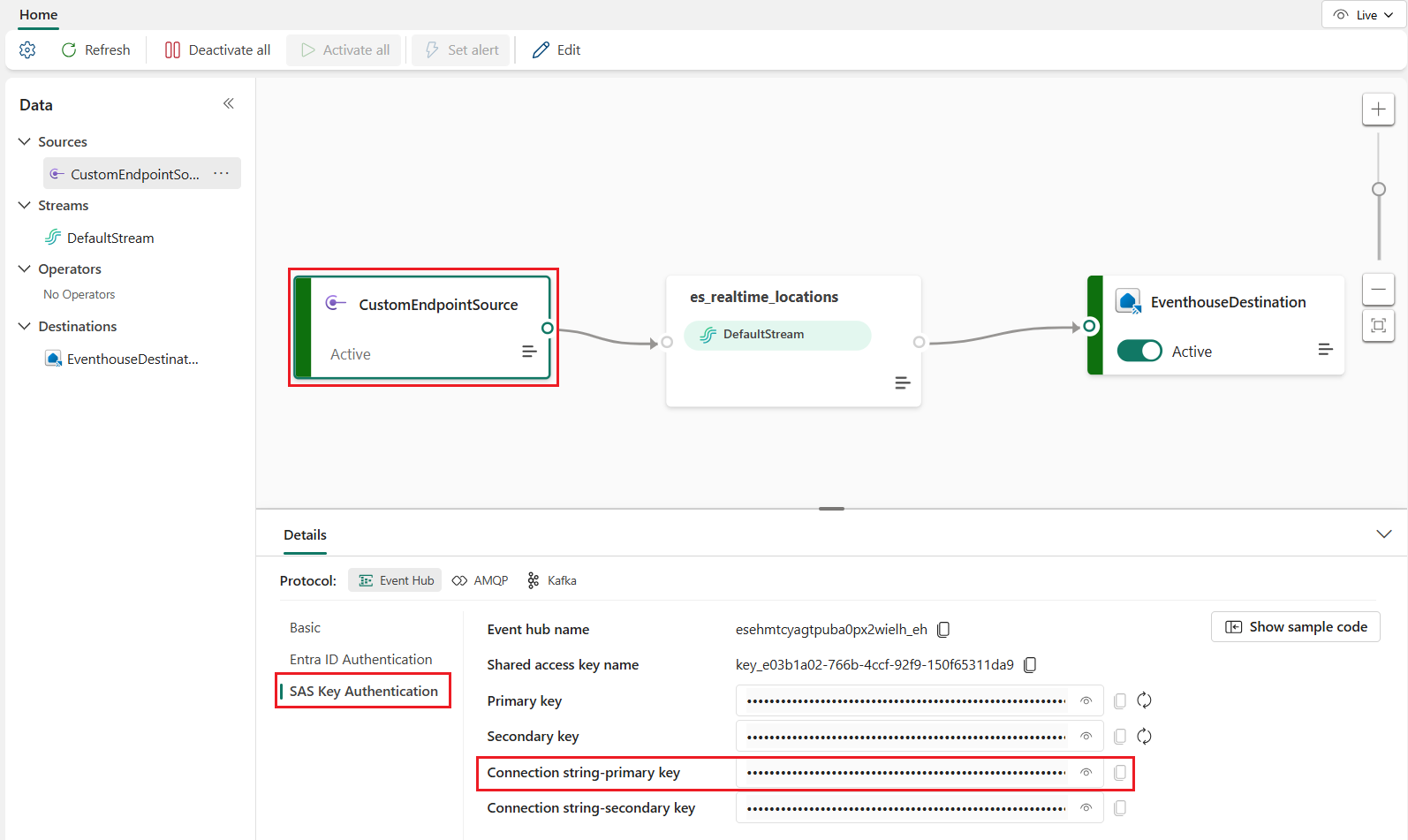
Paste the value into the console when prompted.
Important
The script pauses execution until this value is provided.
Run the script:
python create_realtime_map.py
Verify that all items were created:
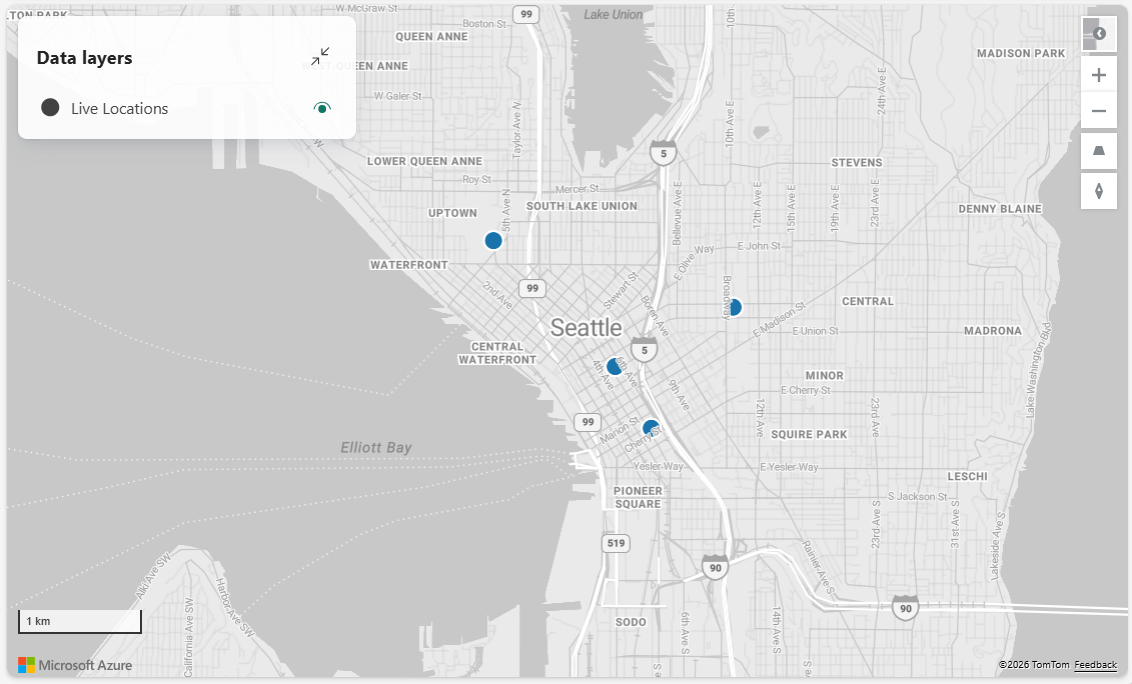
At this point, all resources are created and configured.
To simulate continuous streaming and watch the map update in near real time, continue with the follow-up Tutorial: Simulate real-time data ingestion for a map using REST APIs and Python. It builds directly on this tutorial and reuses the eventhouse, eventstream, KQL function, and map you created.
Summary
In this tutorial, you provisioned the resources needed for a real-time geospatial solution in Microsoft Fabric, using Fabric REST APIs and Python.
You accomplished the following:
- Created an eventhouse and KQL database using the Fabric REST API
- Created an eventstream with a custom endpoint for ingesting streaming events
- Defined a KQL function to query and shape real-time data for map visualization
- Built and deployed a Fabric map with an inline definition referencing eventhouse data
- Seeded the eventstream with initial events so the map displayed data immediately
This architecture demonstrates a common real-time analytics pattern in Fabric:
- External producers send events into Eventstream
- Eventstream routes and ingests data into Eventhouse
- KQL functions transform the data
- Maps query Eventhouse and refresh automatically to reflect new events
By automating resource creation using Python and REST APIs, you now have a repeatable approach for building real-time spatial applications without manual configuration. To drive continuous data into the map, continue with the follow-up simulator tutorial.
Next steps
Now that you understand the end-to-end flow, you can extend this solution to incorporate a real-time simulator.
For a tutorial that demonstrates creating a real-time simulator for the map you just created using REST APIs, see: