Note
Access to this page requires authorization. You can try signing in or changing directories.
Access to this page requires authorization. You can try changing directories.
What this Document Tells You
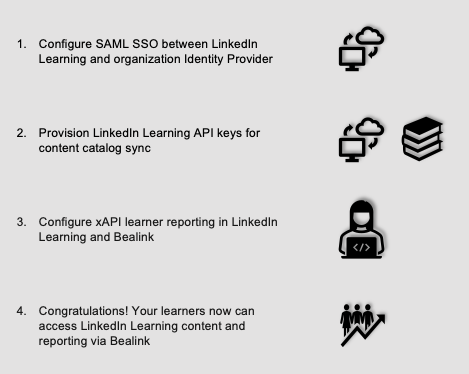
The following steps outline the Bealink and LinkedIn Learning integration process:
Bealink Deep Integration Functionality
Authentication: N/A
Content Discovery: Automated Catalog Sync (All languages)
Reporting: xAPI
Requirements:
The LinkedIn Learning and Bealink integration involves the following requirements:
An active Bealink LMS instance
An active LinkedIn Learning account
Admin access to LinkedIn Learning
Admin privileges to your Bealink LMS instance
Integration Overview
Single Sign-On (SSO)
During the initial configuration, you can configure LinkedIn Learning and Bealink to establish a secure SAML single sign-on (SSO) connection to ensure seamless access to content.
SSO authentication reduces friction for users and administrators by eliminating the need for manual user registration. SSO ensures learners spend more of their time watching content and less of their time trying to remember usernames and passwords.
Automated Content Catalog Sync
The LinkedIn Learning library contains over 20,000 courses, with 20-30 courses added per week at no extra cost. Bealink automates this process using the LinkedIn Learning content APIs, so LMS admins do not have to manually upload new content packages at regular intervals. After the initial setup, Bealink will dynamically refresh the content library on an automated basis. This ensures new LinkedIn Learning content is available to learners within 24 hours of release. All content titles and descriptions are aggregated and indexed to accommodate keyword searches and support efficient discoverability. Bealink supports automatic syncing of All languages content libraries.
Reporting
LinkedIn Learning captures all content viewed on its platform in robust usage reports accessible from the LinkedIn Learning administrative interface. In addition to generating reports, LinkedIn Learning uses xAPI to communicate a learner’s activity back to Bealink when the learner completes a LinkedIn Learning course. All LinkedIn Learning course completions will be reported both in LinkedIn Learning and in Bealink.
Note
For xAPI reporting, SSO must be configured to send the correct identifier for users otherwise completions will not send back successfully.
Configuration – Enabling SAML SSO
We recommend SAML SSO for all enterprise learning platform integrations. You can configure SSO authentication in your LinkedIn Learning Admin settings. Most organizations have a centrally-managed identity management solution like Azure AD, Okta, or ADFS, which can be configured to authenticate users into enterprise applications like LinkedIn Learning.
To configure SAML SSO with your identity management solution, share the LinkedIn Learning SSO Implementation Guide with your organization’s IT team.
Provision API Keys for Content Catalog Sync
For Bealink to sync LinkedIn Learning catalog metadata, you first must provision API keys in the LinkedIn Learning admin settings.
After you log in, if you are not already in the Admin screen, select Go to Admin.

From the side navigation menu, select Access content and reports via API.
Click Add application.

In the Add LinkedIn Learning API application screen, provide the name of your learning platform (e.g., "Bealink LXP"), as the application name.
Provide a short description of the integration use case in the application description field. For example, "Learning Experience Platform".
Under Choose keys, there are two checkboxes – Content and Report. Select Content.
Click Next and accept the "Terms and Conditions".

Copy the generated Client ID and Client Secret. Use these values later in the "Steps Performed in Bealink" section below.

Configuration – Steps Performed in Bealink
To complete the configuration with Bealink, you need the following information:
- Client ID
- Client Secret
Set Up the integration in your portal
To configure the LinkedIn Learning Provider in Bealink, take the following steps:
Go to Bealink Integrations and expand the LinkedIn Learning section.
In Bealink, on the LinkedIn Learning panel, enter the Application key and the Secret key using the information from the Client ID and Client Secret fields respectively in the LinkedIn Learning Admin Center.
Select Next.

Enable xAPI Learner Activity Tracking in LinkedIn Learning
Provision Bealink xAPI keys
To configure the Bealink xAPI reporting in Bealink, take the following steps:
Go to Bealink Integrations and expand the LinkedIn Learning section.
Select xAPI Reporting.
Select Regenerate Client Secret to create the client secret.
Copy the generated credentials and continue to the LinkedIn Learning configuration.

Configuration - Steps Performed in LinkedIn Learning
Using the information you acquired in Bealink, follow the instructions below to configure LinkedIn Learning:
After you log in, if you are not already in the Admin screen, select Go to Admin.

Select Configure reporting integrations.
Expand the Configure xAPI section.
Click Add integration.
In the Integration name field, enter "Bealink Reporting".
In the User Type drop down, select ID.
Copy and paste the following items provided by Bealink into LinkedIn Learning:
Oauth Server URL
Tenant Server URL
Client ID
Client Secret
Click Enable

Congratulations! Your learners now can access LinkedIn Learning content via their Bealink instance.
Questions
For LinkedIn Learning configuration questions, reach out to your dedicated Customer Success Manager.