Note
Access to this page requires authorization. You can try signing in or changing directories.
Access to this page requires authorization. You can try changing directories.
This article helps security and technology teams establish and modernize a Security Architecture discipline that provides a clear, end‑to‑end technical vision for security across the organization.
Security disciplines are groupings of related security work that help organizations consistently deliver security outcomes across the entire technology estate. Within the security adoption model, disciplines help provide a bridge between business scenarios and technical implementation, ensuring that security investments translate into real measurable outcomes as part of the security adoption model.
Why this discipline?
Traditional security architecture approaches are often:
- Network‑centric or perimeter‑focused
- Fragmented across teams and tools
- Limited to static diagrams or reference documents
- Disconnected from day‑to‑day design, implementation, and operations
These limitations make it difficult to manage security as a system. Instead, organizations end up optimizing individual tools or platforms in isolation, which leads to inconsistencies, gaps, conflicts, and increased risk.
The Security Architecture discipline modernizes this model by establishing a coherent, end‑to‑end technical vision that connects people, processes, and technology. Rather than focusing on individual controls in isolation, this discipline ensures that all security controls and capabilities work together as an integrated system aligned to Zero Trust principles.
Without an effective Security Architecture discipline in place, organizations commonly experience:
- Security and technology teams operating in silos.
- Fragmented and duplicated security solutions.
- Gaps and overlaps in security controls.
- Slow and ineffective prevention, detection, and response.
- Repeated incidents caused by unresolved systemic weaknesses.
- Increased organizational risk and business impact.
A mature security architecture overcomes these limitations by:
- Using a common architecture: Ensure that controls and decisions align to a shared architectural model rather than isolated technical solutions.
- Connecting strategy to execution. A common security architecture translates security strategy, policies, and standards into a coordinated technical approach that guides design, implementation, and operations across the full security lifecycle.
- Applying Zero Trust consistently. Ensuring Zero Trust principles are applied uniformly across all security planning, design, and implementation efforts.
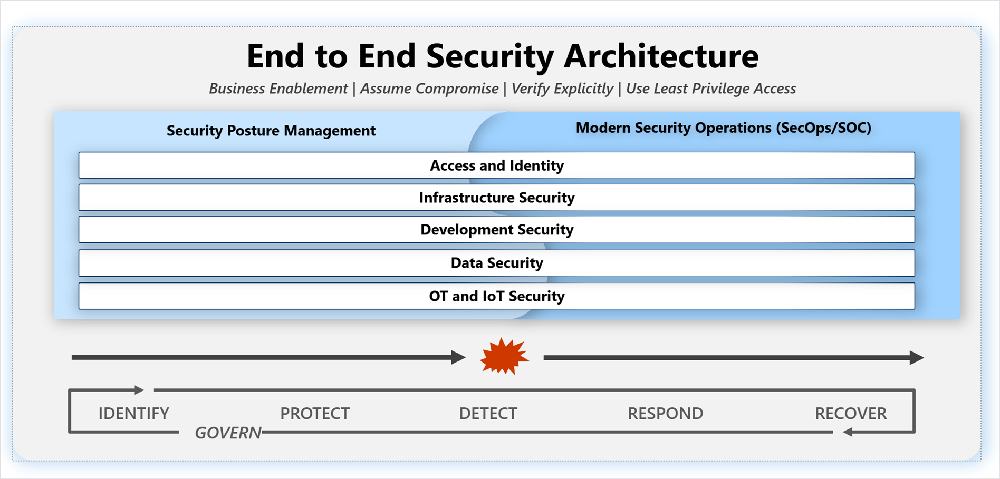
The following diagram illustrates how security architecture enables resilience across the enterprise with Zero Trust principles.
Mission and outcomes
The Security Architecture discipline provides technical clarity and structure for how security capabilities fit together across the organization. It enables organizations to:
- Define a clear end state: Establish a shared understanding of how security platforms, controls, and technologies work together to protect business assets.
- Integrate security across the technology estate: Ensure identities, devices, networks, infrastructure, applications, data, and emerging technologies are protected through a coherent, end‑to‑end architecture.
- Improve consistency and integration: Reduce fragmentation by guiding teams to implement controls that align to architectural principles rather than point‑in‑time or tool‑specific decisions.
- Enable effective prioritization: Focus effort on the most impactful risks using a Zero Trust‑aligned, data‑driven approach instead of reacting to the most visible or urgent issues.
- Reduce incident frequency and impact: Improve resilience by eliminating systemic weaknesses, accelerating response, and reducing repeat incidents over time.
How to apply this discipline
To apply the Security Architecture discipline effectively, focus on establishing a consistent approach across the organization:
- Establish architectural principles and design patterns
Provide clear guidance that ensures security controls and technologies are designed and implemented consistently across systems and environments. - Integrate architecture into design, implementation, and operations
Ensure that architectural guidance is embedded into decision-making processes, not treated as a static, or isolated activity. - Align architecture across disciplines and technology areas
Ensure that identity, infrastructure, applications, and data protections work together as part of a cohesive system rather than independent solutions. - Continuously refine architecture based on risk and feedback
Use insights from security posture, incidents, and changing business requirements to evolve architecture over time.
Manage change through architecture
To provide this support and move modernization forward, a modern Security Architecture discipline must focus on many areas.
Comprehensive coverage
Security architecture must account for end‑to‑end complexity across the organization. This requires integrating individual security disciplines into a coherent whole and maintaining a shared understanding of how security technologies and controls work together to protect business assets. Comprehensive coverage reduces low visibility areas, prevents silos, and ensures security decisions consider the broader system—not just individual components.
Ruthless prioritization
Security architecture must continually drive prioritization so that limited resources are focused on the most impactful risks. Without clear prioritization, organizations waste effort on low‑value (and seemingly urgent) distractions, or overly complex solutions that do little to improve real security outcomes.
Data‑driven prioritization
Effective prioritization is grounded in data and focuses on three factors:
- Cheap, easy, and reliable attacks: Address the attack techniques that are easiest for adversaries to execute and most likely to succeed. This maximizes attacker disruption and security return on investment.
- Business impact: Prioritize defenses that protect the highest‑value business assets or have broad organizational impact.
- Effective and efficient mitigations: For the most important risks, invest first in the simplest, cheapest, and most effective mitigations to reduce risk quickly and measurably.
Continuous improvement
Security architecture should advance through continuous, incremental improvement, rather than attempting to design perfect solutions up front. Continuous improvement recognizes that:
- Security should improve every day, even from a suboptimal starting point.
- The work is never finished, and designs must evolve with threats, technology, and the business.
- Quick wins combined with longer‑term investments keep security moving forward and prevent stagnation.
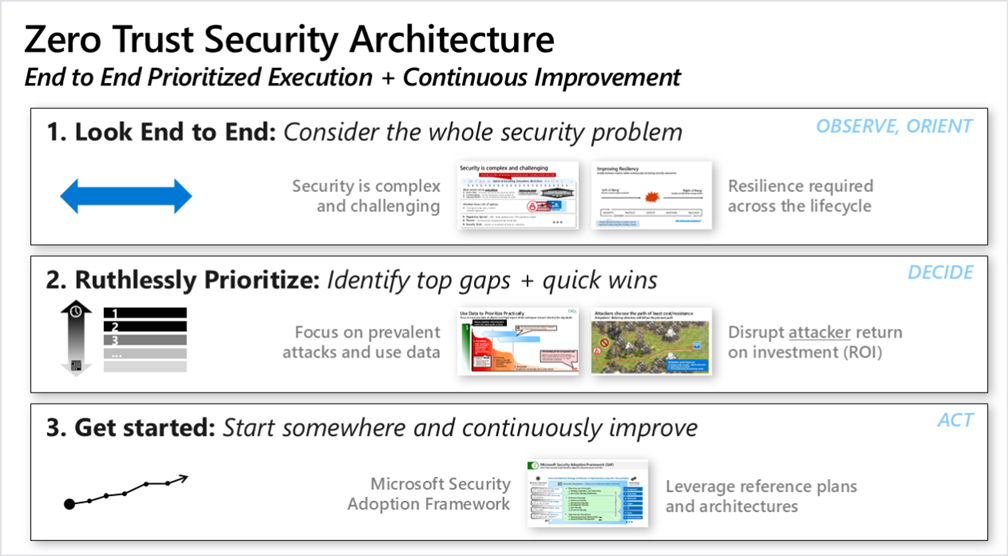
The following graphic shows how the Security Architecture discipline focuses across the enterprise.
Discipline roles and collaborators
Security architects and enterprise architects primarily own the Security Architecture discipline.
In larger organizations, these responsibilities are distributed across formal roles and supported by documented architecture processes. In smaller organizations, roles might be combined and handled more informally. In all cases, documenting security architecture as it develops, formally or informally, is recommended.
Effective delivery depends on close collaboration with:
- Security Strategy, Integration, and Governance discipline: Align architecture to strategy, policy, standards, and risk posture, while providing technical feedback to ensure strategy is practical and actionable.
- Technology and engineering teams: Implement architectural guidance and provide feedback on feasibility and operational impact.
- Domain architecture roles: Align identity, application, infrastructure, data, and network architectures to security architecture principles and standards.
- Security operations (SecOps) discipline: Provide continuous feedback from incidents, detections, and attacker behavior to inform architectural improvements.
The Security Architecture discipline provides the technical clarity that keeps design, engineering, and operations teams aligned to a common vision, ensuring architectural decisions reinforce—not fragment—the security program.
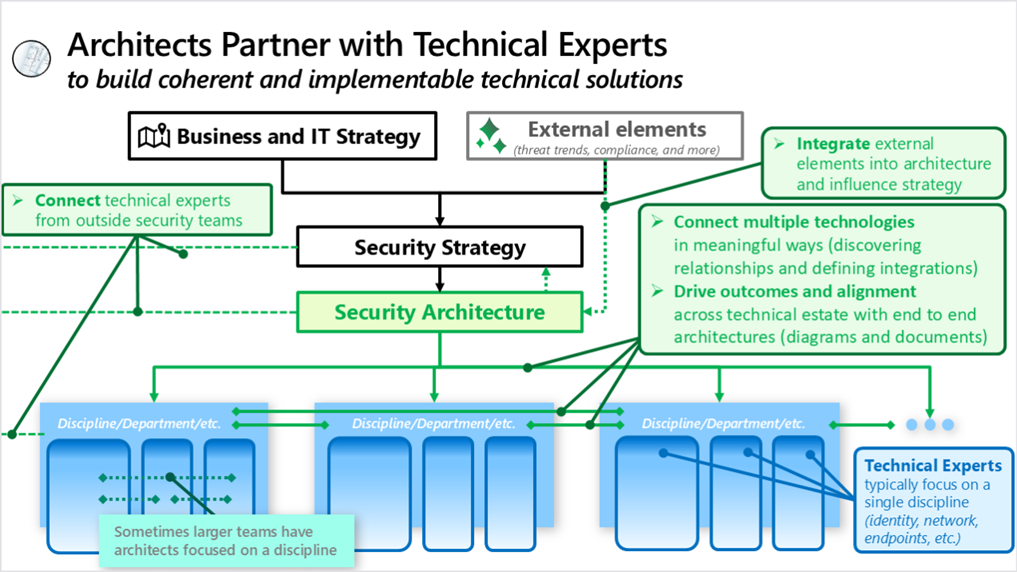
The following diagram shows the breadth of security architecture and contrasts it with engineering and technical experts who tend to focus on single technologies.
Alignment with other disciplines
| Discipline | Security Architecture role |
|---|---|
| Strategy, Integration, and Governance | Translates security strategy, policy, and priorities into a coordinated technical approach, while supplying technical feedback that keeps strategy realistic and clearly communicated. |
| Technical strategy disciplines | Ensures designs and implementations align to shared architectural principles, enabling integration and reuse rather than isolated evolution. |
| Operational disciplines | Guides architectural improvements that strengthen prevention, detection, response, and recovery over time. |
Together, these disciplines enable continuous improvement across security strategy, architecture, and operations.
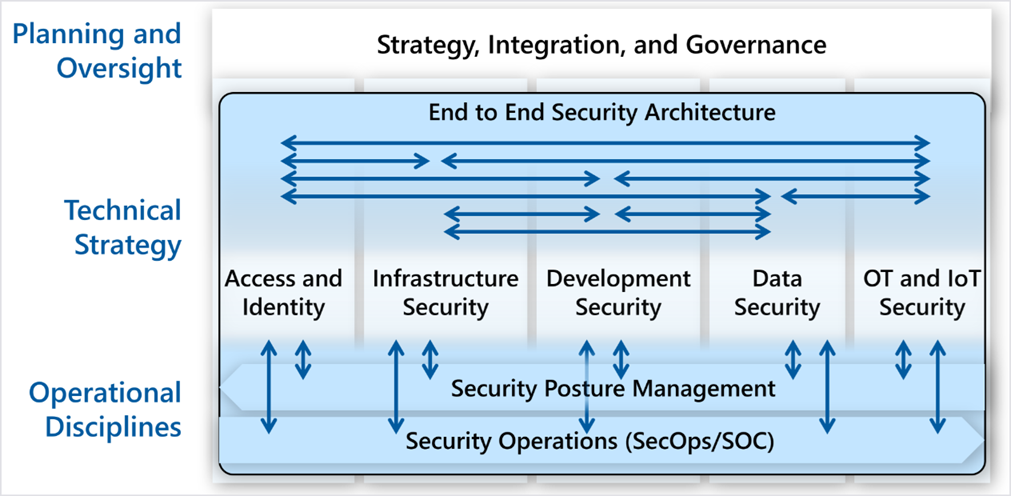
The following diagram illustrates these relationships.
Alignment with technology pillars
Security architecture ensures that controls across all technology pillars align to a coherent Zero Trust‑based design and remain consistent over time. Alignment with technology pillars is as follows:
- Identities: Ensures identity systems and privileged access controls align to Zero Trust and protect access to all assets.
- Endpoints: Secures devices used as operational footholds by attackers through consistent lifecycle management.
- Infrastructure: Protects cloud and on‑premises platforms that underpin workloads and identity systems.
- Apps: Applies consistent security controls across SaaS, packaged, and custom applications and their communication channels.
- Data: Protects business‑critical data from theft, manipulation, and extortion.
- Network: Ensures network controls support identity‑centric access models while mitigating classic network‑based attacks.
- AI: Integrates new skills, tools, and controls to manage AI‑related risks and attacker use of AI.
Next steps
Microsoft Unified offers cybersecurity reference architectures, Zero Trust guidance, and expert-led workshops to help organizations with end to end security architecture.
- Learn more about Microsoft Cybersecurity Reference Architectures.
- Learn more about Security Adoption Framework (SAF) workshops.
- Review other security disciplines.