Add objects to search
The Business Central application contains several objects. Along with the navigation options within the navigation menus, navigation bar, or actions area, you can also search for objects. By using the Search (also referred to as Tell Me), you can search by name.
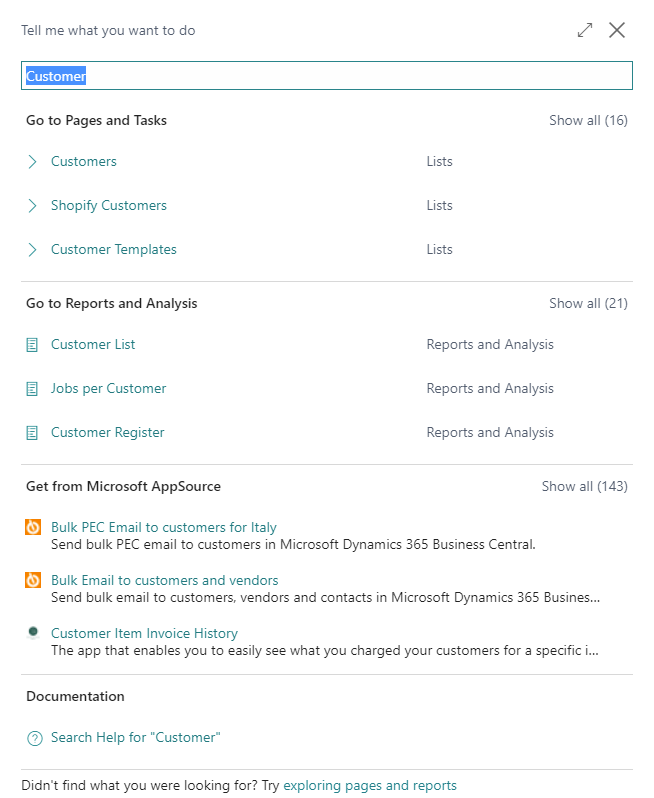
When you create your own objects, they don't show up in the search list by default. To have your objects displayed in the search list, you have to set an extra property: UsageCategory.
page 50101 "Car List"
{
    Caption = 'Car List';
    PageType = List;
    ApplicationArea = All;
    UsageCategory = Lists;
    ...
}
The UsageCategory property sets the category for a searched page, report, or query. You can select one of following categories:
Administration
Documents
History
Lists
None
ReportsAndAnalysis
Tasks
Typically, you wouldn't want a user to directly search for a card page, but would prefer that they are guided through a list page first. Therefore, you can set the UsageCategory to None for card pages. Additionally, you can use the Administration category for Setup pages and the History category for posted documents and transactions.
A UsageCategory property is not provided for CardParts, ListParts, HeadlineParts, and so on.
The UsageCategory property is typically used together with the ApplicationArea property. The ApplicationArea property and the AccessByPermission property are optional settings that you can apply with the UsageCategory property to set restrictions on an object when you enable the search functionality. If the UsageCategory is set to None, or if you don't specify it, the object doesn't show up in search and users can't bookmark a link to it.
With the ApplicationArea property, you can define for which type of license the search entry appears in the list. Starting with Business Central 2022 release wave 2, page controls that don't set the ApplicationArea property explicitly inherit the value that is defined on the parent page, or on the report if it's a request page. Therefore, you can set the property once on the page instead of repeating it on every control. This inheritance has no impact on page or report extensions, where the value must still be set explicitly.
For example, perhaps you want to have users search for a page but with different terms than the name of the page. For that scenario, you can use the AdditionalSearchTerms property. These search terms are in addition to the caption of the page or report. Users can search for "item," but can also search for "product" or "merchandise."
page 50101 "Car List"
{
    Caption = 'Car List';
    PageType = List;
    ApplicationArea = All;
    UsageCategory = Lists;
    AdditionalSearchTerms = 'transport, vehicle, automobile'
    ...
}
Discover report and data analysis content easily
Business Central comes with many options for reporting, business intelligence (BI) dashboards, and data analysis. This content is very easy to discover through search and a new report explorer page.
In the search experience, we include the title and description from teaching tips (if defined by the developer), so that users can better decide whether the report, page, or query is what they're looking for to solve their analytics need.
The role explorer has explanations on all entries, so that when you hover over a report, page, or query, you'll find:
The title and description from the teaching tip (if defined).
You can open the report, page, or query in a new browser tab without closing the explorer view.
An icon that helps you decide whether this is a report that delivers Excel or PDF files, whether the page is a Power BI report, or whether the query supports data analysis.