Note
Access to this page requires authorization. You can try signing in or changing directories.
Access to this page requires authorization. You can try changing directories.
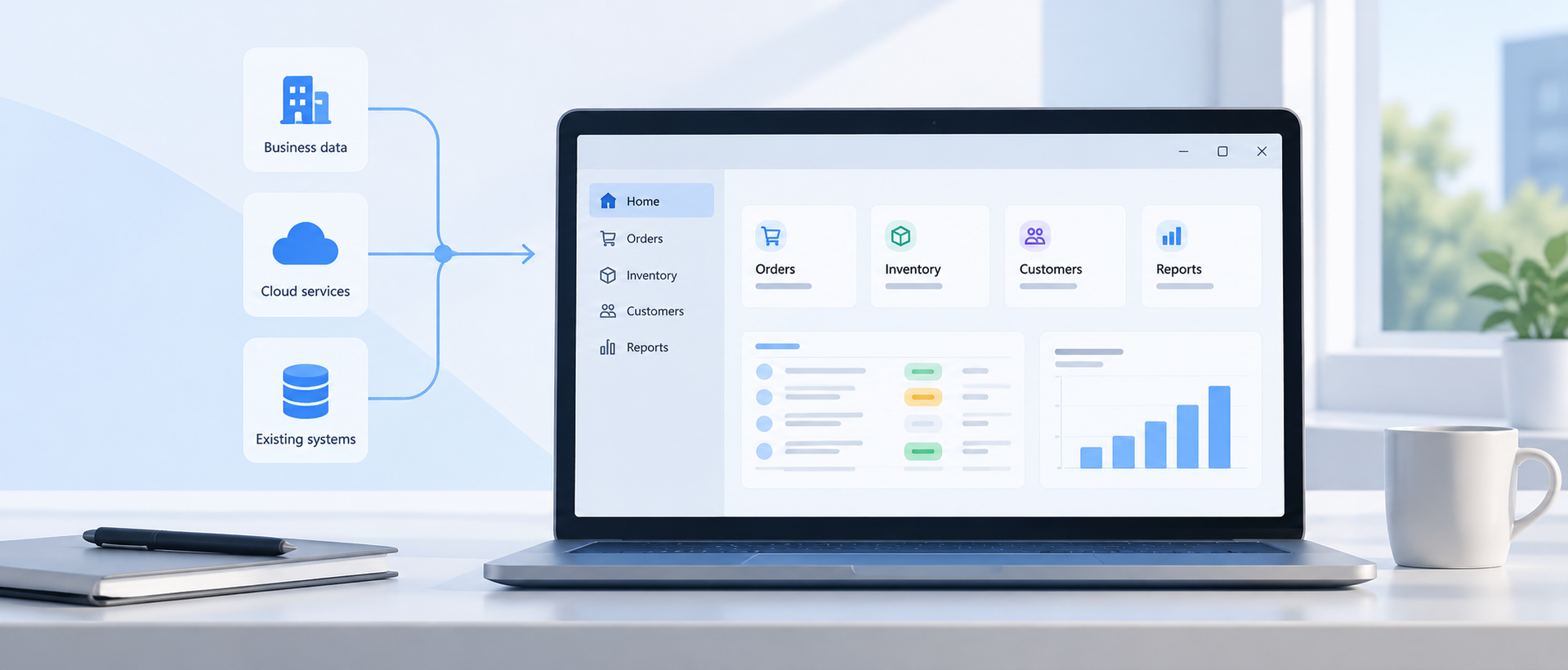
This hub is for developers building line-of-business (LOB) apps, such as internal tools, data-entry apps, reporting dashboards, and enterprise clients, with WinUI 3 and the Windows App SDK.
WinUI 3 provides Fluent Design controls and XAML data binding. The Windows App SDK delivers WinUI 3 and also provides APIs for app lifecycle, windowing, notifications, and other Windows capabilities. Packaging and deployment are separate architectural choices.
Choose an approach
Use this table as a starting point. The appropriate choice depends on your app's data volume, deployment model, security requirements, and the Windows App SDK version that you target.
| Requirement | Starting point |
|---|---|
| Display a collection of records | Use ListView or ItemsView with a DataTemplate. |
| Display dense tabular data | Use a columnar list for simple read-only scenarios, or evaluate a supported third-party grid when you need grid features such as column resizing, grouping, or spreadsheet-style editing. |
| Validate form input | Choose a validation strategy that fits your architecture. WinUI 3 doesn't provide a complete built-in form-validation framework. |
| Authenticate users | Prefer an identity library and OS broker, such as MSAL with Web Account Manager (WAM), instead of implementing an OAuth flow directly. |
| Store structured data locally | Consider EF Core with SQLite. |
| Access enterprise data | Prefer an authenticated HTTPS service layer. Don't embed shared database credentials in a desktop client. |
| Keep the UI responsive | Use asynchronous APIs and avoid blocking the UI thread. Dispatch UI updates only when work completes on another thread. |
| Add AI features | Choose an on-device Windows AI API, ONNX Runtime, or a cloud AI service based on privacy, hardware, connectivity, and model requirements. |
| Package and deploy | Choose packaged with MSIX, packaged with external location, or unpackaged. Separately choose a framework-dependent or self-contained Windows App SDK deployment. |
Build a new app
Display and edit data
- Display tabular data in a WinUI app
- Data binding overview
- Data binding in depth
- Data binding and MVVM
- List views and grid views
Build forms with validation
The CommunityToolkit.Mvvm package remains a Microsoft-maintained option for implementing MVVM. MVVM is not required for every WinUI app, and the toolkit's ObservableValidator is one possible validation implementation rather than a WinUI platform standard.
Connect to data and services
Package and deploy
Modernize an existing app
You don't need to rewrite a working WPF or Windows Forms app to adopt every Windows App SDK capability. You can add supported non-XAML APIs incrementally where they provide value. Full WinUI 3 UI requires a WinUI 3 project or an applicable interop approach.
Migrate from WPF
Migrate from Windows Forms
Migrate from UWP
Add AI to your app
Use Add AI capabilities to a line-of-business WinUI app to compare on-device Windows AI, ONNX Runtime, and cloud AI approaches.
Design for productivity
Use Design for productivity in WinUI LOB apps for guidance about theming, materials, accessibility, responsive layouts, and navigation.
Related content
Collaborate with us on GitHub
The source for this content can be found on GitHub, where you can also create and review issues and pull requests. For more information, see our contributor guide.

Windows developer