Creación de mensajes propios para recopilar datos de entrada del usuario
Artículo
SE APLICA A: SDK v4
A menudo, una conversación entre un usuario y un bot implica mostrar preguntas (avisos) al usuario para obtener información, analizar la respuesta del usuario y, a continuación, actuar en dicha información. El bot debe hacer un seguimiento del contexto de una conversación, para que pueda controlar su comportamiento y recordar las respuestas a las preguntas anteriores. El estado de un bot es la información que sigue con el fin de responder de forma adecuada a los mensajes entrantes.
Sugerencia
La biblioteca de diálogos proporciona avisos incorporados que proporcionan más funcionalidad que pueden usar los usuarios. Se pueden encontrar ejemplos de estos avisos en el artículo Implementación de un flujo de conversación secuencial.
Nota:
Los SDK de JavaScript, C# y Python de Bot Framework seguirán siendo compatibles, pero el SDK de Java se va a retirar con la compatibilidad final a largo plazo que finaliza en noviembre de 2023.
Los bots existentes creados con el SDK de Java seguirán funcionando.
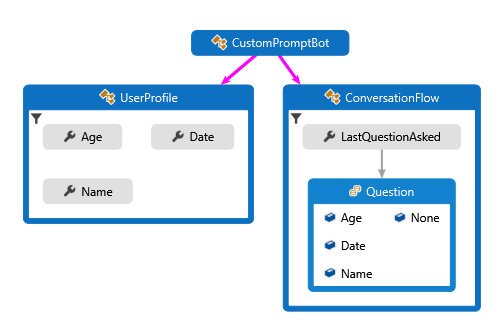
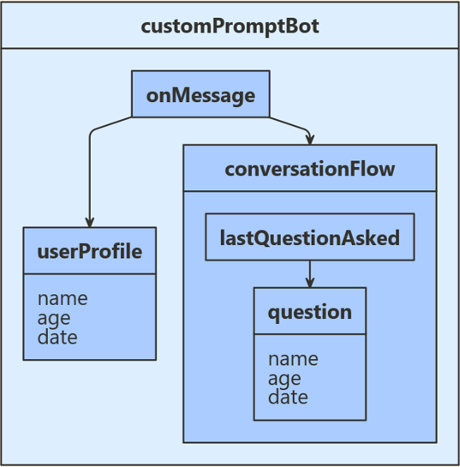
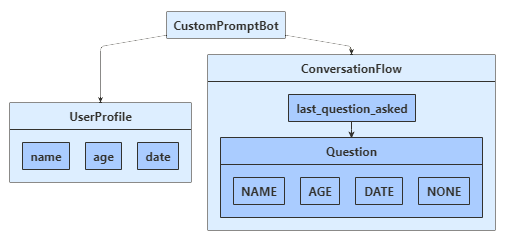
El bot de ejemplo le formula al usuario una serie de preguntas, valida algunas de sus respuestas y guarda sus comentarios. El siguiente diagrama muestra la relación entre el bot, el perfil de usuario y las clases de flujos de conversación.
Una clase UserProfile para la información de usuario que recopilará el bot.
Una clase ConversationFlow para controlar el estado de la conversación mientras se recopila información del usuario.
Una enumeración ConversationFlow.Question interna para el seguimiento de dónde nos encontramos en la conversación.
Una clase userProfile para la información de usuario que recopilará el bot.
Una clase conversationFlow para controlar el estado de la conversación mientras se recopila información del usuario.
Una enumeración conversationFlow.question interna para el seguimiento de dónde nos encontramos en la conversación.
Una clase UserProfile para la información de usuario que recopilará el bot.
Una clase ConversationFlow para controlar el estado de la conversación mientras se recopila información del usuario.
Una enumeración ConversationFlow.Question interna para el seguimiento de dónde nos encontramos en la conversación.
Una clase UserProfile para la información de usuario que recopilará el bot.
Una clase ConversationFlow para controlar el estado de la conversación mientras se recopila información del usuario.
Una enumeración ConversationFlow.Question interna para el seguimiento de dónde nos encontramos en la conversación.
El estado del usuario realiza un seguimiento del nombre, edad y fecha elegida del usuario, y el estado de conversación, un seguimiento de lo que se acaba de preguntar al usuario.
Dado que no tiene previsto implementar este bot, configurará el estado del usuario y de la conversación para utilizar el almacenamiento en memoria.
Se usa el controlador de turnos de mensaje del bot y las propiedades de estado de usuario y de conversación para administrar el flujo de la conversación y la colección de entradas. En el bot, se registrará la información de propiedad de estado que se reciba durante cada iteración del controlador de turnos de mensajes.
Cree los objetos de estado del usuario y la conversación en el inicio y, para consumirlos, inserte dependencias en el constructor del bot.
Startup.cs
// Create the Bot Adapter with error handling enabled.
services.AddSingleton<IBotFrameworkHttpAdapter, AdapterWithErrorHandler>();

// Create the storage we'll be using for User and Conversation state. (Memory is great for testing purposes.)
services.AddSingleton<IStorage, MemoryStorage>();

// Create the User state.
services.AddSingleton<UserState>();

// Create the Conversation state.
services.AddSingleton<ConversationState>();
Cree los objetos de estado del usuario y la conversación en index.js y consúmalos en el constructor del bot.
index.js
// Catch-all for errors.
adapter.onTurnError = async (context, error) => {
    // This check writes out errors to console log .vs. app insights.
    // NOTE: In production environment, you should consider logging this to Azure
bots/customPromptBot.js
class CustomPromptBot extends ActivityHandler {
    constructor(conversationState, userState) {
        super();
// The state management objects for the conversation and user.
this.conversationState = conversationState;
this.userState = userState;
Construya customPromptBot en el método getBot mediante las instancias ConversationState y UserState proporcionadas por el contenedor de Spring. El constructor de CustomPromptBot almacenará referencias a ConversationState y UserState proporcionados durante el inicio.
Application.java
@Bean
public Bot getBot(
    ConversationState conversationState,
    UserState userState
) {
    return new CustomPromptBot(conversationState, userState);
}
CustomPromptBot.java
private final BotState userState;
private final BotState conversationState;

public CustomPromptBot(ConversationState conversationState, UserState userState) {
    this.conversationState = conversationState;
    this.userState = userState;
Cree los objetos de estado del usuario y la conversación en app.py y consúmalos en el constructor del bot.
app.py
CONVERSATION_STATE = ConversationState(MEMORY)

# Create Bot
BOT = CustomPromptBot(CONVERSATION_STATE, USER_STATE)


# Listen for incoming requests on /api/messages.
bots/custom_prompt_bot.py
class CustomPromptBot(ActivityHandler):
    def __init__(self, conversation_state: ConversationState, user_state: UserState):
        if conversation_state is None:
            raise TypeError(
                "[CustomPromptBot]: Missing parameter. conversation_state is required but None was given"
            )
        if user_state is None:
            raise TypeError(
                "[CustomPromptBot]: Missing parameter. user_state is required but None was given"
            )

        self.conversation_state = conversation_state
        self.user_state = user_state
Creación de los descriptores de acceso de la propiedad
Cree descriptores de acceso de propiedad para las propiedades de perfil de usuario y flujo de conversación y, a continuación, llame a GetAsync para recuperar el valor de propiedad del estado.
Bots/CustomPromptBot.cs
protected override async Task OnMessageActivityAsync(ITurnContext<IMessageActivity> turnContext, CancellationToken cancellationToken)
{
    var conversationStateAccessors = _conversationState.CreateProperty<ConversationFlow>(nameof(ConversationFlow));
    var flow = await conversationStateAccessors.GetAsync(turnContext, () => new ConversationFlow(), cancellationToken);

    var userStateAccessors = _userState.CreateProperty<UserProfile>(nameof(UserProfile));
    var profile = await userStateAccessors.GetAsync(turnContext, () => new UserProfile(), cancellationToken);
Antes de que finalice el turno, llame a SaveChangesAsync para escribir los cambios de estado en el almacenamiento.
Cree descriptores de acceso de propiedad para las propiedades de perfil de usuario y flujo de conversación y, a continuación, llame a get para recuperar el valor de propiedad del estado.
Antes de que finalice el turno, llame a saveChanges para escribir los cambios de estado en el almacenamiento.
/**
 * Override the ActivityHandler.run() method to save state changes after the bot logic completes.
 */
async run(context) {
    await super.run(context);

    // Save any state changes. The load happened during the execution of the Dialog.
    await this.conversationState.saveChanges(context, false);
    await this.userState.saveChanges(context, false);
}
Cree descriptores de acceso de propiedad para las propiedades de perfil de usuario y flujo de conversación y, a continuación, llame a get para recuperar el valor de propiedad del estado.
En el constructor, se crearán los descriptores de acceso de la propiedad de estado y se configurarán los objetos de administración de estados (que se crearon anteriormente) para nuestra conversación.
bots/custom_prompt_bot.py
async def on_message_activity(self, turn_context: TurnContext):
    # Get the state properties from the turn context.
    profile = await self.profile_accessor.get(turn_context, UserProfile)
    flow = await self.flow_accessor.get(turn_context, ConversationFlow)
Antes de que finalice el turno, llame a SaveChangesAsync para escribir los cambios de estado en el almacenamiento.
# Save changes to UserState and ConversationState
await self.conversation_state.save_changes(turn_context)
await self.user_state.save_changes(turn_context)
Controlador de turno de mensajes
Al controlar las actividades de mensaje, el controlador de mensajes utiliza un método auxiliar para administrar la conversación y preguntar al usuario. El método auxiliar se describe en la siguiente sección.
async def on_message_activity(self, turn_context: TurnContext):
    # Get the state properties from the turn context.
    profile = await self.profile_accessor.get(turn_context, UserProfile)
    flow = await self.flow_accessor.get(turn_context, ConversationFlow)

    await self._fill_out_user_profile(flow, profile, turn_context)

    # Save changes to UserState and ConversationState
    await self.conversation_state.save_changes(turn_context)
    await self.user_state.save_changes(turn_context)
Rellenado del perfil de usuario
El bot solicita información al usuario, en función de la pregunta que el bot hizo en el turno anterior. La entrada se analiza con un método de validación.
Cada método de validación sigue un diseño similar:
El valor devuelto indica si la entrada es una respuesta válida para esta pregunta.
Si la validación es correcta, se genera un valor normalizado y analizado para guardarlo.
Si se produce un error de validación, se genera un mensaje con el que el bot puede volver a pedir la información.
En las siguientes secciones se describen los métodos de validación.
{
    var input = turnContext.Activity.Text?.Trim();
    string message;

    switch (flow.LastQuestionAsked)
    {
        case ConversationFlow.Question.None:
            await turnContext.SendActivityAsync("Let's get started. What is your name?", null, null, cancellationToken);
            flow.LastQuestionAsked = ConversationFlow.Question.Name;
            break;
        case ConversationFlow.Question.Name:
            if (ValidateName(input, out var name, out message))
            {
                profile.Name = name;
                await turnContext.SendActivityAsync($"Hi {profile.Name}.", null, null, cancellationToken);
                await turnContext.SendActivityAsync("How old are you?", null, null, cancellationToken);
                flow.LastQuestionAsked = ConversationFlow.Question.Age;
                break;
            }
            else
            {
                await turnContext.SendActivityAsync(message ?? "I'm sorry, I didn't understand that.", null, null, cancellationToken);
                break;
            }

        case ConversationFlow.Question.Age:
            if (ValidateAge(input, out var age, out message))
            {
                profile.Age = age;
                await turnContext.SendActivityAsync($"I have your age as {profile.Age}.", null, null, cancellationToken);
                await turnContext.SendActivityAsync("When is your flight?", null, null, cancellationToken);
                flow.LastQuestionAsked = ConversationFlow.Question.Date;
                break;
            }
            else
            {
                await turnContext.SendActivityAsync(message ?? "I'm sorry, I didn't understand that.", null, null, cancellationToken);
                break;
            }

        case ConversationFlow.Question.Date:
            if (ValidateDate(input, out var date, out message))
            {
                profile.Date = date;
                await turnContext.SendActivityAsync($"Your cab ride to the airport is scheduled for {profile.Date}.");
                await turnContext.SendActivityAsync($"Thanks for completing the booking {profile.Name}.");
                await turnContext.SendActivityAsync($"Type anything to run the bot again.");
                flow.LastQuestionAsked = ConversationFlow.Question.None;
                profile = new UserProfile();
                break;
            }
            else
            {
                await turnContext.SendActivityAsync(message ?? "I'm sorry, I didn't understand that.", null, null, cancellationToken);
                break;
            }
    }
}
bots/customPromptBot.js
// Manages the conversation flow for filling out the user's profile.
static async fillOutUserProfile(flow, profile, turnContext) {
    const input = turnContext.activity.text;
    let result;
    switch (flow.lastQuestionAsked) {
    // If we're just starting off, we haven't asked the user for any information yet.
    // Ask the user for their name and update the conversation flag.
    case question.none:
        await turnContext.sendActivity("Let's get started. What is your name?");
        flow.lastQuestionAsked = question.name;
        break;

    // If we last asked for their name, record their response, confirm that we got it.
    // Ask them for their age and update the conversation flag.
    case question.name:
        result = this.validateName(input);
        if (result.success) {
            profile.name = result.name;
            await turnContext.sendActivity(`I have your name as ${ profile.name }.`);
            await turnContext.sendActivity('How old are you?');
            flow.lastQuestionAsked = question.age;
            break;
        } else {
            // If we couldn't interpret their input, ask them for it again.
            // Don't update the conversation flag, so that we repeat this step.
            await turnContext.sendActivity(result.message || "I'm sorry, I didn't understand that.");
            break;
        }

    // If we last asked for their age, record their response, confirm that we got it.
    // Ask them for their date preference and update the conversation flag.
    case question.age:
        result = this.validateAge(input);
        if (result.success) {
            profile.age = result.age;
            await turnContext.sendActivity(`I have your age as ${ profile.age }.`);
            await turnContext.sendActivity('When is your flight?');
            flow.lastQuestionAsked = question.date;
            break;
        } else {
            // If we couldn't interpret their input, ask them for it again.
            // Don't update the conversation flag, so that we repeat this step.
            await turnContext.sendActivity(result.message || "I'm sorry, I didn't understand that.");
            break;
        }

    // If we last asked for a date, record their response, confirm that we got it,
    // let them know the process is complete, and update the conversation flag.
    case question.date:
        result = this.validateDate(input);
        if (result.success) {
            profile.date = result.date;
            await turnContext.sendActivity(`Your cab ride to the airport is scheduled for ${ profile.date }.`);
            await turnContext.sendActivity(`Thanks for completing the booking ${ profile.name }.`);
            await turnContext.sendActivity('Type anything to run the bot again.');
            flow.lastQuestionAsked = question.none;
            profile = {};
            break;
        } else {
            // If we couldn't interpret their input, ask them for it again.
            // Don't update the conversation flag, so that we repeat this step.
            await turnContext.sendActivity(result.message || "I'm sorry, I didn't understand that.");
            break;
        }
    }
}
CustomPromptBot.java
private static CompletableFuture<Void> fillOutUserProfile(ConversationFlow flow,
                                                          UserProfile profile,
                                                          TurnContext turnContext) {
    String input = "";
    if (StringUtils.isNotBlank(turnContext.getActivity().getText())) {
        input = turnContext.getActivity().getText().trim();
    }

    switch (flow.getLastQuestionAsked()) {
        case None:
            return turnContext.sendActivity("Let's get started. What is your name?", null, null)
                .thenRun(() -> {flow.setLastQuestionAsked(ConversationFlow.Question.Name);});
        case Name:
            Triple<Boolean, String, String> nameValidationResult = validateName(input);
            if (nameValidationResult.getLeft()) {
                profile.setName(nameValidationResult.getMiddle());
                return turnContext.sendActivity(String.format("Hi %s.", profile.getName()), null, null)
                    .thenCompose(result -> turnContext.sendActivity("How old are you?", null, null))
                    .thenRun(() -> { flow.setLastQuestionAsked(ConversationFlow.Question.Age); });
            } else {
                if (StringUtils.isNotBlank(nameValidationResult.getRight())) {
                    return turnContext.sendActivity(nameValidationResult.getRight(), null, null)
                           .thenApply(result -> null);
                } else {
                    return turnContext.sendActivity("I'm sorry, I didn't understand that.", null, null)
                           .thenApply(result -> null);
                }
            }
        case Age:
            Triple<Boolean, Integer, String> ageValidationResult = ValidateAge(input);
            if (ageValidationResult.getLeft()) {
                profile.setAge(ageValidationResult.getMiddle());
                return turnContext.sendActivity(String.format("I have your age as %d.", profile.getAge()), null, null)
                    .thenCompose(result -> turnContext.sendActivity("When is your flight?", null, null))
                    .thenRun(() -> { flow.setLastQuestionAsked(ConversationFlow.Question.Date); });
            } else {
                if (StringUtils.isNotBlank(ageValidationResult.getRight())) {
                    return turnContext.sendActivity(ageValidationResult.getRight(), null, null)
                        .thenApply(result -> null);
                } else {
                    return turnContext.sendActivity("I'm sorry, I didn't understand that.", null, null)
                        .thenApply(result -> null);
                }
            }
        case Date:
            Triple<Boolean, String, String> dateValidationResult = ValidateDate(input);
            AtomicReference<UserProfile> profileReference = new AtomicReference<UserProfile>(profile);
            if (dateValidationResult.getLeft()) {
                profile.setDate(dateValidationResult.getMiddle());
                return turnContext.sendActivity(
                    String.format("Your cab ride to the airport is scheduled for %s.",
                                  profileReference.get().getDate()))
                .thenCompose(result -> turnContext.sendActivity(
                    String.format("Thanks for completing the booking %s.", profileReference.get().getDate())))
                .thenCompose(result -> turnContext.sendActivity("Type anything to run the bot again."))
                .thenRun(() -> {
                    flow.setLastQuestionAsked(ConversationFlow.Question.None);
                    profileReference.set(new UserProfile());
                });
            } else {
                if (StringUtils.isNotBlank(dateValidationResult.getRight())) {
                    return turnContext.sendActivity(dateValidationResult.getRight(), null, null)
                        .thenApply(result -> null);
                } else {
                    return turnContext.sendActivity("I'm sorry, I didn't understand that.", null, null)
                            .thenApply(result -> null);
                }
            }
        default:
            return CompletableFuture.completedFuture(null);
    }
bots/custom_prompt_bot.py
async def _fill_out_user_profile(
    self, flow: ConversationFlow, profile: UserProfile, turn_context: TurnContext
):
    user_input = turn_context.activity.text.strip()

    # ask for name
    if flow.last_question_asked == Question.NONE:
        await turn_context.send_activity(
            MessageFactory.text("Let's get started. What is your name?")
        )
        flow.last_question_asked = Question.NAME

    # validate name then ask for age
    elif flow.last_question_asked == Question.NAME:
        validate_result = self._validate_name(user_input)
        if not validate_result.is_valid:
            await turn_context.send_activity(
                MessageFactory.text(validate_result.message)
            )
        else:
            profile.name = validate_result.value
            await turn_context.send_activity(
                MessageFactory.text(f"Hi {profile.name}")
            )
            await turn_context.send_activity(
                MessageFactory.text("How old are you?")
            )
            flow.last_question_asked = Question.AGE

    # validate age then ask for date
    elif flow.last_question_asked == Question.AGE:
        validate_result = self._validate_age(user_input)
        if not validate_result.is_valid:
            await turn_context.send_activity(
                MessageFactory.text(validate_result.message)
            )
        else:
            profile.age = validate_result.value
            await turn_context.send_activity(
                MessageFactory.text(f"I have your age as {profile.age}.")
            )
            await turn_context.send_activity(
                MessageFactory.text("When is your flight?")
            )
            flow.last_question_asked = Question.DATE

    # validate date and wrap it up
    elif flow.last_question_asked == Question.DATE:
        validate_result = self._validate_date(user_input)
        if not validate_result.is_valid:
            await turn_context.send_activity(
                MessageFactory.text(validate_result.message)
            )
        else:
            profile.date = validate_result.value
            await turn_context.send_activity(
                MessageFactory.text(
                    f"Your cab ride to the airport is scheduled for {profile.date}."
                )
            )
            await turn_context.send_activity(
                MessageFactory.text(
                    f"Thanks for completing the booking {profile.name}."
                )
            )
            await turn_context.send_activity(
                MessageFactory.text("Type anything to run the bot again.")
            )
            flow.last_question_asked = Question.NONE
Análisis y validación de la entrada
El bot usa los siguientes criterios para validar la entrada.
El nombre debe ser una cadena que no esté vacía. Para normalizarlo, se recortan los espacios en blanco.
La edad debe estar entre 18 y 120. Para normalizarlo, devuelve un entero.
La fecha debe ser cualquier fecha u hora al menos una hora en el futuro.
Para normalizarlo, se devuelve solo la parte de fecha de la entrada analizada.
Nota:
Para la entrada de edad y fecha, el ejemplo usa bibliotecas Microsoft/Recognizers-Text para realizar el análisis inicial.
Esta es solo una manera de analizar la entrada. Para más información acerca de estas bibliotecas, consulte el archivo Léame del proyecto.
private static bool ValidateName(string input, out string name, out string message)
{
    name = null;
    message = null;

    if (string.IsNullOrWhiteSpace(input))
    {
        message = "Please enter a name that contains at least one character.";
    }
    else
    {
        name = input.Trim();
    }

    return message is null;
}

private static bool ValidateAge(string input, out int age, out string message)
{
    age = 0;
    message = null;

    // Try to recognize the input as a number. This works for responses such as "twelve" as well as "12".
    try
    {
        // Attempt to convert the Recognizer result to an integer. This works for "a dozen", "twelve", "12", and so on.
        // The recognizer returns a list of potential recognition results, if any.

        var results = NumberRecognizer.RecognizeNumber(input, Culture.English);

        foreach (var result in results)
        {
            // The result resolution is a dictionary, where the "value" entry contains the processed string.
            if (result.Resolution.TryGetValue("value", out var value))
            {
                age = Convert.ToInt32(value);
                if (age >= 18 && age <= 120)
                {
                    return true;
                }
            }
        }

        message = "Please enter an age between 18 and 120.";
    }
    catch
    {
        message = "I'm sorry, I could not interpret that as an age. Please enter an age between 18 and 120.";
    }

    return message is null;
}

private static bool ValidateDate(string input, out string date, out string message)
{
    date = null;
    message = null;

    // Try to recognize the input as a date-time. This works for responses such as "11/14/2018", "9pm", "tomorrow", "Sunday at 5pm", and so on.
    // The recognizer returns a list of potential recognition results, if any.
    try
    {
        var results = DateTimeRecognizer.RecognizeDateTime(input, Culture.English);

        // Check whether any of the recognized date-times are appropriate,
        // and if so, return the first appropriate date-time. We're checking for a value at least an hour in the future.
        var earliest = DateTime.Now.AddHours(1.0);

        foreach (var result in results)
        {
            // The result resolution is a dictionary, where the "values" entry contains the processed input.
            var resolutions = result.Resolution["values"] as List<Dictionary<string, string>>;

            foreach (var resolution in resolutions)
            {
                // The processed input contains a "value" entry if it is a date-time value, or "start" and
                // "end" entries if it is a date-time range.
                if (resolution.TryGetValue("value", out var dateString)
                    || resolution.TryGetValue("start", out dateString))
                {
                    if (DateTime.TryParse(dateString, out var candidate)
                        && earliest < candidate)
                    {
                        date = candidate.ToShortDateString();
                        return true;
                    }
                }
            }
        }

        message = "I'm sorry, please enter a date at least an hour out.";
    }
    catch
    {
        message = "I'm sorry, I could not interpret that as an appropriate date. Please enter a date at least an hour out.";
    }

    return false;
}
bots/customPromptBot.js
// Validates name input. Returns whether validation succeeded and either the parsed and normalized
// value or a message the bot can use to ask the user again.
static validateName(input) {
    const name = input && input.trim();
    return name !== undefined
        ? { success: true, name: name }
        : { success: false, message: 'Please enter a name that contains at least one character.' };
};

// Validates age input. Returns whether validation succeeded and either the parsed and normalized
// value or a message the bot can use to ask the user again.
static validateAge(input) {
    // Try to recognize the input as a number. This works for responses such as "twelve" as well as "12".
    try {
        // Attempt to convert the Recognizer result to an integer. This works for "a dozen", "twelve", "12", and so on.
        // The recognizer returns a list of potential recognition results, if any.
        const results = Recognizers.recognizeNumber(input, Recognizers.Culture.English);
        let output;
        results.forEach(result => {
            // result.resolution is a dictionary, where the "value" entry contains the processed string.
            const value = result.resolution.value;
            if (value) {
                const age = parseInt(value);
                if (!isNaN(age) && age >= 18 && age <= 120) {
                    output = { success: true, age: age };
                    return;
                }
            }
        });
        return output || { success: false, message: 'Please enter an age between 18 and 120.' };
    } catch (error) {
        return {
            success: false,
            message: "I'm sorry, I could not interpret that as an age. Please enter an age between 18 and 120."
        };
    }
}

// Validates date input. Returns whether validation succeeded and either the parsed and normalized
// value or a message the bot can use to ask the user again.
static validateDate(input) {
    // Try to recognize the input as a date-time. This works for responses such as "11/14/2018", "today at 9pm", "tomorrow", "Sunday at 5pm", and so on.
    // The recognizer returns a list of potential recognition results, if any.
    try {
        const results = Recognizers.recognizeDateTime(input, Recognizers.Culture.English);
        const now = new Date();
        const earliest = now.getTime() + (60 * 60 * 1000);
        let output;
        results.forEach(result => {
            // result.resolution is a dictionary, where the "values" entry contains the processed input.
            result.resolution.values.forEach(resolution => {
                // The processed input contains a "value" entry if it is a date-time value, or "start" and
                // "end" entries if it is a date-time range.
                const datevalue = resolution.value || resolution.start;
                // If only time is given, assume it's for today.
                const datetime = resolution.type === 'time'
                    ? new Date(`${ now.toLocaleDateString() } ${ datevalue }`)
                    : new Date(datevalue);
                if (datetime && earliest < datetime.getTime()) {
                    output = { success: true, date: datetime.toLocaleDateString() };
                    return;
                }
            });
        });
        return output || { success: false, message: "I'm sorry, please enter a date at least an hour out." };
    } catch (error) {
        return {
            success: false,
            message: "I'm sorry, I could not interpret that as an appropriate date. Please enter a date at least an hour out."
        };
    }
}
CustomPromptBot.java
private static Triple<Boolean, String, String> validateName(String input) {
    String name = null;
    String message = null;

    if (StringUtils.isEmpty(input)) {
        message = "Please enter a name that contains at least one character.";
    } else {
        name = input.trim();
    }

    return Triple.of(StringUtils.isBlank(message), name, message);
}

private static Triple<Boolean, Integer, String> ValidateAge(String input) {
    int age = 0;
    String message = null;

    // Try to recognize the input as a number. This works for responses such as "twelve" as well as "12".
    try {
        // Attempt to convert the Recognizer result to an integer. This works for "a dozen", "twelve", "12", and so on.
        // The recognizer returns a list of potential recognition results, if any.

        List<ModelResult> results = NumberRecognizer.recognizeNumber(input, PromptCultureModels.ENGLISH_CULTURE);
        for (ModelResult result : results) {
            // The result resolution is a dictionary, where the "value" entry contains the processed String.
            Object value = result.resolution.get("value");
            if (value != null) {
                age = Integer.parseInt((String) value);
                if (age >= 18 && age <= 120) {
                    return Triple.of(true, age, "");
                }
            }
        }

        message = "Please enter an age between 18 and 120.";
    }
    catch (Throwable th) {
        message = "I'm sorry, I could not interpret that as an age. Please enter an age between 18 and 120.";
    }

    return Triple.of(StringUtils.isBlank(message), age, message);
}

private static Triple<Boolean, String, String> ValidateDate(String input) {
    String date = null;
    String message = null;

    // Try to recognize the input as a date-time. This works for responses such as "11/14/2018", "9pm", "tomorrow", "Sunday at 5pm", and so on.
    // The recognizer returns a list of potential recognition results, if any.
    try {
        List<ModelResult> results = DateTimeRecognizer.recognizeDateTime(input, PromptCultureModels.ENGLISH_CULTURE);

        // Check whether any of the recognized date-times are appropriate,
        // and if so, return the first appropriate date-time. We're checking for a value at least an hour in the future.
        LocalDateTime earliest = LocalDateTime.now().plus(1, ChronoUnit.HOURS);

        for (ModelResult result : results) {
            // The result resolution is a dictionary, where the "values" entry contains the processed input.
            List<Map<String, Object>> resolutions = (List<Map<String, Object>>) result.resolution.get("values");

             for (Map<String, Object> resolution : resolutions) {
                // The processed input contains a "value" entry if it is a date-time value, or "start" and
                // "end" entries if it is a date-time range.
                String dateString = (String) resolution.get("value");
                if (StringUtils.isBlank(dateString)) {
                    dateString = (String) resolution.get("start");
                }
                if (StringUtils.isNotBlank(dateString)){
                    DateTimeFormatter f = DateTimeFormatter.ofPattern("yyyy-MM-dd HH:mm:ss");
                    LocalDateTime candidate;
                    try {
                        candidate = LocalDateTime.from(f.parse(dateString));
                    } catch (DateTimeParseException err) {
                        // If the input is a date, it will throw an exception and it will create a datetime
                        // with the MIN localtime
                        DateTimeFormatter d = DateTimeFormatter.ofPattern("yyyy-MM-dd");
                        candidate = LocalDateTime.of(LocalDate.parse(dateString, d), LocalDateTime.MIN.toLocalTime());
                    }
                    if (earliest.isBefore(candidate)) {
                        DateTimeFormatter dateformat = DateTimeFormatter.ofPattern("MM-dd-yyyy");
                        date = candidate.format(dateformat);
                        return Triple.of(true, date, message);
                    }
                }

             }
        }
bots/custom_prompt_bot.py
def _validate_name(self, user_input: str) -> ValidationResult:
    if not user_input:
        return ValidationResult(
            is_valid=False,
            message="Please enter a name that contains at least one character.",
        )

    return ValidationResult(is_valid=True, value=user_input)

def _validate_age(self, user_input: str) -> ValidationResult:
    # Attempt to convert the Recognizer result to an integer. This works for "a dozen", "twelve", "12", and so on.
    # The recognizer returns a list of potential recognition results, if any.
    results = recognize_number(user_input, Culture.English)
    for result in results:
        if "value" in result.resolution:
            age = int(result.resolution["value"])
            if 18 <= age <= 120:
                return ValidationResult(is_valid=True, value=age)

    return ValidationResult(
        is_valid=False, message="Please enter an age between 18 and 120."
    )

def _validate_date(self, user_input: str) -> ValidationResult:
    try:
        # Try to recognize the input as a date-time. This works for responses such as "11/14/2018", "9pm",
        # "tomorrow", "Sunday at 5pm", and so on. The recognizer returns a list of potential recognition results,
        # if any.
        results = recognize_datetime(user_input, Culture.English)
        for result in results:
            for resolution in result.resolution["values"]:
                if "value" in resolution:
                    now = datetime.now()

                    value = resolution["value"]
                    if resolution["type"] == "date":
                        candidate = datetime.strptime(value, "%Y-%m-%d")
                    elif resolution["type"] == "time":
                        candidate = datetime.strptime(value, "%H:%M:%S")
                        candidate = candidate.replace(
                            year=now.year, month=now.month, day=now.day
                        )
                    else:
                        candidate = datetime.strptime(value, "%Y-%m-%d %H:%M:%S")

                    # user response must be more than an hour out
                    diff = candidate - now
                    if diff.total_seconds() >= 3600:
                        return ValidationResult(
                            is_valid=True,
                            value=candidate.strftime("%m/%d/%y"),
                        )

        return ValidationResult(
            is_valid=False,
            message="I'm sorry, please enter a date at least an hour out.",
        )
    except ValueError:
        return ValidationResult(
            is_valid=False,
            message="I'm sorry, I could not interpret that as an appropriate "
            "date. Please enter a date at least an hour out.",
        )