नोट
इस पृष्ठ तक पहुंच के लिए प्राधिकरण की आवश्यकता होती है। आप साइन इन करने या निर्देशिकाएँ बदलने का प्रयास कर सकते हैं।
इस पृष्ठ तक पहुंच के लिए प्राधिकरण की आवश्यकता होती है। आप निर्देशिकाएँ बदलने का प्रयास कर सकते हैं।
Applies to:  SQL Server
Azure SQL Database
Azure SQL Managed Instance
SQL database in Microsoft Fabric
SQL Server
Azure SQL Database
Azure SQL Managed Instance
SQL database in Microsoft Fabric
Returns a geometry instance that represents the set of all points whose distance from the calling geometry instance is less than or equal to the distance parameter.
Syntax
.BufferWithCurves ( distance )
Arguments
distance
Is a float indicating the maximum distance that points forming the buffer can be from the geometry instance.
Return Types
SQL Server return type: geometry
CLR return type: SqlGeometry
Exceptions
The following criteria will throw an ArgumentException.
No parameter is passed to the method, such as
@g.BufferWithCurves()A non-numeric parameter is passed to the method, such as
@g.BufferWithCurves('a')NULL is passed to the method, such as
@g.BufferWithCurves(NULL)
Remarks
The following illustration shows an example of a geometry instance returned by this method.
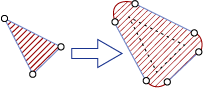
The following table shows the results returned for different distance values.
| distance Value | Type Dimensions | Spatial Type Returned |
|---|---|---|
| distance < 0 | Zero or One | Empty GeometryCollection instance |
| distance < 0 | Two or More | A CurvePolygon or GeometryCollection instance with a negative buffer. Note: A negative buffer may create an empty GeometryCollection |
| distance = 0 | All dimensions | Copy of the invoking geometry instance |
| distance > 0 | All dimensions | CurvePolygon or GeometryCollection instance |
Note
Since distance is a float, a very small value can equate to zero in the calculations. When this occurs then a copy of the calling geometry instance is returned. See float and real (Transact-SQL).
A negative buffer removes all points enclosed in the given distance of the boundary of the geometry. The following illustration shows a negative buffer as the lighter-shaded area of the circle. The dotted line is the boundary of the original polygon and the solid line is the boundary of the resultant polygon.
If a string parameter is passed to the method, then it will be converted to a float or it will throw an ArgumentException.
Examples
A. Calling BufferWithCurves() with a parameter value < 0 on one dimensional geometry instance
The following example returns an empty GeometryCollection instance:
 DECLARE @g geometry= 'LINESTRING(3 4, 8 11)';
 SELECT @g.BufferWithCurves(-1).ToString();
B. Calling BufferWithCurves() with a parameter value < 0 on a two dimensional geometry instance
The following example returns a CurvePolygon instance with a negative buffer:
 DECLARE @g geometry = 'CURVEPOLYGON(COMPOUNDCURVE(CIRCULARSTRING(0 4, 4 0, 8 4), (8 4, 0 4)))';
 SELECT @g.BufferWithCurves(-1).ToString()
C. Calling BufferWithCurves() with a parameter value < 0 that returns an empty GeometryCollection
The following example shows what occurs when the distance parameter equals -2:
 DECLARE @g geometry = 'CURVEPOLYGON(COMPOUNDCURVE(CIRCULARSTRING(0 4, 4 0, 8 4), (8 4, 0 4)))';
 SELECT @g.BufferWithCurves(-2).ToString();
This SELECT statement returns GEOMETRYCOLLECTION EMPTY
D. Calling BufferWithCurves() with a parameter value = 0
The following example returns a copy of the calling geometry instance:
 DECLARE @g geometry = 'LINESTRING(3 4, 8 11)';
 SELECT @g.BufferWithCurves(0).ToString();
E. Calling BufferWithCurves() with a non-zero parameter value that is extremely small
The following example also returns a copy of the calling geometry instance:
 DECLARE @g geometry = 'LINESTRING(3 4, 8 11)';
 DECLARE @distance float = 1e-20;
 SELECT @g.BufferWithCurves(@distance).ToString();
F. Calling BufferWithCurves() with a parameter value > 0
The following example returns a CurvePolygon instance:
 DECLARE @g geometry= 'LINESTRING(3 4, 8 11)';
 SELECT @g.BufferWithCurves(2).ToString();
G. Passing a valid string parameter
The following example returns the same CurvePolygon instance as mentioned earlier, but a string parameter is passed to the method:
 DECLARE @g geometry= 'LINESTRING(3 4, 8 11)';
 SELECT @g.BufferWithCurves('2').ToString();
H. Passing an invalid string parameter
The following example will throw an error:
 DECLARE @g geometry = 'LINESTRING(3 4, 8 11)'
 SELECT @g.BufferWithCurves('a').ToString();
Note that the previous two examples passed a string literal to the BufferWithCurves() method. The first example works because the string literal can be converted to a numeric value. However, the second example throws an ArgumentException.
I. Calling BufferWithCurves() on MultiPoint instance
The following example returns two GeometryCollection instances and one CurvePolygon instance:
 DECLARE @g geometry = 'MULTIPOINT((1 1),(1 4))';
 SELECT @g.BufferWithCurves(1).ToString();
 SELECT @g.BufferWithCurves(1.5).ToString();
 SELECT @g.BufferWithCurves(1.6).ToString();
The first two SELECT statements return a GeometryCollection instance because the parameter distance is less than or equal to 1/2 the distance between the two points (1 1) and (1 4). The third SELECT statement returns a CurvePolygon instance because the buffered instances of the two points (1 1) and (1 4) overlap.