Megjegyzés
Az oldalhoz való hozzáféréshez engedély szükséges. Megpróbálhat bejelentkezni vagy módosítani a címtárat.
Az oldalhoz való hozzáféréshez engedély szükséges. Megpróbálhatja módosítani a címtárat.
Amikor egy alkalmazás meghívja SQLFetchvagy SQLFetchScrollSQLGetDatalekéri az adatokat az adatforrásból, az illesztőprogram lekéri az adatokat. If necessary, it converts the data from the data type in which the driver retrieved it to the data type specified by the TargetType argument in SQLBindCol or SQLGetData. Finally, it stores the data in the location pointed to by the TargetValuePtr argument in SQLBindCol or SQLGetData (and the SQL_DESC_DATA_PTR field of the ARD).
Az alábbi táblázat az ODBC SQL-adattípusokról ODBC C-adattípusokra történő támogatott átalakításokat mutatja be. A filled circle indicates the default conversion for a SQL data type (the C data type to which the data will be converted when the value of TargetType is SQL_C_DEFAULT). Egy üres kör támogatott átalakítást jelez.
For an ODBC 3.x application working with an ODBC 2.x driver, conversion from driver-specific data types might not be supported.
A konvertált adatok formátumát a Windows ország/régió beállítása nem befolyásolja.
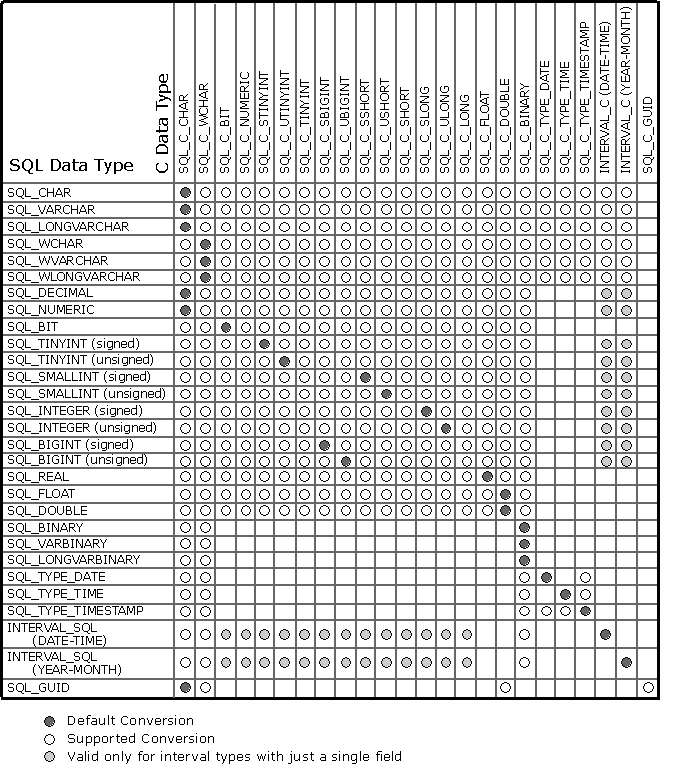
A következő szakaszok táblázatai azt írják le, hogy az illesztőprogram vagy az adatforrás hogyan konvertálja az adatforrásból lekért adatokat; az illesztőprogramoknak támogatniuk kell az általuk támogatott ODBC SQL-adattípusok összes ODBC C-adattípusára való konvertálást. For a given ODBC SQL data type, the first column of the table lists the legal input values of the TargetType argument in SQLBindCol and SQLGetData. The second column lists the outcomes of a test, often using the BufferLength argument specified in SQLBindCol or SQLGetData, which the driver performs to determine whether it can convert the data. For each outcome, the third and fourth columns list the values placed in the buffers specified by the TargetValuePtr and StrLen_or_IndPtr arguments specified in SQLBindCol or SQLGetData after the driver has attempted to convert the data. (The StrLen_or_IndPtr argument corresponds to the SQL_DESC_OCTET_LENGTH_PTR field of the ARD.) The last column lists the SQLSTATE returned for each outcome by SQLFetch, SQLFetchScroll, or SQLGetData.
If the TargetType argument in SQLBindCol or SQLGetData contains an identifier for an ODBC C data type not shown in the table for a given ODBC SQL data type, SQLFetch, SQLFetchScroll, or SQLGetData returns SQLSTATE 07006 (Restricted data type attribute violation). If the TargetType argument contains an identifier that specifies a conversion from a driver-specific SQL data type to an ODBC C data type and this conversion isn't supported by the driver, SQLFetch, SQLFetchScroll, or SQLGetData returns SQLSTATE HYC00 (Optional feature not implemented).
Although it's not shown in the tables, the driver returns SQL_NULL_DATA in the buffer specified by the StrLen_or_IndPtr argument when the SQL data value is NULL. For an explanation of the use of StrLen_or_IndPtr when multiple calls are made to retrieve data, see the SQLGetData Function function description. When SQL data is converted to character C data, the character count returned in StrLen_or_IndPtr doesn't include the null-termination byte. If TargetValuePtr is a null pointer, SQLGetData returns SQLSTATE HY009 (Invalid use of null pointer); in SQLBindCol, this unbinds the column.
A táblák a következő kifejezéseket és konvenciókat használják:
Az adatok bájthossza a TargetValuePtrben visszaadható C-adatok bájtjainak száma, függetlenül attól, hogy az adatok csonkítva lesznek-e az alkalmazáshoz való visszatérés előtt. Sztringadatok esetén ez nem foglalja magában a null-végződés karakter szóközét.
A karakterbájt hossza az adatok karakterformátumban való megjelenítéséhez szükséges bájtok teljes száma. This is as defined for each C data type in the section Display Size, except that character byte length is in bytes while the display size is in characters.
Words in italics represent function arguments or elements of the SQL grammar. A nyelvtani elemek szintaxisát lásd a C függelékben: SQL Grammar.
Ez a szakasz az alábbi cikkeket tartalmazza.