Catatan
Akses ke halaman ini memerlukan otorisasi. Anda dapat mencoba masuk atau mengubah direktori.
Akses ke halaman ini memerlukan otorisasi. Anda dapat mencoba mengubah direktori.
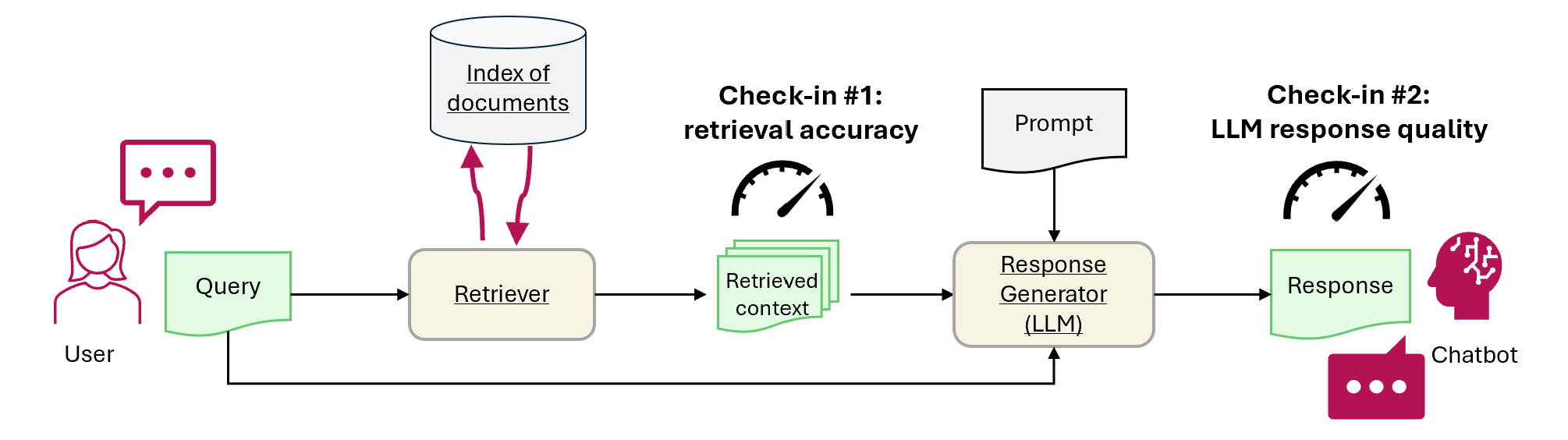
Tutorial ini menunjukkan cara menggunakan Fabric untuk mengevaluasi performa aplikasi RAG. Evaluasi berfokus pada dua komponen RAG utama: retriever (Azure AI Search) dan generator respons (LLM yang menggunakan kueri pengguna, konteks yang diambil, dan permintaan untuk menghasilkan balasan). Berikut adalah langkah-langkah utamanya:
- Menyiapkan layanan Azure OpenAI dan Azure AI Search
- Memuat data dari artikel Wikipedia dalam dataset QA dari CMU untuk membangun tolok ukur
- Jalankan uji asap dengan satu kueri untuk mengonfirmasi sistem RAG berfungsi secara end to end
- Menentukan metrik deterministik dan yang dibantu AI untuk evaluasi
- Check-in 1: Mengevaluasi performa pengambilalih menggunakan akurasi top-N
- Check-in 2: Mengevaluasi performa generator respons menggunakan metrik groundedness, relevansi, dan kesamaan
- Memvisualisasikan dan menyimpan hasil evaluasi di OneLake untuk referensi dan evaluasi yang sedang berlangsung di masa mendatang
Prasyarat
Sebelum Anda memulai tutorial ini, selesaikan panduan langkah-demi-langkah Membangun Generasi Augmented Retrieval di Fabric.
Anda memerlukan layanan ini untuk menjalankan buku catatan:
- Microsoft Fabric
- Tambahkan lakehouse ke buku catatan ini (berisi data yang Anda tambahkan di tutorial sebelumnya).
- Azure AI Studio untuk OpenAI
- Azure AI Search (berisi data yang Anda indeks di tutorial sebelumnya).
Dalam tutorial sebelumnya, Anda mengunggah data ke lakehouse Anda dan membangun indeks dokumen yang digunakan oleh sistem RAG. Gunakan indeks dalam latihan ini untuk mempelajari teknik inti untuk mengevaluasi performa RAG dan mengidentifikasi potensi masalah. Jika Anda tidak membuat indeks atau menghapusnya, ikuti panduan mulai cepat untuk menyelesaikan prasyarat.
Menyiapkan akses ke Azure OpenAI dan Azure AI Search
Tentukan titik akhir dan kunci yang diperlukan. Impor pustaka dan fungsi yang diperlukan. Menginstansiasi klien untuk Azure OpenAI dan Azure AI Search. Tentukan pembungkus fungsi dengan prompt untuk melakukan kueri pada sistem RAG.
# Enter your Azure OpenAI service values
aoai_endpoint = "https://<your-resource-name>.openai.azure.com" # TODO: Provide the Azure OpenAI resource endpoint (replace <your-resource-name>)
aoai_key = "" # TODO: Fill in your API key from Azure OpenAI
aoai_deployment_name_embeddings = "text-embedding-ada-002"
aoai_model_name_query = "gpt-4-32k"
aoai_model_name_metrics = "gpt-4-32k"
aoai_api_version = "2024-02-01"

# Setup key accesses to Azure AI Search
aisearch_index_name = "" # TODO: Create a new index name: must only contain lowercase, numbers, and dashes
aisearch_api_key = "" # TODO: Fill in your API key from Azure AI Search
aisearch_endpoint = "https://.search.windows.net" # TODO: Provide the url endpoint for your created Azure AI Search
import warnings
warnings.filterwarnings("ignore", category=DeprecationWarning)

import os, requests, json

from datetime import datetime, timedelta
from azure.core.credentials import AzureKeyCredential
from azure.search.documents import SearchClient

from pyspark.sql import functions as F
from pyspark.sql.functions import to_timestamp, current_timestamp, concat, col, split, explode, udf, monotonically_increasing_id, when, rand, coalesce, lit, input_file_name, regexp_extract, concat_ws, length, ceil
from pyspark.sql.types import StructType, StructField, StringType, IntegerType, TimestampType, ArrayType, FloatType
from pyspark.sql import Row
import pandas as pd
from azure.search.documents.indexes import SearchIndexClient
from azure.search.documents.models import (
    VectorizedQuery,
)
from azure.search.documents.indexes.models import (
    SearchIndex,
    SearchField,
    SearchFieldDataType,
    SimpleField,
    SearchableField,
    SemanticConfiguration,
    SemanticPrioritizedFields,
    SemanticField,
    SemanticSearch,
    VectorSearch,
    HnswAlgorithmConfiguration,
    HnswParameters,
    VectorSearchProfile,
    VectorSearchAlgorithmKind,
    VectorSearchAlgorithmMetric,
)

import openai
from openai import AzureOpenAI
import uuid
import matplotlib.pyplot as plt
from synapse.ml.featurize.text import PageSplitter
import ipywidgets as widgets
from IPython.display import display as w_display
Keluaran Sel:StatementMeta(, 21cb8cd3-7742-4c1f-8339-265e2846df1d, 6, Finished, Available, Finished)
# Configure access to OpenAI endpoint
openai.api_type = "azure"
openai.api_key = aoai_key
openai.api_base = aoai_endpoint
openai.api_version = aoai_api_version

# Create client for accessing embedding endpoint
embed_client = AzureOpenAI(
    api_version=aoai_api_version,
    azure_endpoint=aoai_endpoint,
    api_key=aoai_key,
)

# Create client for accessing chat endpoint
chat_client = AzureOpenAI(
    azure_endpoint=aoai_endpoint,
    api_key=aoai_key,
    api_version=aoai_api_version,
)

# Configure access to Azure AI Search
search_client = SearchClient(
    aisearch_endpoint,
    aisearch_index_name,
    credential=AzureKeyCredential(aisearch_api_key)
)
Keluaran Sel:StatementMeta(, 21cb8cd3-7742-4c1f-8339-265e2846df1d, 7, Finished, Available, Finished)
Fungsi berikut mengimplementasikan dua komponen RAG utama - retriever (get_context_source) dan generator respons (get_answer). Kode ini mirip dengan tutorial sebelumnya. Parameter topN memungkinkan Anda mengatur berapa banyak sumber daya yang relevan untuk diambil (tutorial ini menggunakan 3, tetapi nilai optimal dapat bervariasi menurut himpunan data):
# Implement retriever
def get_context_source(question, topN=3):
    """
    Retrieves contextual information and sources related to a given question using embeddings and a vector search.
    Parameters:
    question (str): The question for which the context and sources are to be retrieved.
    topN (int, optional): The number of top results to retrieve. Default is 3.

    Returns:
    List: A list containing two elements:
        1. A string with the concatenated retrieved context.
        2. A list of retrieved source paths.
    """
    embed_client = openai.AzureOpenAI(
        api_version=aoai_api_version,
        azure_endpoint=aoai_endpoint,
        api_key=aoai_key,
    )

    query_embedding = embed_client.embeddings.create(input=question, model=aoai_deployment_name_embeddings).data[0].embedding

    vector_query = VectorizedQuery(vector=query_embedding, k_nearest_neighbors=topN, fields="Embedding")

    results = search_client.search(
        vector_queries=[vector_query],
        top=topN,
    )

    retrieved_context = ""
    retrieved_sources = []
    for result in results:
        retrieved_context += result['ExtractedPath'] + "\n" + result['Chunk'] + "\n\n"
        retrieved_sources.append(result['ExtractedPath'])

    return [retrieved_context, retrieved_sources]

# Implement response generator
def get_answer(question, context):
    """
    Generates a response to a given question using provided context and an Azure OpenAI model.

    Parameters:
        question (str): The question that needs to be answered.
        context (str): The contextual information related to the question that will help generate a relevant response.

    Returns:
        str: The response generated by the Azure OpenAI model based on the provided question and context.
    """
    messages = [
        {
            "role": "system",
            "content": "You are a chat assistant. Use provided text to ground your response. Give a one-word answer when possible ('yes'/'no' is OK where appropriate, no details). Unnecessary words incur a $500 penalty."
        }
    ]

    messages.append(
        {
            "role": "user",
            "content": question + "\n" + context,
        },
    )

    chat_client = openai.AzureOpenAI(
        azure_endpoint=aoai_endpoint,
        api_key=aoai_key,
        api_version=aoai_api_version,
    )

    chat_completion = chat_client.chat.completions.create(
        model=aoai_model_name_query,
        messages=messages,
    )

    return chat_completion.choices[0].message.content
Keluaran Sel:StatementMeta(, 21cb8cd3-7742-4c1f-8339-265e2846df1d, 8, Finished, Available, Finished)
Dataset
Versi 1.2 dari himpunan data Question-Answer Universitas Carnegie Mellon adalah korpus artikel Wikipedia dengan pertanyaan dan jawaban faktual yang ditulis secara manual. Ini dihosting di Azure Blob Storage di bawah GFDL. Himpunan data menggunakan satu tabel dengan bidang ini:
-
ArticleTitle: Nama artikel Wikipedia tempat asal pertanyaan dan jawaban -
Question: Pertanyaan yang ditulis secara manual tentang artikel -
Answer: Jawaban tertulis secara manual berdasarkan artikel -
DifficultyFromQuestioner: Kesulitan memberi peringkat yang ditetapkan penulis pertanyaan -
DifficultyFromAnswerer: Tingkat kesulitan yang ditetapkan evaluator; dapat berbeda dariDifficultyFromQuestioner -
ExtractedPath: Jalur ke artikel asli (artikel dapat memiliki beberapa pasangan tanya jawab) -
text: Teks artikel Wikipedia yang dibersihkan
Unduh file LICENSE-S08 dan LICENSE-S09 dari lokasi yang sama untuk detail lisensi.
Riwayat dan kutipan
Gunakan kutipan ini untuk himpunan data:
CMU Question/Answer Dataset, Release 1.2
August 23, 2013
Noah A. Smith, Michael Heilman, and Rebecca Hwa
Question Generation as a Competitive Undergraduate Course Project
In Proceedings of the NSF Workshop on the Question Generation Shared Task and Evaluation Challenge, Arlington, VA, September 2008.
Available at http://www.cs.cmu.edu/~nasmith/papers/smith+heilman+hwa.nsf08.pdf.
Original dataset acknowledgments:
This research project was supported by NSF IIS-0713265 (to Smith), an NSF Graduate Research Fellowship (to Heilman), NSF IIS-0712810 and IIS-0745914 (to Hwa), and Institute of Education Sciences, U.S. Department of Education R305B040063 (to Carnegie Mellon).
cmu-qa-08-09 (modified version)
June 12, 2024
Amir Jafari, Alexandra Savelieva, Brice Chung, Hossein Khadivi Heris, Journey McDowell
This release uses the GNU Free Documentation License (GFDL) (http://www.gnu.org/licenses/fdl.html).
The GNU license applies to all copies of the dataset.
Membuat tolok ukur
Mengimpor tolok ukurnya. Untuk demo ini, gunakan subset pertanyaan dari wadah S08/set1 dan S08/set2. Untuk menyimpan satu pertanyaan per artikel, terapkan df.dropDuplicates(["ExtractedPath"]). Hilangkan pertanyaan duplikat. Proses kurasi menambahkan label kesulitan; contoh ini membatasinya ke medium.
df = spark.sql("SELECT * FROM data_load_tests.cmu_qa")

# Filter the DataFrame to include the specified paths
df = df.filter((col("ExtractedPath").like("S08/data/set1/%")) | (col("ExtractedPath").like("S08/data/set2/%")))

# Keep only medium-difficulty questions.
df = df.filter(col("DifficultyFromQuestioner") == "medium")


# Drop duplicate questions and source paths.
df = df.dropDuplicates(["Question"])
df = df.dropDuplicates(["ExtractedPath"])

num_rows = df.count()
num_columns = len(df.columns)
print(f"Number of rows: {num_rows}, Number of columns: {num_columns}")

# Persist the DataFrame
df.persist()
display(df)
Output sel:StatementMeta(, 21cb8cd3-7742-4c1f-8339-265e2846df1d, 9, Finished, Available, Finished)Number of rows: 20, Number of columns: 7SynapseWidget(Synapse.DataFrame, 47aff8cb-72f8-4a36-885c-f4f3bb830a91)
Hasilnya adalah DataFrame dengan 20 baris - tolok ukur demo. Bidang utama adalah Question, Answer (jawaban kebenaran dasar yang dikumpulkan manusia), dan ExtractedPath (dokumen sumber). Sesuaikan filter untuk menyertakan pertanyaan lain dan berbagai kesulitan untuk contoh yang lebih realistis. Cobalah.
Menjalankan pengujian end-to-end sederhana
Mulailah dengan uji asap end-to-end dari retrieval-augmented generation (RAG).
question = "How many suborders are turtles divided into?"
retrieved_context, retrieved_sources = get_context_source(question)
answer = get_answer(question, retrieved_context)
print(answer)
Output sel:StatementMeta(, 21cb8cd3-7742-4c1f-8339-265e2846df1d, 10, Finished, Available, Finished)Three
Uji asap ini membantu Anda menemukan masalah dalam implementasi RAG, seperti kredensial yang salah, indeks vektor yang hilang atau kosong, atau antarmuka fungsi yang tidak kompatibel. Jika pengujian gagal, periksa penyebab masalah. Output yang diharapkan: Three. Jika uji asap lolos, buka bagian berikutnya untuk mengevaluasi RAG lebih lanjut.
Menetapkan metrik
Tentukan metrik deterministik untuk mengevaluasi pengambil informasi. Ini terinspirasi oleh mesin pencari. Ini memeriksa apakah daftar sumber yang diambil mencakup sumber kebenaran dasar. Metrik ini adalah skor akurasi N teratas karena topN parameter menetapkan jumlah sumber yang diambil.
def get_retrieval_score(target_source, retrieved_sources):
    if target_source in retrieved_sources:
        return 1
    else:
        return 0
Keluaran Sel:StatementMeta(, 21cb8cd3-7742-4c1f-8339-265e2846df1d, 11, Finished, Available, Finished)
Menurut tolok ukur, jawabannya terkandung dalam sumber dengan ID "S08/data/set1/a9". Menguji fungsi pada contoh yang kami jalankan di atas mengembalikan 1, seperti yang diharapkan, karena berada di tiga gugus teks yang relevan teratas.
print("Retrieved sources:", retrieved_sources)
get_retrieval_score("S08/data/set1/a9", retrieved_sources)
Output sel:StatementMeta(, 21cb8cd3-7742-4c1f-8339-265e2846df1d, 12, Finished, Available, Finished)Retrieved sources: ['S08/data/set1/a9', 'S08/data/set1/a9', 'S08/data/set1/a5']1
Bagian ini mendefinisikan metrik yang dibantu AI. Template prompt mencakup beberapa contoh input (KONTEKS dan JAWABAN) dan output yang disarankan - juga dikenal sebagai model few-shot. Ini adalah perintah yang sama yang digunakan di Azure AI Studio. Pelajari selengkapnya dalam Metrik evaluasi bawaan. Demo ini menggunakan groundedness metrik dan relevance - ini biasanya yang paling berguna dan dapat diandalkan untuk mengevaluasi model GPT. Metrik lain dapat berguna tetapi memberikan lebih sedikit intuisi - misalnya, jawaban tidak harus mirip dengan benar, sehingga similarity skor bisa menyesatkan. Skala untuk semua metrik adalah 1 hingga 5. Lebih tinggi lebih baik. Groundedness hanya mengambil dua input (konteks dan jawaban yang dihasilkan), sementara dua metrik lainnya juga menggunakan kebenaran dasar untuk evaluasi.
def get_groundedness_metric(context, answer):
    """Get the groundedness score from the LLM using the context and answer."""

    groundedness_prompt_template = """
    You are presented with a CONTEXT and an ANSWER about that CONTEXT. Decide whether the ANSWER is entailed by the CONTEXT by choosing one of the following ratings:
    1. 5: The ANSWER follows logically from the information contained in the CONTEXT.
    2. 1: The ANSWER is logically false from the information contained in the CONTEXT.
    3. an integer score between 1 and 5 and if such integer score does not exist, use 1: It is not possible to determine whether the ANSWER is true or false without further information. Read the passage of information thoroughly and select the correct answer from the three answer labels. Read the CONTEXT thoroughly to ensure you know what the CONTEXT entails. Note the ANSWER is generated by a computer system, it can contain certain symbols, which should not be a negative factor in the evaluation.
    Independent Examples:
    ## Example Task #1 Input:
    "CONTEXT": "Some are reported as not having been wanted at all.", "QUESTION": "", "ANSWER": "All are reported as being completely and fully wanted."
    ## Example Task #1 Output:
    1
    ## Example Task #2 Input:
    "CONTEXT": "Ten new television shows appeared during the month of September. Five of the shows were sitcoms, three were hourlong dramas, and two were news-magazine shows. By January, only seven of these new shows were still on the air. Five of the shows that remained were sitcoms.", "QUESTION": "", "ANSWER": "At least one of the shows that were cancelled was an hourlong drama."
    ## Example Task #2 Output:
    5
    ## Example Task #3 Input:
    "CONTEXT": "In Quebec, an allophone is a resident, usually an immigrant, whose mother tongue or home language is neither French nor English.", "QUESTION": "", "ANSWER": "In Quebec, an allophone is a resident, usually an immigrant, whose mother tongue or home language is not French."
    5
    ## Example Task #4 Input:
    "CONTEXT": "Some are reported as not having been wanted at all.", "QUESTION": "", "ANSWER": "All are reported as being completely and fully wanted."
    ## Example Task #4 Output:
    1
    ## Actual Task Input:
    "CONTEXT": {context}, "QUESTION": "", "ANSWER": {answer}
    Reminder: The return values for each task should be correctly formatted as an integer between 1 and 5. Do not repeat the context and question.  Don't explain the reasoning. The answer should include only a number: 1, 2, 3, 4, or 5.
    Actual Task Output:
    """

    metric_client = openai.AzureOpenAI(
        api_version=aoai_api_version,
        azure_endpoint=aoai_endpoint,
        api_key=aoai_key,
    )

    messages = [
        {
            "role": "system",
            "content": "You are an AI assistant. You will be given the definition of an evaluation metric for assessing the quality of an answer in a question-answering task. Your job is to compute an accurate evaluation score using the provided evaluation metric."
        },
        {
            "role": "user",
            "content": groundedness_prompt_template.format(context=context, answer=answer)
        }
    ]

    metric_completion = metric_client.chat.completions.create(
        model=aoai_model_name_metrics,
        messages=messages,
        temperature=0,
    )

    return metric_completion.choices[0].message.content
Keluaran Sel:StatementMeta(, 21cb8cd3-7742-4c1f-8339-265e2846df1d, 13, Finished, Available, Finished)
def get_relevance_metric(context, question, answer):
    relevance_prompt_template = """
    Relevance measures how well the answer addresses the main aspects of the question, based on the context. Consider whether all and only the important aspects are contained in the answer when evaluating relevance. Given the context and question, score the relevance of the answer between one to five stars using the following rating scale:
    One star: the answer completely lacks relevance
    Two stars: the answer mostly lacks relevance
    Three stars: the answer is partially relevant
    Four stars: the answer is mostly relevant
    Five stars: the answer has perfect relevance

    This rating value should always be an integer between 1 and 5. So the rating produced should be 1 or 2 or 3 or 4 or 5.

    context: Marie Curie was a Polish-born physicist and chemist who pioneered research on radioactivity and was the first woman to win a Nobel Prize.
    question: What field did Marie Curie excel in?
    answer: Marie Curie was a renowned painter who focused mainly on impressionist styles and techniques.
    stars: 1

    context: The Beatles were an English rock band formed in Liverpool in 1960, and they are widely regarded as the most influential music band in history.
    question: Where were The Beatles formed?
    answer: The band The Beatles began their journey in London, England, and they changed the history of music.
    stars: 2

    context: The recent Mars rover, Perseverance, was launched in 2020 with the main goal of searching for signs of ancient life on Mars. The rover also carries an experiment called MOXIE, which aims to generate oxygen from the Martian atmosphere.
    question: What are the main goals of Perseverance Mars rover mission?
    answer: The Perseverance Mars rover mission focuses on searching for signs of ancient life on Mars.
    stars: 3

    context: The Mediterranean diet is a commonly recommended dietary plan that emphasizes fruits, vegetables, whole grains, legumes, lean proteins, and healthy fats. Studies have shown that it offers numerous health benefits, including a reduced risk of heart disease and improved cognitive health.
    question: What are the main components of the Mediterranean diet?
    answer: The Mediterranean diet primarily consists of fruits, vegetables, whole grains, and legumes.
    stars: 4

    context: The Queen's Royal Castle is a well-known tourist attraction in the United Kingdom. It spans over 500 acres and contains extensive gardens and parks. The castle was built in the 15th century and has been home to generations of royalty.
    question: What are the main attractions of the Queen's Royal Castle?
    answer: The main attractions of the Queen's Royal Castle are its expansive 500-acre grounds, extensive gardens, parks, and the historical castle itself, which dates back to the 15th century and has housed generations of royalty.
    stars: 5

    Don't explain the reasoning. The answer should include only a number: 1, 2, 3, 4, or 5.

    context: {context}
    question: {question}
    answer: {answer}
    stars:
    """

    metric_client = openai.AzureOpenAI(
        api_version=aoai_api_version,
        azure_endpoint=aoai_endpoint,
        api_key=aoai_key,
    )


    messages = [
        {
            "role": "system",
            "content": "You are an AI assistant. You are given the definition of an evaluation metric for assessing the quality of an answer in a question-answering task. Compute an accurate evaluation score using the provided evaluation metric."
        },
        {
            "role": "user",
            "content": relevance_prompt_template.format(context=context, question=question, answer=answer)
        }
    ]

    metric_completion = metric_client.chat.completions.create(
        model=aoai_model_name_metrics,
        messages=messages,
        temperature=0,
    )

    return metric_completion.choices[0].message.content
Keluaran Sel:StatementMeta(, 21cb8cd3-7742-4c1f-8339-265e2846df1d, 14, Finished, Available, Finished)
def get_similarity_metric(question, ground_truth, answer):
    similarity_prompt_template = """
    Equivalence, as a metric, measures the similarity between the predicted answer and the correct answer. If the information and content in the predicted answer is similar or equivalent to the correct answer, then the value of the Equivalence metric should be high, else it should be low. Given the question, correct answer, and predicted answer, determine the value of Equivalence metric using the following rating scale:
    One star: the predicted answer is not at all similar to the correct answer
    Two stars: the predicted answer is mostly not similar to the correct answer
    Three stars: the predicted answer is somewhat similar to the correct answer
    Four stars: the predicted answer is mostly similar to the correct answer
    Five stars: the predicted answer is completely similar to the correct answer

    This rating value should always be an integer between 1 and 5. So the rating produced should be 1 or 2 or 3 or 4 or 5.

    The examples below show the Equivalence score for a question, a correct answer, and a predicted answer.

    question: What is the role of ribosomes?
    correct answer: Ribosomes are cellular structures responsible for protein synthesis. They interpret the genetic information carried by messenger RNA (mRNA) and use it to assemble amino acids into proteins.
    predicted answer: Ribosomes participate in carbohydrate breakdown by removing nutrients from complex sugar molecules.
    stars: 1

    question: Why did the Titanic sink?
    correct answer: The Titanic sank after it struck an iceberg during its maiden voyage in 1912. The impact caused the ship's hull to breach, allowing water to flood into the vessel. The ship's design, lifeboat shortage, and lack of timely rescue efforts contributed to the tragic loss of life.
    predicted answer: The sinking of the Titanic was a result of a large iceberg collision. This caused the ship to take on water and eventually sink, leading to the death of many passengers due to a shortage of lifeboats and insufficient rescue attempts.
    stars: 2

    question: What causes seasons on Earth?
    correct answer: Seasons on Earth are caused by the tilt of the Earth's axis and its revolution around the Sun. As the Earth orbits the Sun, the tilt causes different parts of the planet to receive varying amounts of sunlight, resulting in changes in temperature and weather patterns.
    predicted answer: Seasons occur because of the Earth's rotation and its elliptical orbit around the Sun. The tilt of the Earth's axis causes regions to be subjected to different sunlight intensities, which leads to temperature fluctuations and alternating weather conditions.
    stars: 3

    question: How does photosynthesis work?
    correct answer: Photosynthesis is a process by which green plants and some other organisms convert light energy into chemical energy. This occurs as light is absorbed by chlorophyll molecules, and then carbon dioxide and water are converted into glucose and oxygen through a series of reactions.
    predicted answer: In photosynthesis, sunlight is transformed into nutrients by plants and certain microorganisms. Light is captured by chlorophyll molecules, followed by the conversion of carbon dioxide and water into sugar and oxygen through multiple reactions.
    stars: 4

    question: What are the health benefits of regular exercise?
    correct answer: Regular exercise can help maintain a healthy weight, increase muscle and bone strength, and reduce the risk of chronic diseases. It also promotes mental well-being by reducing stress and improving overall mood.
    predicted answer: Routine physical activity can contribute to maintaining ideal body weight, enhancing muscle and bone strength, and preventing chronic illnesses. In addition, it supports mental health by alleviating stress and augmenting general mood.
    stars: 5

    Don't explain the reasoning. The answer should include only a number: 1, 2, 3, 4, or 5.

    question: {question}
    correct answer:{ground_truth}
    predicted answer: {answer}
    stars:
    """

    metric_client = openai.AzureOpenAI(
        api_version=aoai_api_version,
        azure_endpoint=aoai_endpoint,
        api_key=aoai_key,
    )

    messages = [
        {
            "role": "system",
            "content": "You are an AI assistant. You will be given the definition of an evaluation metric for assessing the quality of an answer in a question-answering task. Your job is to compute an accurate evaluation score using the provided evaluation metric."
        },
        {
            "role": "user",
            "content": similarity_prompt_template.format(question=question, ground_truth=ground_truth, answer=answer)
        }
    ]

    metric_completion = metric_client.chat.completions.create(
        model=aoai_model_name_metrics,
        messages=messages,
        temperature=0,
    )

    return metric_completion.choices[0].message.content
Keluaran Sel:StatementMeta(, 21cb8cd3-7742-4c1f-8339-265e2846df1d, 15, Finished, Available, Finished)
Uji metrik relevansi:
get_relevance_metric(retrieved_context, question, answer)
Output sel:StatementMeta(, 21cb8cd3-7742-4c1f-8339-265e2846df1d, 16, Finished, Available, Finished)'2'
Skor 5 berarti jawabannya relevan. Kode berikut mendapatkan metrik kesamaan:
get_similarity_metric(question, 'three', answer)
Output sel:StatementMeta(, 21cb8cd3-7742-4c1f-8339-265e2846df1d, 17, Finished, Available, Finished)'5'
Skor 5 berarti jawabannya cocok dengan jawaban kebenaran dasar yang dikurasi oleh pakar manusia. Skor metrik yang dibantu AI dapat berfluktuasi dengan input yang sama. Mereka lebih cepat daripada menggunakan hakim manusia.
Mengevaluasi kinerja RAG pada sesi tanya jawab berbasis tolok ukur
Buat pembungkus fungsi untuk dijalankan dalam skala besar. Bungkus setiap fungsi yang berakhiran _udf (singkatan dari user-defined function) agar sesuai dengan persyaratan Spark (@udf(returnType=StructType([ ... ]))) dan menjalankan perhitungan pada data besar lebih cepat di seluruh kluster.
# UDF wrappers for RAG components
@udf(returnType=StructType([
    StructField("retrieved_context", StringType(), True),
    StructField("retrieved_sources", ArrayType(StringType()), True)
]))
def get_context_source_udf(question, topN=3):
    return get_context_source(question, topN)

@udf(returnType=StringType())
def get_answer_udf(question, context):
    return get_answer(question, context)


# UDF wrapper for retrieval score
@udf(returnType=StringType())
def get_retrieval_score_udf(target_source, retrieved_sources):
    return get_retrieval_score(target_source, retrieved_sources)


# UDF wrappers for AI-assisted metrics
@udf(returnType=StringType())
def get_groundedness_metric_udf(context, answer):
    return get_groundedness_metric(context, answer)

@udf(returnType=StringType())
def get_relevance_metric_udf(context, question, answer):
    return get_relevance_metric(context, question, answer)

@udf(returnType=StringType())
def get_similarity_metric_udf(question, ground_truth, answer):
    return get_similarity_metric(question, ground_truth, answer)
Keluaran Sel:StatementMeta(, 21cb8cd3-7742-4c1f-8339-265e2846df1d, 18, Finished, Available, Finished)
Check-in #1: performa pengambil
Berikut adalah kode untuk membuat kolom result dan retrieval_score dalam DataFrame tolok ukur. Kolom ini mencakup jawaban yang dihasilkan RAG dan indikator apakah konteks yang diberikan kepada LLM mencakup artikel yang menjadi dasar pertanyaan.
df = df.withColumn("result", get_context_source_udf(df.Question)).select(df.columns+["result.*"])
df = df.withColumn('retrieval_score', get_retrieval_score_udf(df.ExtractedPath, df.retrieved_sources))
print("Aggregate Retrieval score: {:.2f}%".format((df.where(df["retrieval_score"] == 1).count() / df.count()) * 100))
display(df.select(["question", "retrieval_score",  "ExtractedPath", "retrieved_sources"]))
Output sel:StatementMeta(, 21cb8cd3-7742-4c1f-8339-265e2846df1d, 19, Finished, Available, Finished)Aggregate Retrieval score: 100.00%SynapseWidget(Synapse.DataFrame, 14efe386-836a-4765-bd88-b121f32c7cfc)
Untuk semua pertanyaan, penarik data mengambil konteks yang tepat, dan dalam kebanyakan kasus, konteks ini adalah entri pertama. Pencarian Azure AI berkinerja baik. Anda mungkin bertanya-tanya mengapa, dalam beberapa kasus, konteks memiliki dua atau tiga nilai yang identik. Itu bukan kesalahan - itu berarti pengakses mengambil fragmen dari artikel yang sama yang tidak cocok dengan satu gugus selama pemisahan.
Check-in #2: kinerja pembangkit respons
Teruskan pertanyaan dan konteks ke LLM untuk menghasilkan jawaban. Simpan di kolom generated_answer dalam DataFrame.
df = df.withColumn('generated_answer', get_answer_udf(df.Question, df.retrieved_context))
Keluaran Sel:StatementMeta(, 21cb8cd3-7742-4c1f-8339-265e2846df1d, 20, Finished, Available, Finished)
Gunakan jawaban yang dihasilkan, jawaban kebenaran dasar, pertanyaan, dan konteks untuk menghitung metrik. Tampilkan hasil evaluasi untuk setiap pasangan jawaban atas pertanyaan:
df = df.withColumn('gpt_groundedness', get_groundedness_metric_udf(df.retrieved_context, df.generated_answer))
df = df.withColumn('gpt_relevance', get_relevance_metric_udf(df.retrieved_context, df.Question, df.generated_answer))
df = df.withColumn('gpt_similarity', get_similarity_metric_udf(df.Question, df.Answer, df.generated_answer))
display(df.select(["question", "answer", "generated_answer", "retrieval_score", "gpt_groundedness","gpt_relevance", "gpt_similarity"]))
Output sel:StatementMeta(, 21cb8cd3-7742-4c1f-8339-265e2846df1d, 21, Finished, Available, Finished)SynapseWidget(Synapse.DataFrame, 22b97d27-91e1-40f3-b888-3a3399de9d6b)
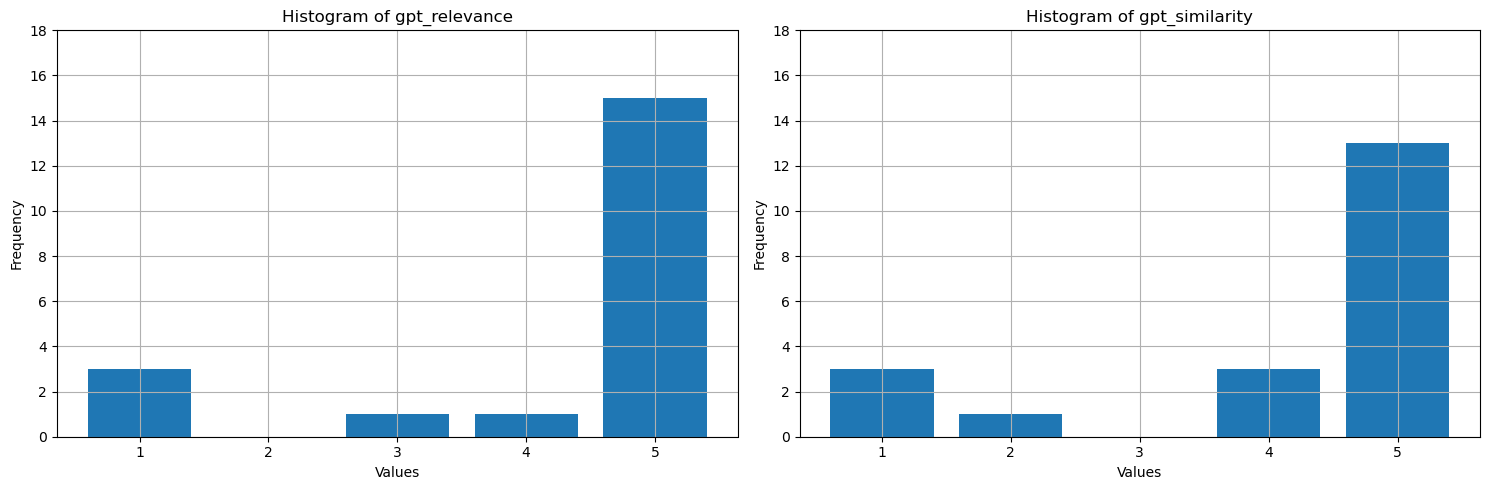
Apa yang ditampilkan nilai-nilai ini? Untuk memudahkan penafsiran, buatlah plot histogram untuk groundedness, relevansi, dan kesamaan. LLM lebih verbose daripada jawaban standar manusia, yang mengurangi metrik kesamaan - sekitar setengah dari jawaban tersebut benar secara semantik tetapi diberikan empat bintang karena sebagian besar mirip. Sebagian besar nilai untuk ketiga metrik adalah 4 atau 5, yang menunjukkan performa RAG baik. Ada beberapa pengecualian - misalnya, untuk pertanyaan How many species of otter are there?, model menghasilkan There are 13 species of otter, yang benar dengan relevansi dan kesamaan tinggi (5). Untuk beberapa alasan, GPT menganggapnya tidak sesuai dengan konteks yang disediakan dan memberinya satu bintang. Dalam tiga kasus lainnya dengan setidaknya satu metrik berbantu AI yang bernilai satu bintang, skor rendah mengindikasikan jawaban yang buruk. LLM terkadang salah skor tetapi biasanya mencetak skor secara akurat.
# Convert Spark DataFrame to Pandas DataFrame
pandas_df = df.toPandas()

selected_columns = ['gpt_groundedness', 'gpt_relevance', 'gpt_similarity']
trimmed_df = pandas_df[selected_columns].astype(int)

# Define a function to plot histograms for the specified columns
def plot_histograms(dataframe, columns):
    # Set up the figure size and subplots
    plt.figure(figsize=(15, 5))
    for i, column in enumerate(columns, 1):
        plt.subplot(1, len(columns), i)
        # Filter the dataframe to only include rows with values 1, 2, 3, 4, 5
        filtered_df = dataframe[dataframe[column].isin([1, 2, 3, 4, 5])]
        filtered_df[column].hist(bins=range(1, 7), align='left', rwidth=0.8)
        plt.title(f'Histogram of {column}')
        plt.xlabel('Values')
        plt.ylabel('Frequency')
        plt.xticks(range(1, 6))
        plt.yticks(range(0, 20, 2))


# Call the function to plot histograms for the specified columns
plot_histograms(trimmed_df, selected_columns)

# Show the plots
plt.tight_layout()
plt.show()
Keluaran Sel:StatementMeta(, 21cb8cd3-7742-4c1f-8339-265e2846df1d, 24, Finished, Available, Finished)
Sebagai langkah terakhir, simpan hasil tolok ukur ke tabel di lakehouse Anda. Langkah ini opsional tetapi sangat direkomendasikan - ini membuat temuan Anda lebih berguna. Saat Anda mengubah sesuatu di RAG (misalnya, memodifikasi perintah, memperbarui indeks, atau menggunakan model GPT yang berbeda di generator respons), ukur dampak, kuantifikasi peningkatan, dan deteksi regresi.
# create name of experiment that is easy to refer to
friendly_name_of_experiment = "rag_tutorial_experiment_1"

# Note the current date and time
time_of_experiment = current_timestamp()

# Generate a unique GUID for all rows
experiment_id = str(uuid.uuid4())

# Add two new columns to the Spark DataFrame
updated_df = df.withColumn("execution_time", time_of_experiment) \
                        .withColumn("experiment_id", lit(experiment_id)) \
                        .withColumn("experiment_friendly_name", lit(friendly_name_of_experiment))

# Store the updated DataFrame in the default lakehouse as a table named 'rag_experiment_runs'
table_name = "rag_experiment_run_demo1"
updated_df.write.format("parquet").mode("append").saveAsTable(table_name)
Keluaran Sel:StatementMeta(, 21cb8cd3-7742-4c1f-8339-265e2846df1d, 28, Finished, Available, Finished)
Kembali ke hasil eksperimen kapan saja untuk meninjaunya, membandingkannya dengan eksperimen baru, dan pilih konfigurasi yang paling sesuai untuk produksi.
Ringkasan
Gunakan metrik yang dibantu AI dan rasio pengambilan top-N untuk membangun solusi generasi yang diperkuat oleh retrieval (RAG).