Nota
L'accesso a questa pagina richiede l'autorizzazione. È possibile provare ad accedere o modificare le directory.
L'accesso a questa pagina richiede l'autorizzazione. È possibile provare a modificare le directory.
Importante
Alcune informazioni in questo articolo fanno riferimento alle caratteristiche di un prodotto prima del rilascio, che possono essere modificate sostanzialmente prima della distribuzione al pubblico. Microsoft non fornisce alcuna garanzia, esplicita o implicita, in relazione alle informazioni contenute in questo documento.
In questo esempio viene illustrato come creare uno strumento GPT (competenza) per l'agente che infanga un URL.
Creare e caricare uno strumento GPT in Security Copilot
Lo strumento GPT è definito come segue:
Descriptor:
  Name: DCA_SampleGPT
  DisplayName: DCA_My Sample GPT Skillset
  Description: Skills for defanging URLs

SkillGroups:
  - Format: GPT
    Skills:
      - Name: DefangUrls
        DisplayName: Defang URLs
        Description: Defangs URLs in the given text
        Inputs:
          - Name: text
            Description: The text containing URLs to be defanged
        Settings:
          ModelName: gpt-4.1
          Template: |-
            To 'defang' a URL means to change the scheme to either hxxp or hxxps and replace '.' with '[.]' in the domain so that the URL is still easily readable by a human but doesn't automatically render as a hyperlink if rendered in a rich client such as Outlook. This is often done when sharing potentially malicious links to prevent the reader accidentally clicking on them and visiting a malicious website.

            Some examples of defanging URLs:
            1. https://example.com --> hxxps://example[.]com
            2. http://subdomain.example.com/path.with.dots/ --> hxxp://subdomain[.]example[.]com/path.with.dots/

            Defang any URLs in the following text and return the new text:
            {{text}}
Per istruzioni su come caricare e abilitare il plug-in, vedere Manifesto dell'agente di compilazione.
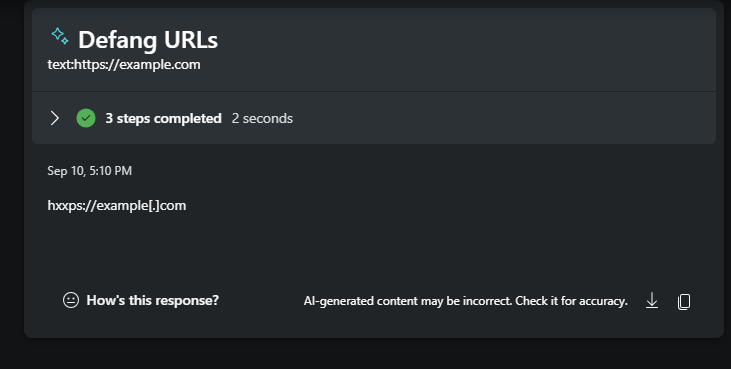
Risultati finali dopo l'esecuzione del plug-in: