このチュートリアルでは、.NET アプリで OpenAI モデルとベクター検索機能を使用した RAG パターンの統合について説明します。 サンプル アプリケーションでは、Azure DocumentDB に格納されているカスタム データに対してベクター検索を実行し、gpt-5 などの生成 AI モデルを使用して応答をさらに絞り込みます。 以下のセクションでは、サンプル アプリケーションを設定し、これらの概念を示す主要なコード例について説明します。
前提条件
- .NET 8.0
- Azure アカウント
- Azure DocumentDB サービス
-
Azure OpenAI サービス
- 埋め込み用
text-embedding-ada-002モデルをデプロイする - チャット完了用
gpt-35-turboモデルをデプロイする
- 埋め込み用
アプリの概要
Cosmos レシピ ガイド アプリを使用すると、一連のレシピ データに対してベクター検索と AI 駆動検索を実行できます。 利用可能なレシピを直接検索するか、関連するレシピを見つけるために成分名をアプリに求めます。 このアプリとセクションでは、この種類の機能を示すために、次のワークフローについて説明します。
Azure DocumentDB データベースにサンプル データをアップロードします。
Azure OpenAI
text-embedding-3-smallモデルを使用して、アップロードされたサンプル データの埋め込みとベクター インデックスを作成します。ユーザー プロンプトに基づいてベクトル類似性検索を実行します。
検索結果データに基づいてより意味のある回答を作成するには、Azure OpenAI
gpt-35-turbo入力候補モデルを使用します。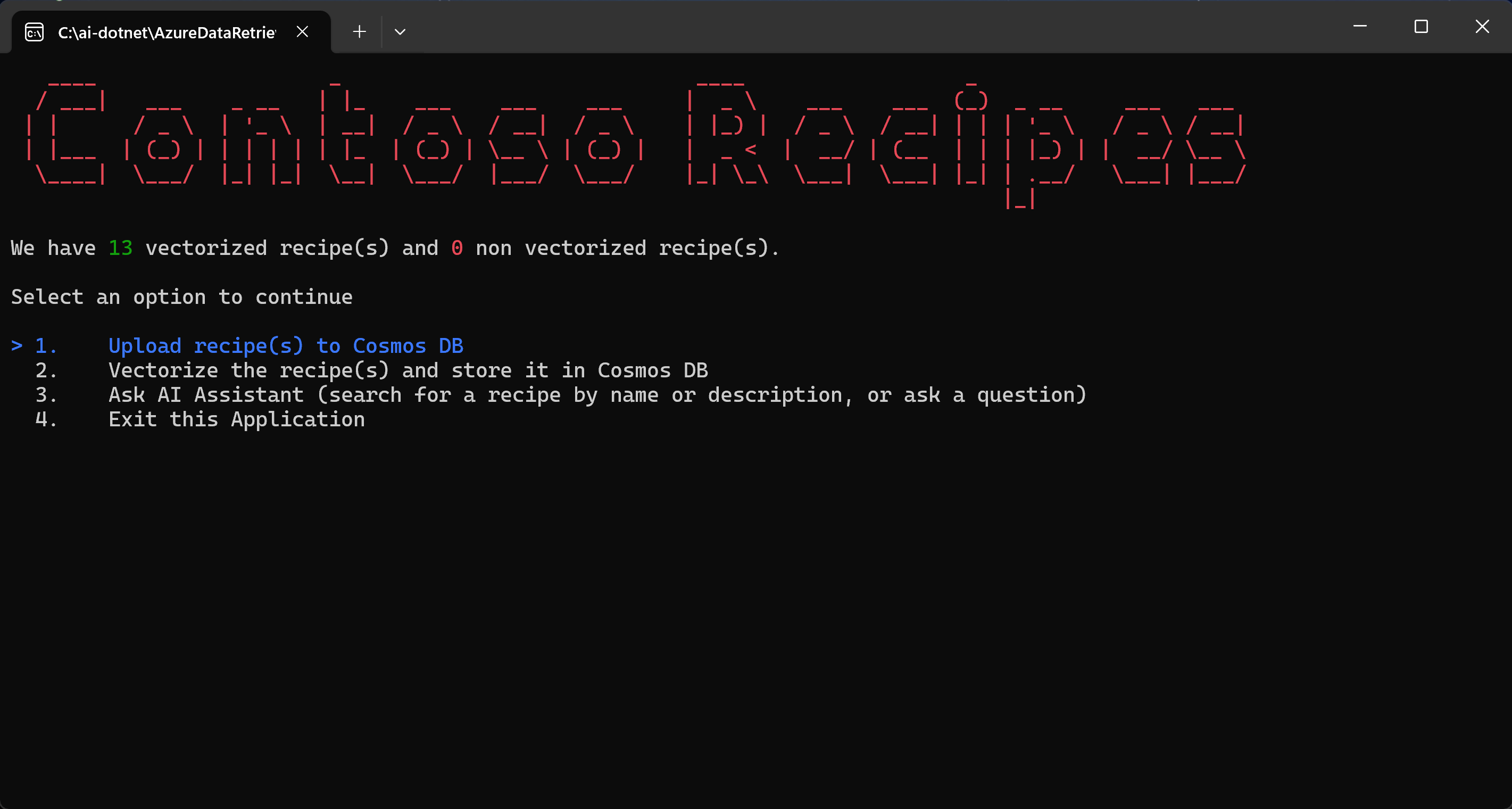
概要
次の GitHub リポジトリを複製します。
git clone https://github.com/microsoft/AzureDataRetrievalAugmentedGenerationSamples.gitC#/CosmosDB-MongoDBvCore フォルダーで、CosmosRecipeGuide.sln ファイルを開きます。
appsettings.json ファイルで、次の構成値を Azure OpenAI と Azure DocumentDB の値に置き換えてください。
"OpenAIEndpoint": "https://<your-service-name>.openai.azure.com/",
"OpenAIKey": "<your-API-key>",
"OpenAIEmbeddingDeployment": "<your-ADA-deployment-name>",
"OpenAIcompletionsDeployment": "<your-GPT-deployment-name>",
"MongoVcoreConnection": "<your-Mongo-connection-string>"
Visual Studio の上部にある [スタート ] ボタンを押して、アプリを起動します。
アプリを探索する
初めてアプリを実行すると、Azure DocumentDB に接続し、利用可能なレシピはまだないと表示します。 アプリに表示される手順に従って、コア ワークフローを開始します。
[ レシピを Cosmos DB にアップロード] を 選択し、 Enter キーを押します。 このコマンドは、ローカル プロジェクトからサンプル JSON ファイルを読み取り、Azure DocumentDB クラスターにアップロードします。
Utility.cs クラスのコードは、ローカル JSON ファイルを解析します。
public static List<Recipe> ParseDocuments(string Folderpath)
{
    List<Recipe> recipes = new List<Recipe>();

    Directory.GetFiles(Folderpath)
        .ToList()
        .ForEach(f =>
        {
            var jsonString= System.IO.File.ReadAllText(f);
            Recipe recipe = JsonConvert.DeserializeObject<Recipe>(jsonString);
            recipe.id = recipe.name.ToLower().Replace(" ", "");
            recipes.Add(recipe);
        }
    );

    return recipes;
}
VCoreMongoService.cs ファイル内の
UpsertVectorAsyncメソッドは、ドキュメントを Azure DocumentDB にアップロードします。public async Task UpsertVectorAsync(Recipe recipe) { BsonDocument document = recipe.ToBsonDocument(); if (!document.Contains("_id")) { Console.WriteLine("UpsertVectorAsync: Document does not contain _id."); throw new ArgumentException("UpsertVectorAsync: Document does not contain _id."); } string? _idValue = document["_id"].ToString(); try { var filter = Builders<BsonDocument>.Filter.Eq("_id", _idValue); var options = new ReplaceOptions { IsUpsert = true }; await _recipeCollection.ReplaceOneAsync(filter, document, options); } catch (Exception ex) { Console.WriteLine($"Exception: UpsertVectorAsync(): {ex.Message}"); throw; } }[ Vectorize the recipe(s)]\(レシピのベクター化\) を選択し、Cosmos DB に保存します。
Azure DocumentDB にアップロードされた JSON 項目には埋め込みがないため、ベクター検索による RAG 用に最適化されていません。 埋め込みは、テキストのセマンティック意味の情報密度の高い数値表現です。 ベクター検索では、コンテキストに似た埋め込みを持つ項目を検索できます。
OpenAIService.cs ファイルの
GetEmbeddingsAsyncメソッドは、データベース内の各項目の埋め込みを作成します。public async Task<float[]?> GetEmbeddingsAsync(dynamic data) { try { EmbeddingsOptions options = new EmbeddingsOptions(data) { Input = data }; var response = await _openAIClient.GetEmbeddingsAsync(openAIEmbeddingDeployment, options); Embeddings embeddings = response.Value; float[] embedding = embeddings.Data[0].Embedding.ToArray(); return embedding; } catch (Exception ex) { Console.WriteLine($"GetEmbeddingsAsync Exception: {ex.Message}"); return null; } }VCoreMongoService.cs ファイル内の
CreateVectorIndexIfNotExistsによってベクター インデックスが作成され、ベクターの類似性検索を実行できます。public void CreateVectorIndexIfNotExists(string vectorIndexName) { try { //Find if vector index exists in vectors collection using (IAsyncCursor<BsonDocument> indexCursor = _recipeCollection.Indexes.List()) { bool vectorIndexExists = indexCursor.ToList().Any(x => x["name"] == vectorIndexName); if (!vectorIndexExists) { BsonDocumentCommand<BsonDocument> command = new BsonDocumentCommand<BsonDocument>( BsonDocument.Parse(@" { createIndexes: 'Recipe', indexes: [{ name: 'vectorSearchIndex', key: { embedding: 'cosmosSearch' }, cosmosSearchOptions: { kind: 'vector-ivf', numLists: 5, similarity: 'COS', dimensions: 1536 } }] }")); BsonDocument result = _database.RunCommand(command); if (result["ok"] != 1) { Console.WriteLine("CreateIndex failed with response: " + result.ToJson()); } } } } catch (MongoException ex) { Console.WriteLine("MongoDbService InitializeVectorIndex: " + ex.Message); throw; } }アプリで [ ASK AI Assistant] (名前または説明でレシピを検索するか、質問する) オプションを選択して、ユーザー クエリを実行します。
アプリは、OpenAI サービスと埋め込みモデルを使用してユーザー クエリを埋め込みに変換し、埋め込みを Azure DocumentDB に送信してベクター検索を実行します。 SearchAsync ファイルの メソッドは、ベクター検索を実行して、指定されたベクターに近いベクトルを検索し、Azure DocumentDB からドキュメントの一覧を返します。
public async Task<List<Recipe>> VectorSearchAsync(float[] queryVector) { List<string> retDocs = new List<string>(); string resultDocuments = string.Empty; try { //Search Azure DocumentDB collection for similar embeddings //Project the fields that are needed BsonDocument[] pipeline = new BsonDocument[] { BsonDocument.Parse( @$"{{$search: {{ cosmosSearch: {{ vector: [{string.Join(',', queryVector)}], path: 'embedding', k: {_maxVectorSearchResults}}}, returnStoredSource:true }} }}"), BsonDocument.Parse($"{{$project: {{embedding: 0}}}}"), }; var bsonDocuments = await _recipeCollection .Aggregate<BsonDocument>(pipeline).ToListAsync(); var recipes = bsonDocuments .ToList() .ConvertAll(bsonDocument => BsonSerializer.Deserialize<Recipe>(bsonDocument)); return recipes; } catch (MongoException ex) { Console.WriteLine($"Exception: VectorSearchAsync(): {ex.Message}"); throw; } }GetChatCompletionAsyncメソッドは、ユーザー プロンプトと関連するベクター検索結果に基づいて、チャット完了応答を改善します。public async Task<(string response, int promptTokens, int responseTokens)> GetChatCompletionAsync(string userPrompt, string documents) { try { ChatMessage systemMessage = new ChatMessage( ChatRole.System, _systemPromptRecipeAssistant + documents); ChatMessage userMessage = new ChatMessage( ChatRole.User, userPrompt); ChatCompletionsOptions options = new() { Messages = { systemMessage, userMessage }, MaxTokens = openAIMaxTokens, Temperature = 0.5f, //0.3f, NucleusSamplingFactor = 0.95f, FrequencyPenalty = 0, PresencePenalty = 0 }; Azure.Response<ChatCompletions> completionsResponse = await openAIClient.GetChatCompletionsAsync(openAICompletionDeployment, options); ChatCompletions completions = completionsResponse.Value; return ( response: completions.Choices[0].Message.Content, promptTokens: completions.Usage.PromptTokens, responseTokens: completions.Usage.CompletionTokens ); } catch (Exception ex) { string message = $"OpenAIService.GetChatCompletionAsync(): {ex.Message}"; Console.WriteLine(message); throw; } }また、このアプリでは、プロンプト エンジニアリングを使用して OpenAI サービスの制限を確保し、提供されたレシピの応答を書式設定します。
//System prompts to send with user prompts to instruct the model for chat session
private readonly string _systemPromptRecipeAssistant = @"
    You are an intelligent assistant for Contoso Recipes.
    You are designed to provide helpful answers to user questions about
    recipes, cooking instructions provided in JSON format below.

    Instructions:
    - Only answer questions related to the recipe provided below.
    - Don't reference any recipe not provided below.
    - If you're unsure of an answer, say ""I don't know"" and recommend users search themselves.
    - Your response  should be complete.
    - List the Name of the Recipe at the start of your response followed by step by step cooking instructions.
    - Assume the user is not an expert in cooking.
    - Format the content so that it can be printed to the Command Line console.
    - In case there is more than one recipe you find, let the user pick the most appropriate recipe.";
GitHub で Microsoft と共同作業する
このコンテンツのソースは GitHub にあります。そこで、issue や pull request を作成および確認することもできます。 詳細については、共同作成者ガイドを参照してください。

.NET