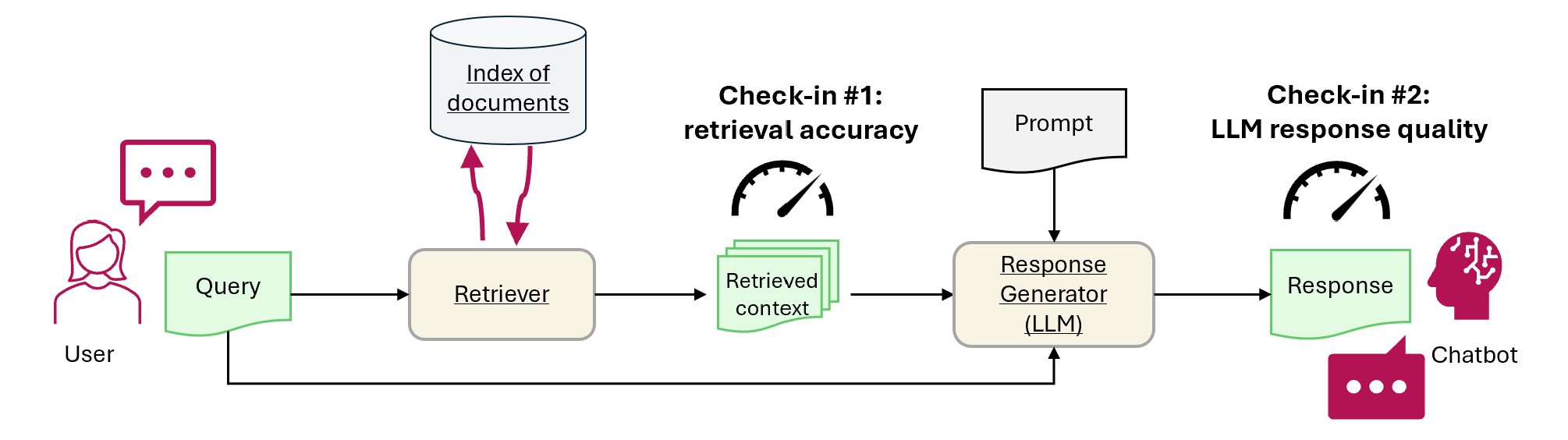
このチュートリアルでは、Fabric を使用して RAG アプリケーションのパフォーマンスを評価する方法について説明します。 この評価では、2 つの主要な RAG コンポーネント (レトリバー (Azure AI Search) と応答ジェネレーター (ユーザーのクエリ、取得されたコンテキスト、応答を生成するためのプロンプトを使用する LLM) に重点を置いています。 主な手順を次に示します。
- Azure OpenAI と Azure AI Search サービスを設定する
- CMU の Wikipedia 記事の QA データセットからデータを読み込み、ベンチマークを構築する
- 1 つのクエリでスモーク テストを実行し、RAG システムがエンド ツー エンドで動作することを確認する
- 評価のための決定論的メトリックと AI 支援メトリックを定義する
- チェックイン 1: トップNの精度を用いてリトリーバーのパフォーマンスを評価する
- チェックイン 2: 接地性、関連性、類似性のメトリックを使用して応答ジェネレーターのパフォーマンスを評価する
- 将来の参照と継続的な評価のために、評価結果を OneLake で視覚化して格納する
[前提条件]
このチュートリアルを開始する前に、 Fabric での建物取得拡張生成のステップ バイ ステップ ガイドを完了してください。
ノートブックを実行するには、次のサービスが必要です。
- Microsoft Fabric
- このノートブックに lakehouse を追加します (前のチュートリアルで追加したデータが含まれています)。
- Azure AI Studio for OpenAI
- Azure AI Search (前のチュートリアルでインデックスを作成したデータが含まれています)。
前のチュートリアルでは、データを Lakehouse にアップロードし、RAG システムで使用されるドキュメント インデックスを作成しました。 この演習のインデックスを使用して、RAG のパフォーマンスを評価し、潜在的な問題を特定する主要な手法を学習します。 インデックスを作成または削除しなかった場合は、 クイックスタート ガイド に従って前提条件を完了してください。
Azure OpenAI と Azure AI Search へのアクセスを設定する
エンドポイントと必要なキーを定義します。 必要なライブラリと関数をインポートします。 Azure OpenAI と Azure AI Search のクライアントをインスタンス化します。 RAG システムに対してクエリを実行するプロンプトを含む関数ラッパーを定義します。
# Enter your Azure OpenAI service values
aoai_endpoint = "https://<your-resource-name>.openai.azure.com" # TODO: Provide the Azure OpenAI resource endpoint (replace <your-resource-name>)
aoai_key = "" # TODO: Fill in your API key from Azure OpenAI
aoai_deployment_name_embeddings = "text-embedding-ada-002"
aoai_model_name_query = "gpt-4-32k"
aoai_model_name_metrics = "gpt-4-32k"
aoai_api_version = "2024-02-01"

# Setup key accesses to Azure AI Search
aisearch_index_name = "" # TODO: Create a new index name: must only contain lowercase, numbers, and dashes
aisearch_api_key = "" # TODO: Fill in your API key from Azure AI Search
aisearch_endpoint = "https://.search.windows.net" # TODO: Provide the url endpoint for your created Azure AI Search
import warnings
warnings.filterwarnings("ignore", category=DeprecationWarning)

import os, requests, json

from datetime import datetime, timedelta
from azure.core.credentials import AzureKeyCredential
from azure.search.documents import SearchClient

from pyspark.sql import functions as F
from pyspark.sql.functions import to_timestamp, current_timestamp, concat, col, split, explode, udf, monotonically_increasing_id, when, rand, coalesce, lit, input_file_name, regexp_extract, concat_ws, length, ceil
from pyspark.sql.types import StructType, StructField, StringType, IntegerType, TimestampType, ArrayType, FloatType
from pyspark.sql import Row
import pandas as pd
from azure.search.documents.indexes import SearchIndexClient
from azure.search.documents.models import (
    VectorizedQuery,
)
from azure.search.documents.indexes.models import (
    SearchIndex,
    SearchField,
    SearchFieldDataType,
    SimpleField,
    SearchableField,
    SemanticConfiguration,
    SemanticPrioritizedFields,
    SemanticField,
    SemanticSearch,
    VectorSearch,
    HnswAlgorithmConfiguration,
    HnswParameters,
    VectorSearchProfile,
    VectorSearchAlgorithmKind,
    VectorSearchAlgorithmMetric,
)

import openai
from openai import AzureOpenAI
import uuid
import matplotlib.pyplot as plt
from synapse.ml.featurize.text import PageSplitter
import ipywidgets as widgets
from IPython.display import display as w_display
セルの出力:StatementMeta(, 21cb8cd3-7742-4c1f-8339-265e2846df1d, 6, Finished, Available, Finished)
# Configure access to OpenAI endpoint
openai.api_type = "azure"
openai.api_key = aoai_key
openai.api_base = aoai_endpoint
openai.api_version = aoai_api_version

# Create client for accessing embedding endpoint
embed_client = AzureOpenAI(
    api_version=aoai_api_version,
    azure_endpoint=aoai_endpoint,
    api_key=aoai_key,
)

# Create client for accessing chat endpoint
chat_client = AzureOpenAI(
    azure_endpoint=aoai_endpoint,
    api_key=aoai_key,
    api_version=aoai_api_version,
)

# Configure access to Azure AI Search
search_client = SearchClient(
    aisearch_endpoint,
    aisearch_index_name,
    credential=AzureKeyCredential(aisearch_api_key)
)
セルの出力:StatementMeta(, 21cb8cd3-7742-4c1f-8339-265e2846df1d, 7, Finished, Available, Finished)
次の関数は、2 つの主要な RAG コンポーネント (レトリバー (get_context_source) と応答ジェネレーター (get_answer) を実装します。 このコードは、前のチュートリアルと似ています。
topN パラメーターを使用すると、取得する関連リソースの数を設定できます (このチュートリアルでは 3 を使用しますが、最適な値はデータセットによって異なる場合があります)。
# Implement retriever
def get_context_source(question, topN=3):
    """
    Retrieves contextual information and sources related to a given question using embeddings and a vector search.
    Parameters:
    question (str): The question for which the context and sources are to be retrieved.
    topN (int, optional): The number of top results to retrieve. Default is 3.

    Returns:
    List: A list containing two elements:
        1. A string with the concatenated retrieved context.
        2. A list of retrieved source paths.
    """
    embed_client = openai.AzureOpenAI(
        api_version=aoai_api_version,
        azure_endpoint=aoai_endpoint,
        api_key=aoai_key,
    )

    query_embedding = embed_client.embeddings.create(input=question, model=aoai_deployment_name_embeddings).data[0].embedding

    vector_query = VectorizedQuery(vector=query_embedding, k_nearest_neighbors=topN, fields="Embedding")

    results = search_client.search(
        vector_queries=[vector_query],
        top=topN,
    )

    retrieved_context = ""
    retrieved_sources = []
    for result in results:
        retrieved_context += result['ExtractedPath'] + "\n" + result['Chunk'] + "\n\n"
        retrieved_sources.append(result['ExtractedPath'])

    return [retrieved_context, retrieved_sources]

# Implement response generator
def get_answer(question, context):
    """
    Generates a response to a given question using provided context and an Azure OpenAI model.

    Parameters:
        question (str): The question that needs to be answered.
        context (str): The contextual information related to the question that will help generate a relevant response.

    Returns:
        str: The response generated by the Azure OpenAI model based on the provided question and context.
    """
    messages = [
        {
            "role": "system",
            "content": "You are a chat assistant. Use provided text to ground your response. Give a one-word answer when possible ('yes'/'no' is OK where appropriate, no details). Unnecessary words incur a $500 penalty."
        }
    ]

    messages.append(
        {
            "role": "user",
            "content": question + "\n" + context,
        },
    )

    chat_client = openai.AzureOpenAI(
        azure_endpoint=aoai_endpoint,
        api_key=aoai_key,
        api_version=aoai_api_version,
    )

    chat_completion = chat_client.chat.completions.create(
        model=aoai_model_name_query,
        messages=messages,
    )

    return chat_completion.choices[0].message.content
セルの出力:StatementMeta(, 21cb8cd3-7742-4c1f-8339-265e2846df1d, 8, Finished, Available, Finished)
Dataset
カーネギーメロン大学 Question-Answer データセットのバージョン1.2は、手動で書かれた事実の質問と回答を含むウィキペディアの記事のコーパスです。 GFDL の下の Azure Blob Storage でホストされます。 データセットでは、次のフィールドを持つ 1 つのテーブルが使用されます。
-
ArticleTitle: 質問と回答の由来である Wikipedia 記事の名前 -
Question:記事に関する手動で書かれた質問 -
Answer: 記事に基づいて手動で回答を書き込む -
DifficultyFromQuestioner: 質問作成者が割り当てる難易度評価 -
DifficultyFromAnswerer: エバリュエーターが割り当てる難易度評価はDifficultyFromQuestionerと異なる可能性があります。 -
ExtractedPath: 元の記事へのパス (1 つの記事に複数の質問と回答のペアを含めることができます) -
text: Wikipedia の記事テキストを消去しました
ライセンスの詳細については、同じ場所から LICENSE-S08 ファイルと LICENSE-S09 ファイルをダウンロードします。
履歴と引用
データセットには、次の引用文献を使用します。
CMU Question/Answer Dataset, Release 1.2
August 23, 2013
Noah A. Smith, Michael Heilman, and Rebecca Hwa
Question Generation as a Competitive Undergraduate Course Project
In Proceedings of the NSF Workshop on the Question Generation Shared Task and Evaluation Challenge, Arlington, VA, September 2008.
Available at http://www.cs.cmu.edu/~nasmith/papers/smith+heilman+hwa.nsf08.pdf.
Original dataset acknowledgments:
This research project was supported by NSF IIS-0713265 (to Smith), an NSF Graduate Research Fellowship (to Heilman), NSF IIS-0712810 and IIS-0745914 (to Hwa), and Institute of Education Sciences, U.S. Department of Education R305B040063 (to Carnegie Mellon).
cmu-qa-08-09 (modified version)
June 12, 2024
Amir Jafari, Alexandra Savelieva, Brice Chung, Hossein Khadivi Heris, Journey McDowell
This release uses the GNU Free Documentation License (GFDL) (http://www.gnu.org/licenses/fdl.html).
The GNU license applies to all copies of the dataset.
ベンチマークを作成する
ベンチマークをインポートします。 このデモでは、 S08/set1 バケットと S08/set2 バケットからの質問のサブセットを使用します。 記事ごとに 1 つの質問を保持するには、 df.dropDuplicates(["ExtractedPath"])適用します。 重複する質問を削除します。 キュレーション プロセスでは、難易度ラベルが追加されます。この例では、 mediumに制限します。
df = spark.sql("SELECT * FROM data_load_tests.cmu_qa")

# Filter the DataFrame to include the specified paths
df = df.filter((col("ExtractedPath").like("S08/data/set1/%")) | (col("ExtractedPath").like("S08/data/set2/%")))

# Keep only medium-difficulty questions.
df = df.filter(col("DifficultyFromQuestioner") == "medium")


# Drop duplicate questions and source paths.
df = df.dropDuplicates(["Question"])
df = df.dropDuplicates(["ExtractedPath"])

num_rows = df.count()
num_columns = len(df.columns)
print(f"Number of rows: {num_rows}, Number of columns: {num_columns}")

# Persist the DataFrame
df.persist()
display(df)
セルの出力:StatementMeta(, 21cb8cd3-7742-4c1f-8339-265e2846df1d, 9, Finished, Available, Finished)Number of rows: 20, Number of columns: 7SynapseWidget(Synapse.DataFrame, 47aff8cb-72f8-4a36-885c-f4f3bb830a91)
結果は、デモ ベンチマークである 20 行の DataFrame になります。 主要なフィールドは、 Question、 Answer (人間が選んだ地上の真実の回答)、 ExtractedPath (ソース ドキュメント) です。 他の質問を含むようにフィルターを調整し、より現実的な例のために難易度を変えます。 試してみてください。
単純なエンド ツー エンド テストを実行する
検索拡張生成 (RAG) のエンドツーエンドのスモークテストから始めます。
question = "How many suborders are turtles divided into?"
retrieved_context, retrieved_sources = get_context_source(question)
answer = get_answer(question, retrieved_context)
print(answer)
セルの出力:StatementMeta(, 21cb8cd3-7742-4c1f-8339-265e2846df1d, 10, Finished, Available, Finished)Three
このスモーク テストは、不正な資格情報、欠落または空のベクター インデックス、互換性のない関数インターフェイスなど、RAG 実装の問題を見つけるのに役立ちます。 テストが失敗した場合は、問題がないか確認します。 予想される出力: Three。 スモーク テストに合格した場合は、次のセクションに進み、RAG をさらに評価します。
メトリックを確立する
取得元を評価する決定論的メトリックを定義します。 検索エンジンから着想を得た。 取得したソースリストにグラウンドトゥルース ソースが含まれているか確認します。
topN パラメーターは取得したソースの数を設定するため、このメトリックは上位 N の精度スコアです。
def get_retrieval_score(target_source, retrieved_sources):
    if target_source in retrieved_sources:
        return 1
    else:
        return 0
セルの出力:StatementMeta(, 21cb8cd3-7742-4c1f-8339-265e2846df1d, 11, Finished, Available, Finished)
ベンチマークによると、答えはID "S08/data/set1/a9"を持つソースに含まれています。 上で実行した例で関数をテストすると、上位 3 つの関連するテキスト チャンクに含まれているため、期待どおりに 1が返されます。
print("Retrieved sources:", retrieved_sources)
get_retrieval_score("S08/data/set1/a9", retrieved_sources)
セルの出力:StatementMeta(, 21cb8cd3-7742-4c1f-8339-265e2846df1d, 12, Finished, Available, Finished)Retrieved sources: ['S08/data/set1/a9', 'S08/data/set1/a9', 'S08/data/set1/a5']1
このセクションでは、AI 支援メトリックを定義します。 プロンプト テンプレートには、入力の例 (CONTEXT と ANSWER) と推奨される出力が含まれています。これは、いくつかのショット モデルとも呼ばれます。 これは、Azure AI Studio で使用されるのと同じプロンプトです。 詳細については、 組み込みの評価メトリックを参照してください。 このデモでは、 groundedness と relevance メトリックを使用します。これらは通常、GPT モデルの評価に最も役立ち、信頼性が高いです。 その他のメトリックは役に立ちますが、直感が少なくなります。たとえば、回答が正しいことに似ている必要がないため、スコア similarity 誤解を招く可能性があります。 すべてのメトリックのスケールは 1 から 5 です。 高い方が良いです。 Groundedness は 2 つの入力 (コンテキストと生成された回答) のみを受け取りますが、他の 2 つのメトリックでは評価に正確な値も使用します。
def get_groundedness_metric(context, answer):
    """Get the groundedness score from the LLM using the context and answer."""

    groundedness_prompt_template = """
    You are presented with a CONTEXT and an ANSWER about that CONTEXT. Decide whether the ANSWER is entailed by the CONTEXT by choosing one of the following ratings:
    1. 5: The ANSWER follows logically from the information contained in the CONTEXT.
    2. 1: The ANSWER is logically false from the information contained in the CONTEXT.
    3. an integer score between 1 and 5 and if such integer score does not exist, use 1: It is not possible to determine whether the ANSWER is true or false without further information. Read the passage of information thoroughly and select the correct answer from the three answer labels. Read the CONTEXT thoroughly to ensure you know what the CONTEXT entails. Note the ANSWER is generated by a computer system, it can contain certain symbols, which should not be a negative factor in the evaluation.
    Independent Examples:
    ## Example Task #1 Input:
    "CONTEXT": "Some are reported as not having been wanted at all.", "QUESTION": "", "ANSWER": "All are reported as being completely and fully wanted."
    ## Example Task #1 Output:
    1
    ## Example Task #2 Input:
    "CONTEXT": "Ten new television shows appeared during the month of September. Five of the shows were sitcoms, three were hourlong dramas, and two were news-magazine shows. By January, only seven of these new shows were still on the air. Five of the shows that remained were sitcoms.", "QUESTION": "", "ANSWER": "At least one of the shows that were cancelled was an hourlong drama."
    ## Example Task #2 Output:
    5
    ## Example Task #3 Input:
    "CONTEXT": "In Quebec, an allophone is a resident, usually an immigrant, whose mother tongue or home language is neither French nor English.", "QUESTION": "", "ANSWER": "In Quebec, an allophone is a resident, usually an immigrant, whose mother tongue or home language is not French."
    5
    ## Example Task #4 Input:
    "CONTEXT": "Some are reported as not having been wanted at all.", "QUESTION": "", "ANSWER": "All are reported as being completely and fully wanted."
    ## Example Task #4 Output:
    1
    ## Actual Task Input:
    "CONTEXT": {context}, "QUESTION": "", "ANSWER": {answer}
    Reminder: The return values for each task should be correctly formatted as an integer between 1 and 5. Do not repeat the context and question.  Don't explain the reasoning. The answer should include only a number: 1, 2, 3, 4, or 5.
    Actual Task Output:
    """

    metric_client = openai.AzureOpenAI(
        api_version=aoai_api_version,
        azure_endpoint=aoai_endpoint,
        api_key=aoai_key,
    )

    messages = [
        {
            "role": "system",
            "content": "You are an AI assistant. You will be given the definition of an evaluation metric for assessing the quality of an answer in a question-answering task. Your job is to compute an accurate evaluation score using the provided evaluation metric."
        },
        {
            "role": "user",
            "content": groundedness_prompt_template.format(context=context, answer=answer)
        }
    ]

    metric_completion = metric_client.chat.completions.create(
        model=aoai_model_name_metrics,
        messages=messages,
        temperature=0,
    )

    return metric_completion.choices[0].message.content
セルの出力:StatementMeta(, 21cb8cd3-7742-4c1f-8339-265e2846df1d, 13, Finished, Available, Finished)
def get_relevance_metric(context, question, answer):
    relevance_prompt_template = """
    Relevance measures how well the answer addresses the main aspects of the question, based on the context. Consider whether all and only the important aspects are contained in the answer when evaluating relevance. Given the context and question, score the relevance of the answer between one to five stars using the following rating scale:
    One star: the answer completely lacks relevance
    Two stars: the answer mostly lacks relevance
    Three stars: the answer is partially relevant
    Four stars: the answer is mostly relevant
    Five stars: the answer has perfect relevance

    This rating value should always be an integer between 1 and 5. So the rating produced should be 1 or 2 or 3 or 4 or 5.

    context: Marie Curie was a Polish-born physicist and chemist who pioneered research on radioactivity and was the first woman to win a Nobel Prize.
    question: What field did Marie Curie excel in?
    answer: Marie Curie was a renowned painter who focused mainly on impressionist styles and techniques.
    stars: 1

    context: The Beatles were an English rock band formed in Liverpool in 1960, and they are widely regarded as the most influential music band in history.
    question: Where were The Beatles formed?
    answer: The band The Beatles began their journey in London, England, and they changed the history of music.
    stars: 2

    context: The recent Mars rover, Perseverance, was launched in 2020 with the main goal of searching for signs of ancient life on Mars. The rover also carries an experiment called MOXIE, which aims to generate oxygen from the Martian atmosphere.
    question: What are the main goals of Perseverance Mars rover mission?
    answer: The Perseverance Mars rover mission focuses on searching for signs of ancient life on Mars.
    stars: 3

    context: The Mediterranean diet is a commonly recommended dietary plan that emphasizes fruits, vegetables, whole grains, legumes, lean proteins, and healthy fats. Studies have shown that it offers numerous health benefits, including a reduced risk of heart disease and improved cognitive health.
    question: What are the main components of the Mediterranean diet?
    answer: The Mediterranean diet primarily consists of fruits, vegetables, whole grains, and legumes.
    stars: 4

    context: The Queen's Royal Castle is a well-known tourist attraction in the United Kingdom. It spans over 500 acres and contains extensive gardens and parks. The castle was built in the 15th century and has been home to generations of royalty.
    question: What are the main attractions of the Queen's Royal Castle?
    answer: The main attractions of the Queen's Royal Castle are its expansive 500-acre grounds, extensive gardens, parks, and the historical castle itself, which dates back to the 15th century and has housed generations of royalty.
    stars: 5

    Don't explain the reasoning. The answer should include only a number: 1, 2, 3, 4, or 5.

    context: {context}
    question: {question}
    answer: {answer}
    stars:
    """

    metric_client = openai.AzureOpenAI(
        api_version=aoai_api_version,
        azure_endpoint=aoai_endpoint,
        api_key=aoai_key,
    )


    messages = [
        {
            "role": "system",
            "content": "You are an AI assistant. You are given the definition of an evaluation metric for assessing the quality of an answer in a question-answering task. Compute an accurate evaluation score using the provided evaluation metric."
        },
        {
            "role": "user",
            "content": relevance_prompt_template.format(context=context, question=question, answer=answer)
        }
    ]

    metric_completion = metric_client.chat.completions.create(
        model=aoai_model_name_metrics,
        messages=messages,
        temperature=0,
    )

    return metric_completion.choices[0].message.content
セルの出力:StatementMeta(, 21cb8cd3-7742-4c1f-8339-265e2846df1d, 14, Finished, Available, Finished)
def get_similarity_metric(question, ground_truth, answer):
    similarity_prompt_template = """
    Equivalence, as a metric, measures the similarity between the predicted answer and the correct answer. If the information and content in the predicted answer is similar or equivalent to the correct answer, then the value of the Equivalence metric should be high, else it should be low. Given the question, correct answer, and predicted answer, determine the value of Equivalence metric using the following rating scale:
    One star: the predicted answer is not at all similar to the correct answer
    Two stars: the predicted answer is mostly not similar to the correct answer
    Three stars: the predicted answer is somewhat similar to the correct answer
    Four stars: the predicted answer is mostly similar to the correct answer
    Five stars: the predicted answer is completely similar to the correct answer

    This rating value should always be an integer between 1 and 5. So the rating produced should be 1 or 2 or 3 or 4 or 5.

    The examples below show the Equivalence score for a question, a correct answer, and a predicted answer.

    question: What is the role of ribosomes?
    correct answer: Ribosomes are cellular structures responsible for protein synthesis. They interpret the genetic information carried by messenger RNA (mRNA) and use it to assemble amino acids into proteins.
    predicted answer: Ribosomes participate in carbohydrate breakdown by removing nutrients from complex sugar molecules.
    stars: 1

    question: Why did the Titanic sink?
    correct answer: The Titanic sank after it struck an iceberg during its maiden voyage in 1912. The impact caused the ship's hull to breach, allowing water to flood into the vessel. The ship's design, lifeboat shortage, and lack of timely rescue efforts contributed to the tragic loss of life.
    predicted answer: The sinking of the Titanic was a result of a large iceberg collision. This caused the ship to take on water and eventually sink, leading to the death of many passengers due to a shortage of lifeboats and insufficient rescue attempts.
    stars: 2

    question: What causes seasons on Earth?
    correct answer: Seasons on Earth are caused by the tilt of the Earth's axis and its revolution around the Sun. As the Earth orbits the Sun, the tilt causes different parts of the planet to receive varying amounts of sunlight, resulting in changes in temperature and weather patterns.
    predicted answer: Seasons occur because of the Earth's rotation and its elliptical orbit around the Sun. The tilt of the Earth's axis causes regions to be subjected to different sunlight intensities, which leads to temperature fluctuations and alternating weather conditions.
    stars: 3

    question: How does photosynthesis work?
    correct answer: Photosynthesis is a process by which green plants and some other organisms convert light energy into chemical energy. This occurs as light is absorbed by chlorophyll molecules, and then carbon dioxide and water are converted into glucose and oxygen through a series of reactions.
    predicted answer: In photosynthesis, sunlight is transformed into nutrients by plants and certain microorganisms. Light is captured by chlorophyll molecules, followed by the conversion of carbon dioxide and water into sugar and oxygen through multiple reactions.
    stars: 4

    question: What are the health benefits of regular exercise?
    correct answer: Regular exercise can help maintain a healthy weight, increase muscle and bone strength, and reduce the risk of chronic diseases. It also promotes mental well-being by reducing stress and improving overall mood.
    predicted answer: Routine physical activity can contribute to maintaining ideal body weight, enhancing muscle and bone strength, and preventing chronic illnesses. In addition, it supports mental health by alleviating stress and augmenting general mood.
    stars: 5

    Don't explain the reasoning. The answer should include only a number: 1, 2, 3, 4, or 5.

    question: {question}
    correct answer:{ground_truth}
    predicted answer: {answer}
    stars:
    """

    metric_client = openai.AzureOpenAI(
        api_version=aoai_api_version,
        azure_endpoint=aoai_endpoint,
        api_key=aoai_key,
    )

    messages = [
        {
            "role": "system",
            "content": "You are an AI assistant. You will be given the definition of an evaluation metric for assessing the quality of an answer in a question-answering task. Your job is to compute an accurate evaluation score using the provided evaluation metric."
        },
        {
            "role": "user",
            "content": similarity_prompt_template.format(question=question, ground_truth=ground_truth, answer=answer)
        }
    ]

    metric_completion = metric_client.chat.completions.create(
        model=aoai_model_name_metrics,
        messages=messages,
        temperature=0,
    )

    return metric_completion.choices[0].message.content
セルの出力:StatementMeta(, 21cb8cd3-7742-4c1f-8339-265e2846df1d, 15, Finished, Available, Finished)
関連性メトリックをテストします。
get_relevance_metric(retrieved_context, question, answer)
セルの出力:StatementMeta(, 21cb8cd3-7742-4c1f-8339-265e2846df1d, 16, Finished, Available, Finished)'2'
スコアが 5 の場合は、回答が関連します。 次のコードは、類似性メトリックを取得します。
get_similarity_metric(question, 'three', answer)
セルの出力:StatementMeta(, 21cb8cd3-7742-4c1f-8339-265e2846df1d, 17, Finished, Available, Finished)'5'
スコアが 5 の場合、回答は人間の専門家によってキュレーションされた地上の真実の回答と一致します。 AI 支援メトリック スコアは、同じ入力で変動する可能性があります。 彼らは人間のジャッジを使用するよりも速いです。
ベンチマーク Q&A で RAG パフォーマンスを評価する
大規模に実行可能な関数ラッパーを作成する。 Spark の要件 (_udf) に準拠し、クラスター全体で大規模なデータに対する計算を高速に実行できるように、user-defined function (@udf(returnType=StructType([ ... ])) の略) で終わる各関数をラップします。
# UDF wrappers for RAG components
@udf(returnType=StructType([
    StructField("retrieved_context", StringType(), True),
    StructField("retrieved_sources", ArrayType(StringType()), True)
]))
def get_context_source_udf(question, topN=3):
    return get_context_source(question, topN)

@udf(returnType=StringType())
def get_answer_udf(question, context):
    return get_answer(question, context)


# UDF wrapper for retrieval score
@udf(returnType=StringType())
def get_retrieval_score_udf(target_source, retrieved_sources):
    return get_retrieval_score(target_source, retrieved_sources)


# UDF wrappers for AI-assisted metrics
@udf(returnType=StringType())
def get_groundedness_metric_udf(context, answer):
    return get_groundedness_metric(context, answer)

@udf(returnType=StringType())
def get_relevance_metric_udf(context, question, answer):
    return get_relevance_metric(context, question, answer)

@udf(returnType=StringType())
def get_similarity_metric_udf(question, ground_truth, answer):
    return get_similarity_metric(question, ground_truth, answer)
セルの出力:StatementMeta(, 21cb8cd3-7742-4c1f-8339-265e2846df1d, 18, Finished, Available, Finished)
チェックイン #1: レトリバーのパフォーマンス
次のコードは、ベンチマーク DataFrame に result 列と retrieval_score 列を作成します。 これらの列には、RAG で生成された回答と、LLM に提供されるコンテキストに、質問の基になっている記事が含まれているかどうかを示すインジケーターが含まれます。
df = df.withColumn("result", get_context_source_udf(df.Question)).select(df.columns+["result.*"])
df = df.withColumn('retrieval_score', get_retrieval_score_udf(df.ExtractedPath, df.retrieved_sources))
print("Aggregate Retrieval score: {:.2f}%".format((df.where(df["retrieval_score"] == 1).count() / df.count()) * 100))
display(df.select(["question", "retrieval_score",  "ExtractedPath", "retrieved_sources"]))
セルの出力:StatementMeta(, 21cb8cd3-7742-4c1f-8339-265e2846df1d, 19, Finished, Available, Finished)Aggregate Retrieval score: 100.00%SynapseWidget(Synapse.DataFrame, 14efe386-836a-4765-bd88-b121f32c7cfc)
すべての質問に対して、レトリバーは正しいコンテキストを取得し、ほとんどの場合それが最初の項目です。 Azure AI Search のパフォーマンスは良好です。 場合によっては、コンテキストに 2 つまたは 3 つの同じ値が含まれているのはなぜか疑問に思うかもしれません。 それはエラーではありません。それは、レトリバーが分割時に1つのチャンクに収まりきらない同一記事の断片を取得することを意味します。
チェックイン #2: 応答ジェネレーターのパフォーマンス
質問とコンテキストを LLM に渡して、回答を生成します。 DataFrame の generated_answer 列に格納します。
df = df.withColumn('generated_answer', get_answer_udf(df.Question, df.retrieved_context))
セルの出力:StatementMeta(, 21cb8cd3-7742-4c1f-8339-265e2846df1d, 20, Finished, Available, Finished)
生成された回答、根拠となる答え、質問、コンテキストを使用して、メトリックを計算します。 各質問と回答のペアの評価結果を表示します。
df = df.withColumn('gpt_groundedness', get_groundedness_metric_udf(df.retrieved_context, df.generated_answer))
df = df.withColumn('gpt_relevance', get_relevance_metric_udf(df.retrieved_context, df.Question, df.generated_answer))
df = df.withColumn('gpt_similarity', get_similarity_metric_udf(df.Question, df.Answer, df.generated_answer))
display(df.select(["question", "answer", "generated_answer", "retrieval_score", "gpt_groundedness","gpt_relevance", "gpt_similarity"]))
セルの出力:StatementMeta(, 21cb8cd3-7742-4c1f-8339-265e2846df1d, 21, Finished, Available, Finished)SynapseWidget(Synapse.DataFrame, 22b97d27-91e1-40f3-b888-3a3399de9d6b)
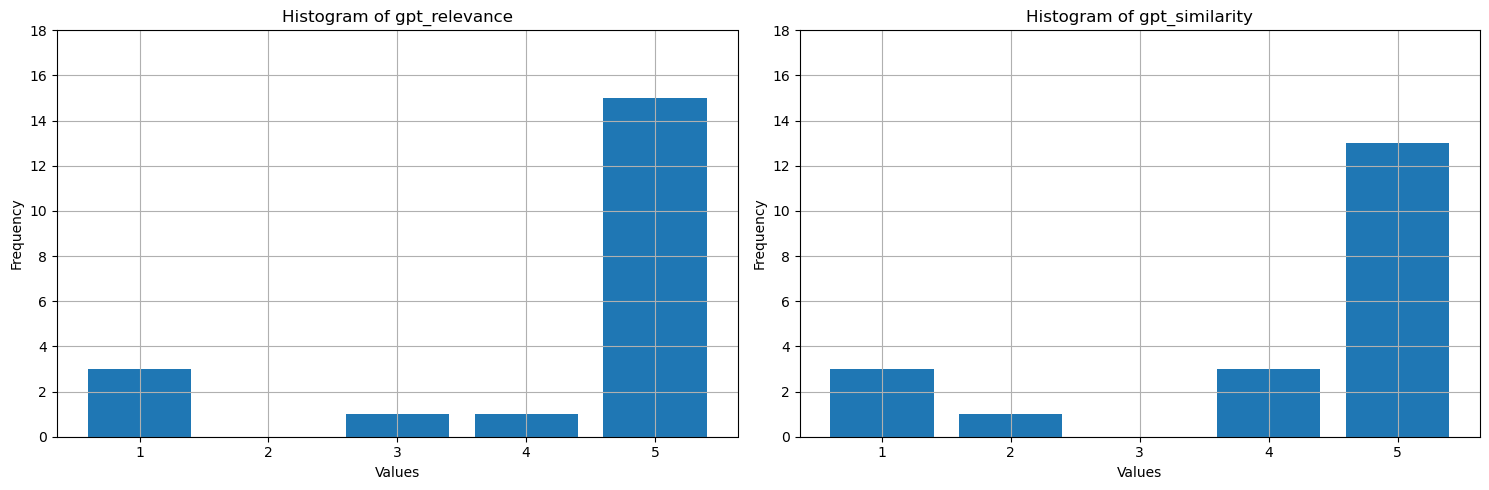
これらの値は何を示していますか? 解釈しやすくするために、地表性、関連性、類似性のヒストグラムをプロットします。 LLM は人間の回答の事実に基づく内容よりも詳細で、その結果、類似度指標が下がります。回答の約半分は意味的に正しいですが、類似しているものとして4つ星を受け取ります。 3 つのメトリックすべてに対するほとんどの値は 4 または 5 であり、RAG パフォーマンスが良好であることを示しています。 外れ値がいくつかあります。たとえば、質問How many species of otter are there?に対して、モデルが生成したThere are 13 species of otterは、関連性と類似性が非常に高く、正確です (5)。 何らかの理由で、GPTは提供されたコンテキストにおいて、根拠が不十分であると判断して1つ星を付けました。 1 つの星の少なくとも 1 つの AI 支援メトリックがある他の 3 つのケースでは、低スコアは不適切な回答を指しています。 LLM は時々誤ってスコアを評価しますが、通常は正確に評価します。
# Convert Spark DataFrame to Pandas DataFrame
pandas_df = df.toPandas()

selected_columns = ['gpt_groundedness', 'gpt_relevance', 'gpt_similarity']
trimmed_df = pandas_df[selected_columns].astype(int)

# Define a function to plot histograms for the specified columns
def plot_histograms(dataframe, columns):
    # Set up the figure size and subplots
    plt.figure(figsize=(15, 5))
    for i, column in enumerate(columns, 1):
        plt.subplot(1, len(columns), i)
        # Filter the dataframe to only include rows with values 1, 2, 3, 4, 5
        filtered_df = dataframe[dataframe[column].isin([1, 2, 3, 4, 5])]
        filtered_df[column].hist(bins=range(1, 7), align='left', rwidth=0.8)
        plt.title(f'Histogram of {column}')
        plt.xlabel('Values')
        plt.ylabel('Frequency')
        plt.xticks(range(1, 6))
        plt.yticks(range(0, 20, 2))


# Call the function to plot histograms for the specified columns
plot_histograms(trimmed_df, selected_columns)

# Show the plots
plt.tight_layout()
plt.show()
セルの出力:StatementMeta(, 21cb8cd3-7742-4c1f-8339-265e2846df1d, 24, Finished, Available, Finished)
最後の手順として、ベンチマーク結果を lakehouse のテーブルに保存します。 この手順は省略可能ですが、強くお勧めします。結果がより役に立ちます。 RAG で何かを変更する場合 (プロンプトの変更、インデックスの更新、応答ジェネレーターで別の GPT モデルの使用など)、影響を測定し、改善点を定量化し、回帰を検出します。
# create name of experiment that is easy to refer to
friendly_name_of_experiment = "rag_tutorial_experiment_1"

# Note the current date and time
time_of_experiment = current_timestamp()

# Generate a unique GUID for all rows
experiment_id = str(uuid.uuid4())

# Add two new columns to the Spark DataFrame
updated_df = df.withColumn("execution_time", time_of_experiment) \
                        .withColumn("experiment_id", lit(experiment_id)) \
                        .withColumn("experiment_friendly_name", lit(friendly_name_of_experiment))

# Store the updated DataFrame in the default lakehouse as a table named 'rag_experiment_runs'
table_name = "rag_experiment_run_demo1"
updated_df.write.format("parquet").mode("append").saveAsTable(table_name)
セルの出力:StatementMeta(, 21cb8cd3-7742-4c1f-8339-265e2846df1d, 28, Finished, Available, Finished)
実験の結果にいつでも戻り、それらを確認し、新しい実験と比較し、運用環境に最適な構成を選択します。
概要
AI 支援メトリックとトップ N 取得率を使用して、取得拡張生成 (RAG) ソリューションを構築します。