Notatka
Dostęp do tej strony wymaga autoryzacji. Może spróbować zalogować się lub zmienić katalogi.
Dostęp do tej strony wymaga autoryzacji. Możesz spróbować zmienić katalogi.
Aplikacja Obsługa wielokanałowa klientów dla Dynamics 365 oferuje zestaw funkcji, które rozszerzają możliwości Dynamics 365 Customer Service Enterprise, aby umożliwić organizacjom natychmiastowe łączenie się i interakcję z klientami za pośrednictwem cyfrowych kanałów komunikacji. Do uzyskania dostępu do plików sieciOwych w celu obsługa klienta jest wymagana dodatkowa licencja. Aby uzyskać więcej informacji, zobacz omówienie cennika usługi Dynamics 365 Customer Service i strony cennika Dynamics 365 Customer Service.
Ta metoda jest wymagana do zaimplementowania w zasobie internetowym. Ta metoda jest wywoływana dla każdej wiadomości konwersacji wymienianej między klientem a agentem, jeśli tłumaczenie jest włączone i jeśli wiadomość nie została przetłumaczona wcześniej w konwersacji dla języka docelowego.
Ważne
Zobacz ten przykładowy zasób internetowy , aby uzyskać więcej informacji na temat implementowania translateMessage interfejsu API.
Składnia
function (conversationId, translationConfig): Object
Parametry
| Name | Typ | Description |
|---|---|---|
translationConfig |
Obiekt JavaScript | Składa się z conversationIdpar , messagePayload i translateToC1orC2 klucz-wartość. |
Oto struktura translationConfig parametru.
export class UserType {
        public static readonly C1 = "Agent"; //Used if the sender of the message is agent
        public static readonly C2 = "Customer"; //Used if the sender of the message is customer
        public static readonly CONSULT = "Consult Agent"; //Used if the sender of the message is other than agent or customer
}

export class TranslateTo {
        public static readonly C1 = "Agent"; //Used if message is translated for agent
        public static readonly C2 = "Customer"; //Used if message is translated for customer
}

export class MessageContentType {
        public static readonly Text = "Text"; //Used if the content type is text
}

interface Sender {
        userType: UserType;  //Points to any static field in UserType type,Represents the type of the user who is sending this message
}

interface MessagePayload {
        content: string;                 //Contains the content to be translated
        contentType: MessageContentType;  //Points to any static field in MessageContentType type,Represents the type of message content. For example: "Text" etc.
        sender: Sender; //Implements Sender interface, Represents the sender of the message
}

interface translationConfig {
        conversationId: string;   //Unique Id for conversation in Omnichannel for Customer Service
        messagePayload: MessagePayload;  //Implements MessagePayload interface, Represents the payload for the message to be translated
        translateToC1orC2: TranslateTo;   //Points to any static field in TranslateTo type,Represents for whom the message has to be translated
 }
Oto przykładowy parametr.conversationConfig
translationConfig = {
  "conversationId": "2b330c52-6844-4d36-8e05-03c78c9681dc",
  "messagePayload": {
    "content": "Hello",
    "contentType": "Text",
    "sender": {
      "userType": "Agent"
    }
  },
  "translateToC1orC2": "Customer"
}
Wartość zwracana
Zwraca obietnicę, która jest rozpoznawana jako interfejs implementujący TranslatedMessageResponse obiekt JavaScript.
Obiekt interfejsu
export interface ErrorObject{
        isError: boolean; //mandatory field, represents true for error while executing this function else no
        errorCode: ErrorCodes; //mandatory field, represents the type of error based on errorCode
}

export interface TranslatedMessageResponse {
        translatedMessage: string;  //mandatory field, Contains the translated message
        sourceLanguage: string;       //mandatory field, represents the language locale of the original content
        destinationLanguage: string;  //mandatory field, represents the language locale of the translated content
        errorObject?: ErrorObject;  //optional field, represents the error object for any error scenarios
}
Parametr errorCode in ErrorObject reprezentuje błędy tylko z poniższej listy.
| Komunikat o błędzie | Kod błędu | Description |
|---|---|---|
| MESSAGE_TOO_LONG | 100 | Kod błędu dla bardzo długiej wiadomości, której usługa tłumaczenia nie może przetłumaczyć |
| LANGUAGE_NOT_SUPPORTED | 101 | Kod błędu dla języka, który nie jest obsługiwany przez usługę tłumaczenia |
| MESSAGE_NOT_TRANSLATED | 102 | Kod błędu dla wiadomości, która nie została przetłumaczona przez usługę tłumaczenia |
| TRANSLATION_SERVICE_LIMIT_EXCEEDED | 103 | Kod błędu w przypadku przekroczenia limitu przydziału dla usługi tłumaczeniowej |
| TRANSLATION_FAILED | 104 | Kod błędu, jeśli usługa tłumaczenia nie może przetłumaczyć komunikatu |
| UNRECOGNIZED_TEXT | 105 | Kod błędu, jeśli tekst nie jest rozpoznawany przez usługę tłumaczenia |
| UNRECOGNIZED_ERROR | 200 | Kod błędu, jeśli wystąpił błąd inny niż wymieniony. |
Parametr sourceLanguage and destinationLanguage w TranslatedMessageResponse interfejsie reprezentuje identyfikator ustawień regionalnych. Więcej informacji: Identyfikator ustawień regionalnych.
Przykładowa odpowiedź
{
  "translatedMessage": "Hola",
  "destinationLanguage": "3082",
  "errorObject": {
    "isError": false,
    "errorCode": null
  },
  "sourceLanguage": "3082"
}
Uwaga / Notatka
- W przypadku wyjątku podczas wykonywania tej metody, aplikacja Obsługa wielokanałowa dla Customer Service nie ponowi próby, a zamiast tego wyświetli komunikat o błędzie z nieudanym tłumaczeniem.
- Błąd podczas wykonywania tej metody można powiadomić za pomocą
errorObject. W przypadku wystąpienia błędu, aplikacja Obsługa wielokanałowa dla Customer Service nie ponowi próby, a zamiast tego wyświetli komunikat o błędzie na podstawie podanych kodów błędów. - W przypadku, gdy zwrócona odpowiedź jest nieprawidłowa lub niekompletna, w kontrolce konwersacji pojawi się komunikat o błędzie na banerze tłumaczenia.
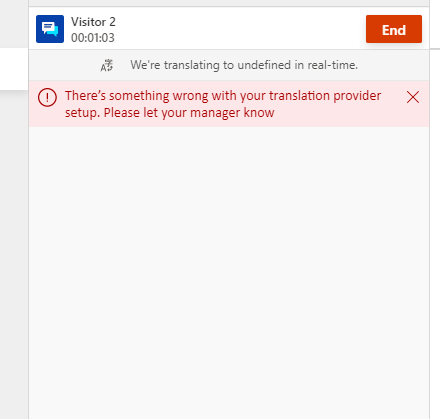
- Jeśli ta metoda nie zostanie zaimplementowana, komunikat nie zostanie przetłumaczony, a następujący komunikat o błędzie zostanie wyświetlony agentowi.
Informacje pokrewne
Dodawanie zasobu internetowego do tłumaczenia w czasie rzeczywistym