Notatka
Dostęp do tej strony wymaga autoryzacji. Może spróbować zalogować się lub zmienić katalogi.
Dostęp do tej strony wymaga autoryzacji. Możesz spróbować zmienić katalogi.
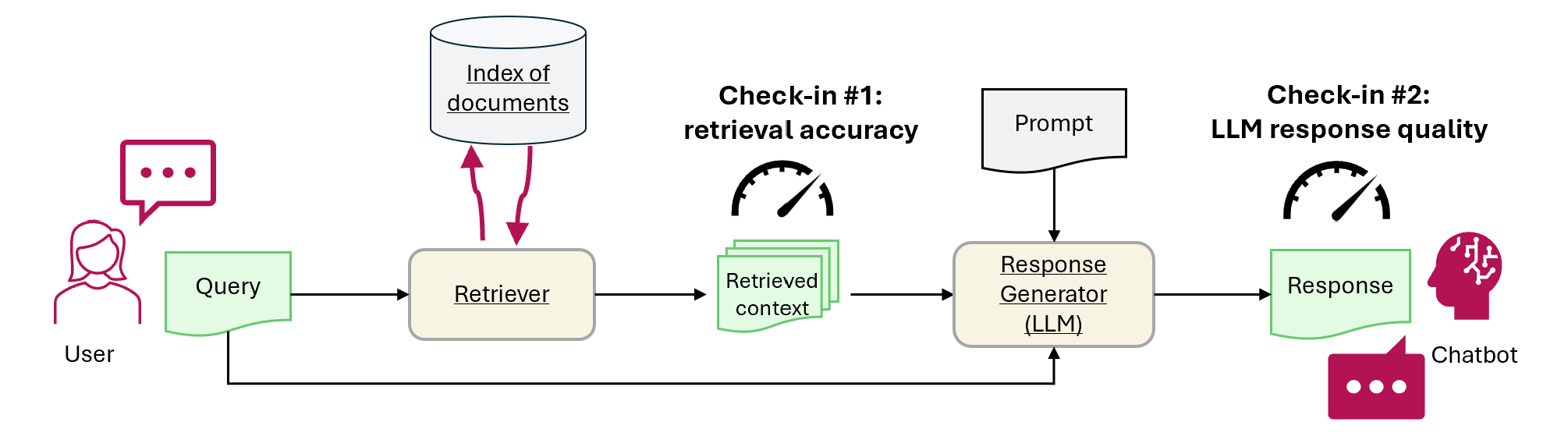
W tym samouczku pokazano, jak ocenić wydajność aplikacji RAG za pomocą Fabric. Ocena koncentruje się na dwóch głównych składnikach RAG: retriever (Azure AI Search) i generator odpowiedzi (LLM, który używa zapytania użytkownika, pobranego kontekstu i monitu o wygenerowanie odpowiedzi). Oto główne kroki:
- Konfigurowanie usług Azure OpenAI i Azure AI Search
- Załaduj dane z zestawu danych QA artykułów Wikipedii CMU w celu zbudowania benchmarku
- Uruchom test dymny z jednym zapytaniem, aby potwierdzić, że system RAG działa od początku do końca
- Definiowanie metryk deterministycznych i wspomaganych przez sztuczną inteligencję na potrzeby oceny
- Punkt kontrolny 1: Ocena wydajności mechanizmu wyszukiwania używając dokładności top-N
- Lista kontrolna 2: Ocena wydajności generatora odpowiedzi przy użyciu metryk uzasadnienia, istotności i podobieństwa
- Wizualizowanie i przechowywanie wyników oceny w usłudze OneLake na potrzeby przyszłej dokumentacji i bieżącej oceny
Wymagania wstępne
Przed rozpoczęciem tego samouczka ukończ przewodnik krok po kroku Budowanie Generacji Augmentowanej z Wyszukiwaniem w Fabric.
Do uruchomienia notesu potrzebne są następujące usługi:
- Microsoft Fabric
- Dodaj usługę Lakehouse do tego notesu (zawiera dane dodane w poprzednim samouczku).
- Azure AI Studio for OpenAI
- Azure AI Search (zawiera dane indeksowane w poprzednim samouczku).
W poprzednim samouczku przekazano dane do usługi Lakehouse i utworzono indeks dokumentów używany przez system RAG. Skorzystaj z indeksu w tym ćwiczeniu, aby nauczyć się kluczowych technik ewaluacji wydajności RAG i zidentyfikować potencjalne problemy. Jeśli indeks nie został utworzony lub usunięty, postępuj zgodnie z przewodnikiem Szybki start , aby spełnić wymagania wstępne.
Konfigurowanie dostępu do usług Azure OpenAI i Azure AI Search
Zdefiniuj punkty końcowe i wymagane klucze. Zaimportuj wymagane biblioteki i funkcje. Instancjonowanie klientów dla usług Azure OpenAI i Azure AI Search. Zdefiniuj otokę funkcji z monitem o zapytanie dotyczące systemu RAG.
# Enter your Azure OpenAI service values
aoai_endpoint = "https://<your-resource-name>.openai.azure.com" # TODO: Provide the Azure OpenAI resource endpoint (replace <your-resource-name>)
aoai_key = "" # TODO: Fill in your API key from Azure OpenAI
aoai_deployment_name_embeddings = "text-embedding-ada-002"
aoai_model_name_query = "gpt-4-32k"
aoai_model_name_metrics = "gpt-4-32k"
aoai_api_version = "2024-02-01"

# Setup key accesses to Azure AI Search
aisearch_index_name = "" # TODO: Create a new index name: must only contain lowercase, numbers, and dashes
aisearch_api_key = "" # TODO: Fill in your API key from Azure AI Search
aisearch_endpoint = "https://.search.windows.net" # TODO: Provide the url endpoint for your created Azure AI Search
import warnings
warnings.filterwarnings("ignore", category=DeprecationWarning)

import os, requests, json

from datetime import datetime, timedelta
from azure.core.credentials import AzureKeyCredential
from azure.search.documents import SearchClient

from pyspark.sql import functions as F
from pyspark.sql.functions import to_timestamp, current_timestamp, concat, col, split, explode, udf, monotonically_increasing_id, when, rand, coalesce, lit, input_file_name, regexp_extract, concat_ws, length, ceil
from pyspark.sql.types import StructType, StructField, StringType, IntegerType, TimestampType, ArrayType, FloatType
from pyspark.sql import Row
import pandas as pd
from azure.search.documents.indexes import SearchIndexClient
from azure.search.documents.models import (
    VectorizedQuery,
)
from azure.search.documents.indexes.models import (
    SearchIndex,
    SearchField,
    SearchFieldDataType,
    SimpleField,
    SearchableField,
    SemanticConfiguration,
    SemanticPrioritizedFields,
    SemanticField,
    SemanticSearch,
    VectorSearch,
    HnswAlgorithmConfiguration,
    HnswParameters,
    VectorSearchProfile,
    VectorSearchAlgorithmKind,
    VectorSearchAlgorithmMetric,
)

import openai
from openai import AzureOpenAI
import uuid
import matplotlib.pyplot as plt
from synapse.ml.featurize.text import PageSplitter
import ipywidgets as widgets
from IPython.display import display as w_display
Wynik komórki:StatementMeta(, 21cb8cd3-7742-4c1f-8339-265e2846df1d, 6, Finished, Available, Finished)
# Configure access to OpenAI endpoint
openai.api_type = "azure"
openai.api_key = aoai_key
openai.api_base = aoai_endpoint
openai.api_version = aoai_api_version

# Create client for accessing embedding endpoint
embed_client = AzureOpenAI(
    api_version=aoai_api_version,
    azure_endpoint=aoai_endpoint,
    api_key=aoai_key,
)

# Create client for accessing chat endpoint
chat_client = AzureOpenAI(
    azure_endpoint=aoai_endpoint,
    api_key=aoai_key,
    api_version=aoai_api_version,
)

# Configure access to Azure AI Search
search_client = SearchClient(
    aisearch_endpoint,
    aisearch_index_name,
    credential=AzureKeyCredential(aisearch_api_key)
)
Wynik komórki:StatementMeta(, 21cb8cd3-7742-4c1f-8339-265e2846df1d, 7, Finished, Available, Finished)
Następujące funkcje implementują dwa główne składniki RAG — retriever (get_context_source) i generator odpowiedzi (get_answer). Kod jest podobny do poprzedniego samouczka. Parametr topN umożliwia ustawienie liczby odpowiednich zasobów do pobrania (w tym samouczku jest używana wartość 3, ale optymalna wartość może się różnić w zależności od zestawu danych):
# Implement retriever
def get_context_source(question, topN=3):
    """
    Retrieves contextual information and sources related to a given question using embeddings and a vector search.
    Parameters:
    question (str): The question for which the context and sources are to be retrieved.
    topN (int, optional): The number of top results to retrieve. Default is 3.

    Returns:
    List: A list containing two elements:
        1. A string with the concatenated retrieved context.
        2. A list of retrieved source paths.
    """
    embed_client = openai.AzureOpenAI(
        api_version=aoai_api_version,
        azure_endpoint=aoai_endpoint,
        api_key=aoai_key,
    )

    query_embedding = embed_client.embeddings.create(input=question, model=aoai_deployment_name_embeddings).data[0].embedding

    vector_query = VectorizedQuery(vector=query_embedding, k_nearest_neighbors=topN, fields="Embedding")

    results = search_client.search(
        vector_queries=[vector_query],
        top=topN,
    )

    retrieved_context = ""
    retrieved_sources = []
    for result in results:
        retrieved_context += result['ExtractedPath'] + "\n" + result['Chunk'] + "\n\n"
        retrieved_sources.append(result['ExtractedPath'])

    return [retrieved_context, retrieved_sources]

# Implement response generator
def get_answer(question, context):
    """
    Generates a response to a given question using provided context and an Azure OpenAI model.

    Parameters:
        question (str): The question that needs to be answered.
        context (str): The contextual information related to the question that will help generate a relevant response.

    Returns:
        str: The response generated by the Azure OpenAI model based on the provided question and context.
    """
    messages = [
        {
            "role": "system",
            "content": "You are a chat assistant. Use provided text to ground your response. Give a one-word answer when possible ('yes'/'no' is OK where appropriate, no details). Unnecessary words incur a $500 penalty."
        }
    ]

    messages.append(
        {
            "role": "user",
            "content": question + "\n" + context,
        },
    )

    chat_client = openai.AzureOpenAI(
        azure_endpoint=aoai_endpoint,
        api_key=aoai_key,
        api_version=aoai_api_version,
    )

    chat_completion = chat_client.chat.completions.create(
        model=aoai_model_name_query,
        messages=messages,
    )

    return chat_completion.choices[0].message.content
Wynik komórki:StatementMeta(, 21cb8cd3-7742-4c1f-8339-265e2846df1d, 8, Finished, Available, Finished)
Dataset
Wersja 1.2 zestawu danych Carnegie Mellon University Question-Answer jest korpusem artykułów Wikipedii z faktycznymi pytaniami i odpowiedziami napisanymi ręcznie. Jest hostowana w usłudze Azure Blob Storage w ramach GFDL. Zestaw danych używa jednej tabeli z następującymi polami:
-
ArticleTitle: Nazwa artykułu w Wikipedii, z których pochodzą pytania i odpowiedzi -
Question: Ręcznie napisane pytanie dotyczące artykułu -
Answer: Ręcznie napisana odpowiedź na podstawie artykułu -
DifficultyFromQuestioner: Ocena trudności przypisana przez autora pytania -
DifficultyFromAnswerer: Ocena trudności, którą przypisuje ewaluator, może różnić się odDifficultyFromQuestioner -
ExtractedPath: Ścieżka do oryginalnego artykułu (artykuł może zawierać wiele par odpowiedzi na pytania) -
text: Oczyszczony tekst artykułu w Wikipedii
Pobierz pliki LICENSE-S08 i LICENSE-S09 z tej samej lokalizacji, aby uzyskać szczegółowe informacje o licencji.
Historia i cytat
Użyj tego cytatu dla zestawu danych:
CMU Question/Answer Dataset, Release 1.2
August 23, 2013
Noah A. Smith, Michael Heilman, and Rebecca Hwa
Question Generation as a Competitive Undergraduate Course Project
In Proceedings of the NSF Workshop on the Question Generation Shared Task and Evaluation Challenge, Arlington, VA, September 2008.
Available at http://www.cs.cmu.edu/~nasmith/papers/smith+heilman+hwa.nsf08.pdf.
Original dataset acknowledgments:
This research project was supported by NSF IIS-0713265 (to Smith), an NSF Graduate Research Fellowship (to Heilman), NSF IIS-0712810 and IIS-0745914 (to Hwa), and Institute of Education Sciences, U.S. Department of Education R305B040063 (to Carnegie Mellon).
cmu-qa-08-09 (modified version)
June 12, 2024
Amir Jafari, Alexandra Savelieva, Brice Chung, Hossein Khadivi Heris, Journey McDowell
This release uses the GNU Free Documentation License (GFDL) (http://www.gnu.org/licenses/fdl.html).
The GNU license applies to all copies of the dataset.
Tworzenie testu porównawczego
Zaimportuj test porównawczy. Na potrzeby tego pokazu użyj podzbioru pytań z grup S08/set1 i S08/set2. Aby zachować jedno pytanie na artykuł, zastosuj polecenie df.dropDuplicates(["ExtractedPath"]). Upuść zduplikowane pytania. Proces curation dodaje etykiety trudności; ten przykład ogranicza je do medium.
df = spark.sql("SELECT * FROM data_load_tests.cmu_qa")

# Filter the DataFrame to include the specified paths
df = df.filter((col("ExtractedPath").like("S08/data/set1/%")) | (col("ExtractedPath").like("S08/data/set2/%")))

# Keep only medium-difficulty questions.
df = df.filter(col("DifficultyFromQuestioner") == "medium")


# Drop duplicate questions and source paths.
df = df.dropDuplicates(["Question"])
df = df.dropDuplicates(["ExtractedPath"])

num_rows = df.count()
num_columns = len(df.columns)
print(f"Number of rows: {num_rows}, Number of columns: {num_columns}")

# Persist the DataFrame
df.persist()
display(df)
Dane wyjściowe komórki:StatementMeta(, 21cb8cd3-7742-4c1f-8339-265e2846df1d, 9, Finished, Available, Finished)Number of rows: 20, Number of columns: 7SynapseWidget(Synapse.DataFrame, 47aff8cb-72f8-4a36-885c-f4f3bb830a91)
Wynikiem jest DataFrame z 20 wierszami — próbny test porównawczy. Kluczowe pola to Question, Answer (wyselekcjonowane przez człowieka odpowiedzi na prawdę naziemną) i ExtractedPath (dokument źródłowy). Dostosuj filtry, aby uwzględnić inne pytania i różnić trudności w bardziej realistycznym przykładzie. Wypróbuj.
Uruchom prosty test od początku do końca
Zacznij od kompleksowego smoke testu generacji wspomaganej wyszukiwaniem (RAG).
question = "How many suborders are turtles divided into?"
retrieved_context, retrieved_sources = get_context_source(question)
answer = get_answer(question, retrieved_context)
print(answer)
Wynik komórki:StatementMeta(, 21cb8cd3-7742-4c1f-8339-265e2846df1d, 10, Finished, Available, Finished)Three
Ten test dymny pomaga znaleźć problemy w implementacji RAG, takie jak nieprawidłowe poświadczenia, brakujący lub pusty indeks wektorowy, lub niezgodne interfejsy funkcji. Jeśli test zakończy się niepowodzeniem, sprawdź, czy występują problemy. Oczekiwane dane wyjściowe: Three. Jeśli test smoke zakończy się pomyślnie, przejdź do następnej sekcji, aby dokładniej ocenić RAG.
Ustanawianie metryk
Zdefiniuj metrykę deterministyczną do oceny systemu wyszukiwania. Jest to inspirowane wyszukiwarkami. Sprawdza, czy lista pobranych źródeł zawiera źródło prawdy podstawowej. Ta metryka jest wynikiem dokładności typu top-N, ponieważ parametr topN ustala liczbę pobranych źródeł.
def get_retrieval_score(target_source, retrieved_sources):
    if target_source in retrieved_sources:
        return 1
    else:
        return 0
Wynik komórki:StatementMeta(, 21cb8cd3-7742-4c1f-8339-265e2846df1d, 11, Finished, Available, Finished)
Zgodnie z testem porównawczym odpowiedź jest zawarta w źródle o identyfikatorze "S08/data/set1/a9". Testowanie funkcji w przykładzie, który uruchomiliśmy powyżej, zwraca wartość 1, zgodnie z oczekiwaniami, ponieważ znajdowała się ona w trzech najważniejszych fragmentach tekstu.
print("Retrieved sources:", retrieved_sources)
get_retrieval_score("S08/data/set1/a9", retrieved_sources)
Dane wyjściowe komórki:StatementMeta(, 21cb8cd3-7742-4c1f-8339-265e2846df1d, 12, Finished, Available, Finished)Retrieved sources: ['S08/data/set1/a9', 'S08/data/set1/a9', 'S08/data/set1/a5']1
W tej sekcji zdefiniowano metryki wspomagane przez sztuczną inteligencję. Szablon monitu zawiera kilka przykładów danych wejściowych (CONTEXT i ANSWER) i sugerowanych danych wyjściowych — nazywanych również modelem kilku zdjęć. Jest to ten sam monit, który jest używany w programie Azure AI Studio. Dowiedz się więcej w artykule Wbudowane metryki oceny. W tym demonstracyjnym przypadku użyto metryk groundedness i relevance — są one zwykle najbardziej przydatne i niezawodne do oceny modeli GPT. Inne metryki mogą być przydatne, ale zapewniają mniej intuicji — na przykład odpowiedzi nie muszą być podobne do poprawnych, więc similarity wyniki mogą być mylące. Skala wszystkich metryk wynosi od 1 do 5. Wyższe jest lepsze. Groundedness przyjmuje tylko dwa dane wejściowe (kontekst i wygenerowana odpowiedź), podczas gdy pozostałe dwie metryki używają również podstawy prawdy do oceny.
def get_groundedness_metric(context, answer):
    """Get the groundedness score from the LLM using the context and answer."""

    groundedness_prompt_template = """
    You are presented with a CONTEXT and an ANSWER about that CONTEXT. Decide whether the ANSWER is entailed by the CONTEXT by choosing one of the following ratings:
    1. 5: The ANSWER follows logically from the information contained in the CONTEXT.
    2. 1: The ANSWER is logically false from the information contained in the CONTEXT.
    3. an integer score between 1 and 5 and if such integer score does not exist, use 1: It is not possible to determine whether the ANSWER is true or false without further information. Read the passage of information thoroughly and select the correct answer from the three answer labels. Read the CONTEXT thoroughly to ensure you know what the CONTEXT entails. Note the ANSWER is generated by a computer system, it can contain certain symbols, which should not be a negative factor in the evaluation.
    Independent Examples:
    ## Example Task #1 Input:
    "CONTEXT": "Some are reported as not having been wanted at all.", "QUESTION": "", "ANSWER": "All are reported as being completely and fully wanted."
    ## Example Task #1 Output:
    1
    ## Example Task #2 Input:
    "CONTEXT": "Ten new television shows appeared during the month of September. Five of the shows were sitcoms, three were hourlong dramas, and two were news-magazine shows. By January, only seven of these new shows were still on the air. Five of the shows that remained were sitcoms.", "QUESTION": "", "ANSWER": "At least one of the shows that were cancelled was an hourlong drama."
    ## Example Task #2 Output:
    5
    ## Example Task #3 Input:
    "CONTEXT": "In Quebec, an allophone is a resident, usually an immigrant, whose mother tongue or home language is neither French nor English.", "QUESTION": "", "ANSWER": "In Quebec, an allophone is a resident, usually an immigrant, whose mother tongue or home language is not French."
    5
    ## Example Task #4 Input:
    "CONTEXT": "Some are reported as not having been wanted at all.", "QUESTION": "", "ANSWER": "All are reported as being completely and fully wanted."
    ## Example Task #4 Output:
    1
    ## Actual Task Input:
    "CONTEXT": {context}, "QUESTION": "", "ANSWER": {answer}
    Reminder: The return values for each task should be correctly formatted as an integer between 1 and 5. Do not repeat the context and question.  Don't explain the reasoning. The answer should include only a number: 1, 2, 3, 4, or 5.
    Actual Task Output:
    """

    metric_client = openai.AzureOpenAI(
        api_version=aoai_api_version,
        azure_endpoint=aoai_endpoint,
        api_key=aoai_key,
    )

    messages = [
        {
            "role": "system",
            "content": "You are an AI assistant. You will be given the definition of an evaluation metric for assessing the quality of an answer in a question-answering task. Your job is to compute an accurate evaluation score using the provided evaluation metric."
        },
        {
            "role": "user",
            "content": groundedness_prompt_template.format(context=context, answer=answer)
        }
    ]

    metric_completion = metric_client.chat.completions.create(
        model=aoai_model_name_metrics,
        messages=messages,
        temperature=0,
    )

    return metric_completion.choices[0].message.content
Wynik komórki:StatementMeta(, 21cb8cd3-7742-4c1f-8339-265e2846df1d, 13, Finished, Available, Finished)
def get_relevance_metric(context, question, answer):
    relevance_prompt_template = """
    Relevance measures how well the answer addresses the main aspects of the question, based on the context. Consider whether all and only the important aspects are contained in the answer when evaluating relevance. Given the context and question, score the relevance of the answer between one to five stars using the following rating scale:
    One star: the answer completely lacks relevance
    Two stars: the answer mostly lacks relevance
    Three stars: the answer is partially relevant
    Four stars: the answer is mostly relevant
    Five stars: the answer has perfect relevance

    This rating value should always be an integer between 1 and 5. So the rating produced should be 1 or 2 or 3 or 4 or 5.

    context: Marie Curie was a Polish-born physicist and chemist who pioneered research on radioactivity and was the first woman to win a Nobel Prize.
    question: What field did Marie Curie excel in?
    answer: Marie Curie was a renowned painter who focused mainly on impressionist styles and techniques.
    stars: 1

    context: The Beatles were an English rock band formed in Liverpool in 1960, and they are widely regarded as the most influential music band in history.
    question: Where were The Beatles formed?
    answer: The band The Beatles began their journey in London, England, and they changed the history of music.
    stars: 2

    context: The recent Mars rover, Perseverance, was launched in 2020 with the main goal of searching for signs of ancient life on Mars. The rover also carries an experiment called MOXIE, which aims to generate oxygen from the Martian atmosphere.
    question: What are the main goals of Perseverance Mars rover mission?
    answer: The Perseverance Mars rover mission focuses on searching for signs of ancient life on Mars.
    stars: 3

    context: The Mediterranean diet is a commonly recommended dietary plan that emphasizes fruits, vegetables, whole grains, legumes, lean proteins, and healthy fats. Studies have shown that it offers numerous health benefits, including a reduced risk of heart disease and improved cognitive health.
    question: What are the main components of the Mediterranean diet?
    answer: The Mediterranean diet primarily consists of fruits, vegetables, whole grains, and legumes.
    stars: 4

    context: The Queen's Royal Castle is a well-known tourist attraction in the United Kingdom. It spans over 500 acres and contains extensive gardens and parks. The castle was built in the 15th century and has been home to generations of royalty.
    question: What are the main attractions of the Queen's Royal Castle?
    answer: The main attractions of the Queen's Royal Castle are its expansive 500-acre grounds, extensive gardens, parks, and the historical castle itself, which dates back to the 15th century and has housed generations of royalty.
    stars: 5

    Don't explain the reasoning. The answer should include only a number: 1, 2, 3, 4, or 5.

    context: {context}
    question: {question}
    answer: {answer}
    stars:
    """

    metric_client = openai.AzureOpenAI(
        api_version=aoai_api_version,
        azure_endpoint=aoai_endpoint,
        api_key=aoai_key,
    )


    messages = [
        {
            "role": "system",
            "content": "You are an AI assistant. You are given the definition of an evaluation metric for assessing the quality of an answer in a question-answering task. Compute an accurate evaluation score using the provided evaluation metric."
        },
        {
            "role": "user",
            "content": relevance_prompt_template.format(context=context, question=question, answer=answer)
        }
    ]

    metric_completion = metric_client.chat.completions.create(
        model=aoai_model_name_metrics,
        messages=messages,
        temperature=0,
    )

    return metric_completion.choices[0].message.content
Wynik komórki:StatementMeta(, 21cb8cd3-7742-4c1f-8339-265e2846df1d, 14, Finished, Available, Finished)
def get_similarity_metric(question, ground_truth, answer):
    similarity_prompt_template = """
    Equivalence, as a metric, measures the similarity between the predicted answer and the correct answer. If the information and content in the predicted answer is similar or equivalent to the correct answer, then the value of the Equivalence metric should be high, else it should be low. Given the question, correct answer, and predicted answer, determine the value of Equivalence metric using the following rating scale:
    One star: the predicted answer is not at all similar to the correct answer
    Two stars: the predicted answer is mostly not similar to the correct answer
    Three stars: the predicted answer is somewhat similar to the correct answer
    Four stars: the predicted answer is mostly similar to the correct answer
    Five stars: the predicted answer is completely similar to the correct answer

    This rating value should always be an integer between 1 and 5. So the rating produced should be 1 or 2 or 3 or 4 or 5.

    The examples below show the Equivalence score for a question, a correct answer, and a predicted answer.

    question: What is the role of ribosomes?
    correct answer: Ribosomes are cellular structures responsible for protein synthesis. They interpret the genetic information carried by messenger RNA (mRNA) and use it to assemble amino acids into proteins.
    predicted answer: Ribosomes participate in carbohydrate breakdown by removing nutrients from complex sugar molecules.
    stars: 1

    question: Why did the Titanic sink?
    correct answer: The Titanic sank after it struck an iceberg during its maiden voyage in 1912. The impact caused the ship's hull to breach, allowing water to flood into the vessel. The ship's design, lifeboat shortage, and lack of timely rescue efforts contributed to the tragic loss of life.
    predicted answer: The sinking of the Titanic was a result of a large iceberg collision. This caused the ship to take on water and eventually sink, leading to the death of many passengers due to a shortage of lifeboats and insufficient rescue attempts.
    stars: 2

    question: What causes seasons on Earth?
    correct answer: Seasons on Earth are caused by the tilt of the Earth's axis and its revolution around the Sun. As the Earth orbits the Sun, the tilt causes different parts of the planet to receive varying amounts of sunlight, resulting in changes in temperature and weather patterns.
    predicted answer: Seasons occur because of the Earth's rotation and its elliptical orbit around the Sun. The tilt of the Earth's axis causes regions to be subjected to different sunlight intensities, which leads to temperature fluctuations and alternating weather conditions.
    stars: 3

    question: How does photosynthesis work?
    correct answer: Photosynthesis is a process by which green plants and some other organisms convert light energy into chemical energy. This occurs as light is absorbed by chlorophyll molecules, and then carbon dioxide and water are converted into glucose and oxygen through a series of reactions.
    predicted answer: In photosynthesis, sunlight is transformed into nutrients by plants and certain microorganisms. Light is captured by chlorophyll molecules, followed by the conversion of carbon dioxide and water into sugar and oxygen through multiple reactions.
    stars: 4

    question: What are the health benefits of regular exercise?
    correct answer: Regular exercise can help maintain a healthy weight, increase muscle and bone strength, and reduce the risk of chronic diseases. It also promotes mental well-being by reducing stress and improving overall mood.
    predicted answer: Routine physical activity can contribute to maintaining ideal body weight, enhancing muscle and bone strength, and preventing chronic illnesses. In addition, it supports mental health by alleviating stress and augmenting general mood.
    stars: 5

    Don't explain the reasoning. The answer should include only a number: 1, 2, 3, 4, or 5.

    question: {question}
    correct answer:{ground_truth}
    predicted answer: {answer}
    stars:
    """

    metric_client = openai.AzureOpenAI(
        api_version=aoai_api_version,
        azure_endpoint=aoai_endpoint,
        api_key=aoai_key,
    )

    messages = [
        {
            "role": "system",
            "content": "You are an AI assistant. You will be given the definition of an evaluation metric for assessing the quality of an answer in a question-answering task. Your job is to compute an accurate evaluation score using the provided evaluation metric."
        },
        {
            "role": "user",
            "content": similarity_prompt_template.format(question=question, ground_truth=ground_truth, answer=answer)
        }
    ]

    metric_completion = metric_client.chat.completions.create(
        model=aoai_model_name_metrics,
        messages=messages,
        temperature=0,
    )

    return metric_completion.choices[0].message.content
Wynik komórki:StatementMeta(, 21cb8cd3-7742-4c1f-8339-265e2846df1d, 15, Finished, Available, Finished)
Testowanie metryki istotności:
get_relevance_metric(retrieved_context, question, answer)
Wynik komórki:StatementMeta(, 21cb8cd3-7742-4c1f-8339-265e2846df1d, 16, Finished, Available, Finished)'2'
Wynik 5 oznacza, że odpowiedź jest odpowiednia. Następujący kod pobiera metrykę podobieństwa:
get_similarity_metric(question, 'three', answer)
Wynik komórki:StatementMeta(, 21cb8cd3-7742-4c1f-8339-265e2846df1d, 17, Finished, Available, Finished)'5'
Wynik 5 oznacza, że odpowiedź pasuje do odpowiedzi zgodnej z rzeczywistością opracowanej przez eksperta. Wyniki metryk wspomagane przez sztuczną inteligencję mogą się zmieniać przy użyciu tych samych danych wejściowych. Są one szybsze niż korzystanie z sędziów ludzkich.
Ocena wydajności RAG na benchmarku Pytań i Odpowiedzi
Twórz opakowania funkcji do uruchamiania na dużą skalę. Opatul każdą funkcję kończącą się na _udf (skrót od user-defined function), aby spełniała wymagania Spark i szybciej uruchamiała obliczenia na dużych zbiorach danych w klastrach.
# UDF wrappers for RAG components
@udf(returnType=StructType([
    StructField("retrieved_context", StringType(), True),
    StructField("retrieved_sources", ArrayType(StringType()), True)
]))
def get_context_source_udf(question, topN=3):
    return get_context_source(question, topN)

@udf(returnType=StringType())
def get_answer_udf(question, context):
    return get_answer(question, context)


# UDF wrapper for retrieval score
@udf(returnType=StringType())
def get_retrieval_score_udf(target_source, retrieved_sources):
    return get_retrieval_score(target_source, retrieved_sources)


# UDF wrappers for AI-assisted metrics
@udf(returnType=StringType())
def get_groundedness_metric_udf(context, answer):
    return get_groundedness_metric(context, answer)

@udf(returnType=StringType())
def get_relevance_metric_udf(context, question, answer):
    return get_relevance_metric(context, question, answer)

@udf(returnType=StringType())
def get_similarity_metric_udf(question, ground_truth, answer):
    return get_similarity_metric(question, ground_truth, answer)
Wynik komórki:StatementMeta(, 21cb8cd3-7742-4c1f-8339-265e2846df1d, 18, Finished, Available, Finished)
Sprawdzenie nr 1: wydajność modułu pobierającego
Poniższy kod tworzy kolumny result i retrieval_score w ramce danych benchmarku. Te kolumny obejmują odpowiedź wygenerowaną przez RAG oraz wskaźnik tego, czy kontekst dostarczony do LLM zawiera artykuł, na którym opiera się pytanie.
df = df.withColumn("result", get_context_source_udf(df.Question)).select(df.columns+["result.*"])
df = df.withColumn('retrieval_score', get_retrieval_score_udf(df.ExtractedPath, df.retrieved_sources))
print("Aggregate Retrieval score: {:.2f}%".format((df.where(df["retrieval_score"] == 1).count() / df.count()) * 100))
display(df.select(["question", "retrieval_score",  "ExtractedPath", "retrieved_sources"]))
Dane wyjściowe komórki:StatementMeta(, 21cb8cd3-7742-4c1f-8339-265e2846df1d, 19, Finished, Available, Finished)Aggregate Retrieval score: 100.00%SynapseWidget(Synapse.DataFrame, 14efe386-836a-4765-bd88-b121f32c7cfc)
W przypadku wszystkich pytań program retriever pobiera prawidłowy kontekst, a w większości przypadków jest to pierwszy wpis. Usługa Azure AI Search działa dobrze. Możesz się zastanawiać, dlaczego w niektórych przypadkach kontekst ma dwie lub trzy identyczne wartości. To nie jest błąd — oznacza to, że moduł pobierający wybiera fragmenty tego samego artykułu, które nie mieszczą się w jednym kawałku podczas jego dzielenia na części.
Sprawdzenie nr 2: wydajność generatora odpowiedzi
Przekaż pytanie i kontekst do usługi LLM, aby wygenerować odpowiedź. Zapisz ją w kolumnie generated_answer w ramce danych:
df = df.withColumn('generated_answer', get_answer_udf(df.Question, df.retrieved_context))
Wynik komórki:StatementMeta(, 21cb8cd3-7742-4c1f-8339-265e2846df1d, 20, Finished, Available, Finished)
Użyj wygenerowanej odpowiedzi, odpowiedzi prawdziwej, pytania i kontekstu, żeby obliczyć metryki. Wyświetl wyniki oceny dla każdej pary pytań i odpowiedzi:
df = df.withColumn('gpt_groundedness', get_groundedness_metric_udf(df.retrieved_context, df.generated_answer))
df = df.withColumn('gpt_relevance', get_relevance_metric_udf(df.retrieved_context, df.Question, df.generated_answer))
df = df.withColumn('gpt_similarity', get_similarity_metric_udf(df.Question, df.Answer, df.generated_answer))
display(df.select(["question", "answer", "generated_answer", "retrieval_score", "gpt_groundedness","gpt_relevance", "gpt_similarity"]))
Wynik komórki:StatementMeta(, 21cb8cd3-7742-4c1f-8339-265e2846df1d, 21, Finished, Available, Finished)SynapseWidget(Synapse.DataFrame, 22b97d27-91e1-40f3-b888-3a3399de9d6b)
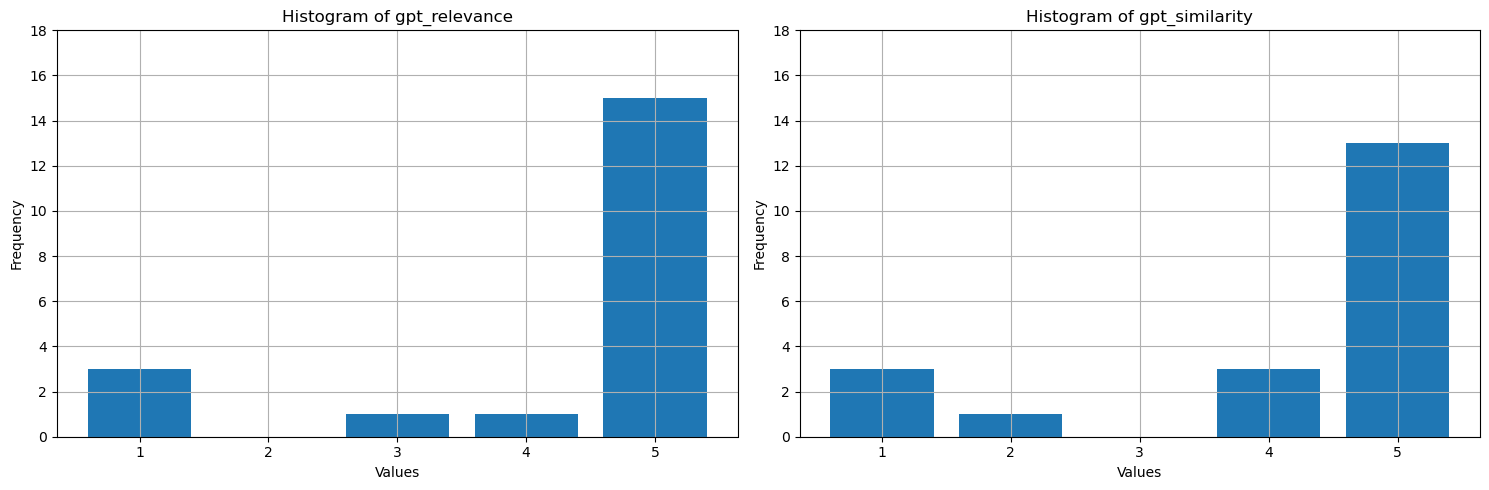
Co pokazują te wartości? Aby ułatwić ich interpretację, wykreślij histogramy podstaw, istotności i podobieństwa. LLM jest bardziej rozwlekły niż ludzkie odpowiedzi źródłowe, co obniża metryki podobieństwa - około połowa odpowiedzi jest semantycznie poprawna, ale otrzymuje cztery gwiazdki za przeważnie podobne. Większość wartości dla wszystkich trzech metryk to 4 lub 5, co sugeruje, że wydajność rag jest dobra. Istnieje kilka wartości odstających — na przykład dla pytania How many species of otter are there?, wygenerowany There are 13 species of ottermodel jest poprawny z wysoką istotnością i podobieństwem (5). Z jakiegoś powodu GPT uznał go za słabo zakorzeniony w podanym kontekście i dał mu jedną gwiazdę. W pozostałych trzech przypadkach, z co najmniej jedną metryką wspomaganą przez sztuczną inteligencję ocenioną na jedną gwiazdkę, niska ocena wskazuje niewłaściwą odpowiedź. LLM od czasu do czasu błędnie ocenia, ale zwykle robi to poprawnie.
# Convert Spark DataFrame to Pandas DataFrame
pandas_df = df.toPandas()

selected_columns = ['gpt_groundedness', 'gpt_relevance', 'gpt_similarity']
trimmed_df = pandas_df[selected_columns].astype(int)

# Define a function to plot histograms for the specified columns
def plot_histograms(dataframe, columns):
    # Set up the figure size and subplots
    plt.figure(figsize=(15, 5))
    for i, column in enumerate(columns, 1):
        plt.subplot(1, len(columns), i)
        # Filter the dataframe to only include rows with values 1, 2, 3, 4, 5
        filtered_df = dataframe[dataframe[column].isin([1, 2, 3, 4, 5])]
        filtered_df[column].hist(bins=range(1, 7), align='left', rwidth=0.8)
        plt.title(f'Histogram of {column}')
        plt.xlabel('Values')
        plt.ylabel('Frequency')
        plt.xticks(range(1, 6))
        plt.yticks(range(0, 20, 2))


# Call the function to plot histograms for the specified columns
plot_histograms(trimmed_df, selected_columns)

# Show the plots
plt.tight_layout()
plt.show()
Wynik komórki:StatementMeta(, 21cb8cd3-7742-4c1f-8339-265e2846df1d, 24, Finished, Available, Finished)
W ostatnim kroku zapisz wyniki testu porównawczego w tabeli w lakehouse. Ten krok jest opcjonalny, ale zdecydowanie zalecany — sprawia, że wyniki są bardziej przydatne. Gdy zmienisz coś w narzędziu RAG (na przykład zmodyfikuj monit, zaktualizuj indeks lub użyj innego modelu GPT w generatorze odpowiedzi), zmierz wpływ, kwantyfikuj ulepszenia i wykryj regresje.
# create name of experiment that is easy to refer to
friendly_name_of_experiment = "rag_tutorial_experiment_1"

# Note the current date and time
time_of_experiment = current_timestamp()

# Generate a unique GUID for all rows
experiment_id = str(uuid.uuid4())

# Add two new columns to the Spark DataFrame
updated_df = df.withColumn("execution_time", time_of_experiment) \
                        .withColumn("experiment_id", lit(experiment_id)) \
                        .withColumn("experiment_friendly_name", lit(friendly_name_of_experiment))

# Store the updated DataFrame in the default lakehouse as a table named 'rag_experiment_runs'
table_name = "rag_experiment_run_demo1"
updated_df.write.format("parquet").mode("append").saveAsTable(table_name)
Wynik komórki:StatementMeta(, 21cb8cd3-7742-4c1f-8339-265e2846df1d, 28, Finished, Available, Finished)
Wróć do wyników eksperymentu w dowolnym momencie, aby je przejrzeć, porównać z nowymi eksperymentami i wybrać konfigurację, która działa najlepiej w środowisku produkcyjnym.
Podsumowanie
Użyj metryk z wykorzystaniem sztucznej inteligencji i wskaźnika odzyskiwania top-N, aby utworzyć rozwiązanie typu RAG z rozszerzonym odzyskiwaniem danych.