APLICA-SE A: CLI do Azure ml extension v2 (current)Python SDK azure-ai-ml v2 (current)
Neste artigo, aprende como ligar-se a serviços de armazenamento de dados Azure usando os datastores Azure Machine Learning.
Pré-requisitos
Sugestão
Os exemplos de código do SDK Python neste artigo utilizam MLClient.from_config(), o que requer um arquivo config.json no seu diretório atual ou num diretório superior. Descarregue este ficheiro do portal Azure: vá ao seu espaço de trabalho e depois selecione Visão Geral>para descarregar config.json. Em alternativa, pode criar manualmente MLClient :
ml_client = MLClient(
    credential=DefaultAzureCredential(),
    subscription_id="<your-subscription-id>",
    resource_group_name="<your-resource-group>",
    workspace_name="<your-workspace-name>",
)
Nota
Os datastores de Machine Learning não criam os recursos subjacentes da conta de armazenamento. Em vez disso, ligam uma conta de armazenamento existente para uso em Machine Learning.
Cada tipo de datastore (Azure Blob, ADLS Gen2, Ficheiros do Azure, OneLake) é criado de forma independente. A ordem das secções neste artigo não representa uma sequência obrigatória de passos.
Criar um armazenamento de dados de Blob do Azure
from azure.ai.ml.entities import AzureBlobDatastore
from azure.ai.ml import MLClient
from azure.identity import DefaultAzureCredential

ml_client = MLClient.from_config(credential=DefaultAzureCredential())

store = AzureBlobDatastore(
    name="",
    description="",
    account_name="",
    container_name=""
)

ml_client.create_or_update(store)
from azure.ai.ml.entities import AzureBlobDatastore
from azure.ai.ml.entities import AccountKeyConfiguration
from azure.ai.ml import MLClient
from azure.identity import DefaultAzureCredential

ml_client = MLClient.from_config(credential=DefaultAzureCredential())

store = AzureBlobDatastore(
    name="blob_protocol_example",
    description="Datastore pointing to a blob container using https protocol.",
    account_name="mytestblobstore",
    container_name="data-container",
    protocol="https",
    credentials=AccountKeyConfiguration(
        account_key="aaaaaaaa-0b0b-1c1c-2d2d-333333333333"
    ),
)

ml_client.create_or_update(store)
from azure.ai.ml.entities import AzureBlobDatastore
from azure.ai.ml.entities import SasTokenConfiguration
from azure.ai.ml import MLClient
from azure.identity import DefaultAzureCredential

ml_client = MLClient.from_config(credential=DefaultAzureCredential())

store = AzureBlobDatastore(
    name="blob_sas_example",
    description="Datastore pointing to a blob container using SAS token.",
    account_name="mytestblobstore",
    container_name="data-container",
    credentials=SasTokenConfiguration(
        sas_token= "?xx=A1bC2dE3fH4iJ5kL6mN7oP8qR9sT0u&xx=C2dE3fH4iJ5kL6mN7oP8qR9sT0uV1wx&xx=Ff6Gg~7Hh8.-Ii9Jj0Kk1Ll2Mm3Nn4_Oo5Pp6Qq7&xx=N7oP8qR9sT0uV1wX2yZ3aB4cD5eF6g&xxx=Ee5Ff~6Gg7.-Hh8Ii9Jj0Kk1Ll2Mm3_Nn4Oo5Pp6&xxx=C2dE3fH4iJ5kL6mN7oP8qR9sT0uV1w"
    ),
)

ml_client.create_or_update(store)
Crie o seguinte arquivo YAML (atualize os valores apropriados):
# my_blob_datastore.yml
$schema: https://azuremlschemas.azureedge.net/latest/azureBlob.schema.json
name: my_blob_ds # add your datastore name here
type: azure_blob
description: here is a description # add a datastore description here
account_name: my_account_name # add the storage account name here
container_name: my_container_name # add the storage container name here
Crie o armazenamento de dados do Aprendizado de Máquina na CLI do Azure:
az ml datastore create --file my_blob_datastore.yml
Crie este arquivo YAML (atualize os valores apropriados):
# my_blob_datastore.yml
$schema: https://azuremlschemas.azureedge.net/latest/azureBlob.schema.json
name: blob_example
type: azure_blob
description: Datastore pointing to a blob container.
account_name: mytestblobstore
container_name: data-container
credentials:
  account_key: aaaaaaaa-0b0b-1c1c-2d2d-333333333333
Crie o armazenamento de dados do Aprendizado de Máquina na CLI:
az ml datastore create --file my_blob_datastore.yml
Crie este arquivo YAML (atualize os valores apropriados):
# my_blob_datastore.yml
$schema: https://azuremlschemas.azureedge.net/latest/azureBlob.schema.json
name: blob_sas_example
type: azure_blob
description: Datastore pointing to a blob container using SAS token.
account_name: mytestblobstore
container_name: data-container
credentials:
  sas_token: "?xx=A1bC2dE3fH4iJ5kL6mN7oP8qR9sT0u&xx=C2dE3fH4iJ5kL6mN7oP8qR9sT0uV1wx&xx=Ff6Gg~7Hh8.-Ii9Jj0Kk1Ll2Mm3Nn4_Oo5Pp6Qq7&xx=N7oP8qR9sT0uV1wX2yZ3aB4cD5eF6g&xxx=Ee5Ff~6Gg7.-Hh8Ii9Jj0Kk1Ll2Mm3_Nn4Oo5Pp6&xxx=C2dE3fH4iJ5kL6mN7oP8qR9sT0uV1w"
Crie o armazenamento de dados do Aprendizado de Máquina na CLI:
az ml datastore create --file my_blob_datastore.yml
Criar um armazenamento de dados do Azure Data Lake Storage Gen2
from azure.ai.ml.entities import AzureDataLakeGen2Datastore
from azure.ai.ml import MLClient
from azure.identity import DefaultAzureCredential

ml_client = MLClient.from_config(credential=DefaultAzureCredential())

store = AzureDataLakeGen2Datastore(
    name="",
    description="",
    account_name="",
    filesystem=""
)

ml_client.create_or_update(store)
from azure.ai.ml.entities import AzureDataLakeGen2Datastore
from azure.ai.ml.entities._datastore.credentials import ServicePrincipalCredentials

from azure.ai.ml import MLClient
from azure.identity import DefaultAzureCredential

ml_client = MLClient.from_config(credential=DefaultAzureCredential())

store = AzureDataLakeGen2Datastore(
    name="adls_gen2_example",
    description="Datastore pointing to an Azure Data Lake Storage Gen2.",
    account_name="mytestdatalakegen2",
    filesystem="my-gen2-container",
     credentials=ServicePrincipalCredentials(
        tenant_id= "bbbbcccc-1111-dddd-2222-eeee3333ffff",
        client_id= "44445555-eeee-6666-ffff-7777aaaa8888",
        client_secret= "Cc3Dd~4Ee5.-Ff6Gg7Hh8Ii9Jj0Kk1_Ll2Mm3Nn4",
    ),
)

ml_client.create_or_update(store)
Crie este arquivo YAML (atualize os valores):
# my_adls_datastore.yml
$schema: https://azuremlschemas.azureedge.net/latest/azureDataLakeGen2.schema.json
name: adls_gen2_credless_example
type: azure_data_lake_gen2
description: Credential-less datastore pointing to an Azure Data Lake Storage Gen2 instance.
account_name: mytestdatalakegen2
filesystem: my-gen2-container
Crie o armazenamento de dados do Aprendizado de Máquina na CLI:
az ml datastore create --file my_adls_datastore.yml
Crie este arquivo YAML (atualize os valores):
# my_adls_datastore.yml
$schema: https://azuremlschemas.azureedge.net/latest/azureDataLakeGen2.schema.json
name: adls_gen2_example
type: azure_data_lake_gen2
description: Datastore pointing to an Azure Data Lake Storage Gen2 instance.
account_name: mytestdatalakegen2
filesystem: my-gen2-container
credentials:
  tenant_id: bbbbcccc-1111-dddd-2222-eeee3333ffff
  client_id: 44445555-eeee-6666-ffff-7777aaaa8888
  client_secret: Cc3Dd~4Ee5.-Ff6Gg7Hh8Ii9Jj0Kk1_Ll2Mm3Nn4
Crie o armazenamento de dados do Aprendizado de Máquina na CLI:
az ml datastore create --file my_adls_datastore.yml
Criar um armazenamento de dados do Ficheiros do Azure
from azure.ai.ml.entities import AzureFileDatastore
from azure.ai.ml.entities import AccountKeyConfiguration
from azure.ai.ml import MLClient
from azure.identity import DefaultAzureCredential

ml_client = MLClient.from_config(credential=DefaultAzureCredential())

store = AzureFileDatastore(
    name="file_example",
    description="Datastore pointing to an Azure File Share.",
    account_name="mytestfilestore",
    file_share_name="my-share",
    credentials=AccountKeyConfiguration(
        account_key= "aaaaaaaa-0b0b-1c1c-2d2d-333333333333"
    ),
)

ml_client.create_or_update(store)
from azure.ai.ml.entities import AzureFileDatastore
from azure.ai.ml.entities import SasTokenConfiguration
from azure.ai.ml import MLClient
from azure.identity import DefaultAzureCredential

ml_client = MLClient.from_config(credential=DefaultAzureCredential())

store = AzureFileDatastore(
    name="file_sas_example",
    description="Datastore pointing to an Azure File Share using SAS token.",
    account_name="mytestfilestore",
    file_share_name="my-share",
    credentials=SasTokenConfiguration(
        sas_token="?xx=A1bC2dE3fH4iJ5kL6mN7oP8qR9sT0u&xx=C2dE3fH4iJ5kL6mN7oP8qR9sT0uV1wx&xx=Ff6Gg~7Hh8.-Ii9Jj0Kk1Ll2Mm3Nn4_Oo5Pp6Qq7&xx=N7oP8qR9sT0uV1wX2yZ3aB4cD5eF6g&xxx=Ee5Ff~6Gg7.-Hh8Ii9Jj0Kk1Ll2Mm3_Nn4Oo5Pp6&xxx=C2dE3fH4iJ5kL6mN7oP8qR9sT0uV1w"
    ),
)

ml_client.create_or_update(store)
Crie este arquivo YAML (atualize os valores):
# my_files_datastore.yml
$schema: https://azuremlschemas.azureedge.net/latest/azureFile.schema.json
name: file_example
type: azure_file
description: Datastore pointing to an Azure File Share.
account_name: mytestfilestore
file_share_name: my-share
credentials:
  account_key: aaaaaaaa-0b0b-1c1c-2d2d-333333333333
Crie o armazenamento de dados do Aprendizado de Máquina na CLI:
az ml datastore create --file my_files_datastore.yml
Crie este arquivo YAML (atualize os valores):
# my_files_datastore.yml
$schema: https://azuremlschemas.azureedge.net/latest/azureFile.schema.json
name: file_sas_example
type: azure_file
description: Datastore pointing to an Azure File Share using a SAS token.
account_name: mytestfilestore
file_share_name: my-share
credentials:
  sas_token: "?xx=A1bC2dE3fH4iJ5kL6mN7oP8qR9sT0u&xx=C2dE3fH4iJ5kL6mN7oP8qR9sT0uV1wx&xx=Ff6Gg~7Hh8.-Ii9Jj0Kk1Ll2Mm3Nn4_Oo5Pp6Qq7&xx=N7oP8qR9sT0uV1wX2yZ3aB4cD5eF6g&xxx=Ee5Ff~6Gg7.-Hh8Ii9Jj0Kk1Ll2Mm3_Nn4Oo5Pp6&xxx=C2dE3fH4iJ5kL6mN7oP8qR9sT0uV1w"
Crie o armazenamento de dados do Aprendizado de Máquina na CLI:
az ml datastore create --file my_files_datastore.yml
Criar um armazenamento de dados do Azure Data Lake Storage Gen1
Importante
O Azure Data Lake Storage Gen1 foi descontinuado a 29 de fevereiro de 2024. Não podes criar novas contas Gen1, e os recursos existentes de Gen1 já não estão acessíveis. O conteúdo seguinte é fornecido apenas para referência. Para novos armazenamentos de dados, use o Azure Data Lake Storage Gen2 . Para saber sobre a migração de dados existentes, consulte Migrar Azure Data Lake Storage de Gen1 para Gen2.
from azure.ai.ml.entities import AzureDataLakeGen1Datastore
from azure.ai.ml import MLClient
from azure.identity import DefaultAzureCredential

ml_client = MLClient.from_config(credential=DefaultAzureCredential())

store = AzureDataLakeGen1Datastore(
    name="",
    store_name="",
    description="",
)

ml_client.create_or_update(store)
from azure.ai.ml.entities import AzureDataLakeGen1Datastore
from azure.ai.ml.entities._datastore.credentials import ServicePrincipalCredentials
from azure.ai.ml import MLClient
from azure.identity import DefaultAzureCredential

ml_client = MLClient.from_config(credential=DefaultAzureCredential())

store = AzureDataLakeGen1Datastore(
    name="adls_gen1_example",
    description="Datastore pointing to an Azure Data Lake Storage Gen1.",
    store_name="mytestdatalakegen1",
    credentials=ServicePrincipalCredentials(
        tenant_id= "bbbbcccc-1111-dddd-2222-eeee3333ffff",
        client_id= "44445555-eeee-6666-ffff-7777aaaa8888",
        client_secret= "Cc3Dd~4Ee5.-Ff6Gg7Hh8Ii9Jj0Kk1_Ll2Mm3Nn4",
    ),
)

ml_client.create_or_update(store)
Crie este arquivo YAML (atualize os valores):
# my_adls_datastore.yml
$schema: https://azuremlschemas.azureedge.net/latest/azureDataLakeGen1.schema.json
name: alds_gen1_credless_example
type: azure_data_lake_gen1
description: Credential-less datastore pointing to an Azure Data Lake Storage Gen1 instance.
store_name: mytestdatalakegen1
Crie o armazenamento de dados do Aprendizado de Máquina na CLI:
az ml datastore create --file my_adls_datastore.yml
Crie este arquivo YAML (atualize os valores):
# my_adls_datastore.yml
$schema: https://azuremlschemas.azureedge.net/latest/azureDataLakeGen1.schema.json
name: adls_gen1_example
type: azure_data_lake_gen1
description: Datastore pointing to an Azure Data Lake Storage Gen1 instance.
store_name: mytestdatalakegen1
credentials:
  tenant_id: bbbbcccc-1111-dddd-2222-eeee3333ffff
  client_id: 44445555-eeee-6666-ffff-7777aaaa8888
  client_secret: Cc3Dd~4Ee5.-Ff6Gg7Hh8Ii9Jj0Kk1_Ll2Mm3Nn4
Crie o armazenamento de dados do Aprendizado de Máquina na CLI:
az ml datastore create --file my_adls_datastore.yml
Criar um armazenamento de dados OneLake (Microsoft Fabric) (visualização)
Esta seção descreve várias opções para criar um armazenamento de dados OneLake. O armazenamento de dados OneLake faz parte do Microsoft Fabric. Neste momento, a Aprendizagem Automática suporta a ligação a artefactos de lakehouse do Microsoft Fabric na pasta "Files", que incluem pastas, ficheiros e atalhos do Amazon S3. Para obter mais informações sobre lakehouses, consulte O que é uma lakehouse no Microsoft Fabric?.
A criação do armazenamento de dados do OneLake requer as seguintes informações da sua instância do Microsoft Fabric:
- Ponto final
- GUID do espaço de trabalho
- GUID do artefato
As capturas de ecrã seguintes descrevem como recuperar estes recursos de informação necessários da sua instância Microsoft Fabric.

Pode encontrar o "Endpoint", "Workspace GUID" e "Artifact GUID" no "URL" e no "caminho ABFS" na página "Propriedades".
-
Formato URL: https://{your_one_lake_endpoint}/{your_one_lake_workspace_guid}/{your_one_lake_artifact_guid}/Ficheiros
-
Formato de caminho ABFS: abfss://{your_one_lake_workspace_guid}@{your_one_lake_endpoint}/{your_one_lake_artifact_guid}/Files
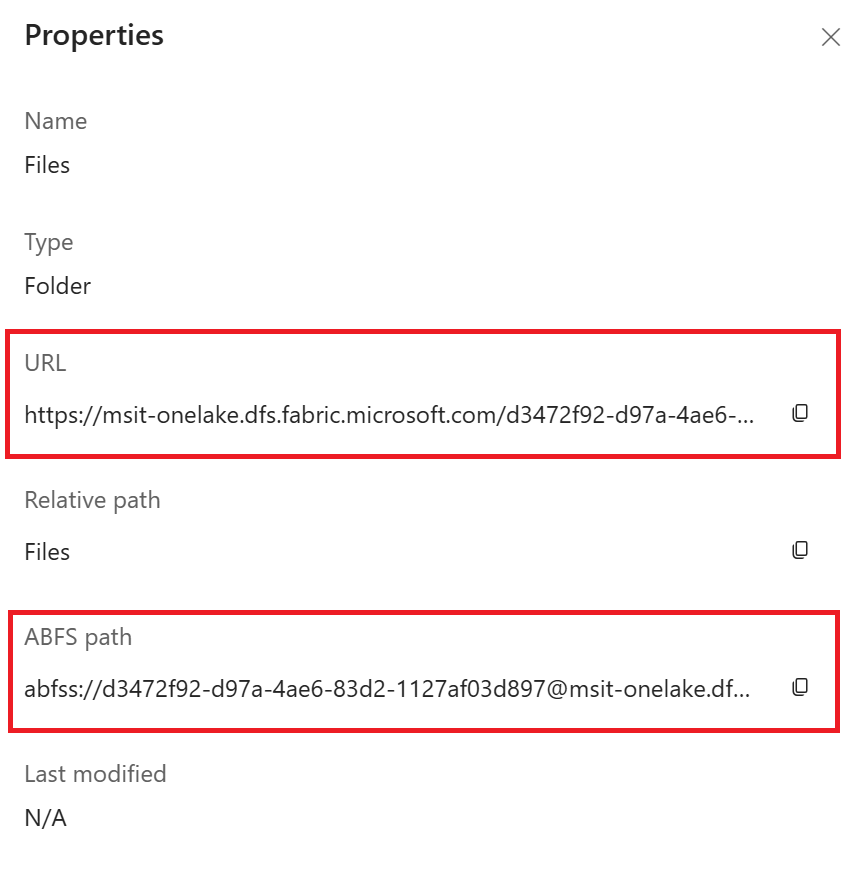
Criar um armazenamento de dados OneLake
from azure.ai.ml.entities import OneLakeDatastore, OneLakeArtifact
from azure.ai.ml import MLClient
from azure.identity import DefaultAzureCredential

ml_client = MLClient.from_config(credential=DefaultAzureCredential())

store = OneLakeDatastore(
    name="onelake_example_id",
    description="Datastore pointing to a Microsoft fabric artifact.",
    one_lake_workspace_name="bbbbbbbb-7777-8888-9999-cccccccccccc", #{your_one_lake_workspace_guid}
    endpoint="msit-onelake.dfs.fabric.microsoft.com", #{your_one_lake_endpoint}
    artifact=OneLakeArtifact(
        name="cccccccc-8888-9999-0000-dddddddddddd/Files", #{your_one_lake_artifact_guid}/Files
        type="lake_house"
    )
)

ml_client.create_or_update(store)
from azure.ai.ml.entities import OneLakeDatastore, OneLakeArtifact
from azure.ai.ml.entities._datastore.credentials import ServicePrincipalCredentials
from azure.ai.ml import MLClient
from azure.identity import DefaultAzureCredential

ml_client = MLClient.from_config(credential=DefaultAzureCredential())

store = OneLakeDatastore(
    name="onelake_example_sp",
    description="Datastore pointing to a Microsoft fabric artifact.",
    one_lake_workspace_name="bbbbbbbb-7777-8888-9999-cccccccccccc", #{your_one_lake_workspace_guid}
    endpoint="msit-onelake.dfs.fabric.microsoft.com", #{your_one_lake_endpoint}
    artifact=OneLakeArtifact(
        name="cccccccc-8888-9999-0000-dddddddddddd/Files", #{your_one_lake_artifact_guid}/Files
        type="lake_house"
    ),
    credentials=ServicePrincipalCredentials(
        tenant_id= "bbbbcccc-1111-dddd-2222-eeee3333ffff",
        client_id= "44445555-eeee-6666-ffff-7777aaaa8888",
        client_secret= "Cc3Dd~4Ee5.-Ff6Gg7Hh8Ii9Jj0Kk1_Ll2Mm3Nn4",
    ),
)

ml_client.create_or_update(store)
Crie o seguinte ficheiro YAML. Atualize os valores:
# my_onelake_datastore.yml
$schema: http://azureml/sdk-2-0/OneLakeDatastore.json
name: onelake_example_id
type: one_lake
description: Credential-less datastore pointing to a OneLake lakehouse.
one_lake_workspace_name: "eeeeffff-4444-aaaa-5555-bbbb6666cccc"
endpoint: "msit-onelake.dfs.fabric.microsoft.com"
artifact:
  type: lake_house
  name: "1111bbbb-22cc-dddd-ee33-ffffff444444/Files"
Crie o armazenamento de dados do Aprendizado de Máquina na CLI:
az ml datastore create --file my_onelake_datastore.yml
Crie o seguinte ficheiro YAML. Atualize os valores:
# my_onelakesp_datastore.yml
$schema: http://azureml/sdk-2-0/OneLakeDatastore.json
name: onelake_example_id
type: one_lake
description: Credential-less datastore pointing to a OneLake lakehouse.
one_lake_workspace_name: "eeeeffff-4444-aaaa-5555-bbbb6666cccc"
endpoint: "msit-onelake.dfs.fabric.microsoft.com"
artifact:
  type: lake_house
  name: "1111bbbb-22cc-dddd-ee33-ffffff444444/Files"
credentials:
  tenant_id: bbbbcccc-1111-dddd-2222-eeee3333ffff
  client_id: 44445555-eeee-6666-ffff-7777aaaa8888
  client_secret: Cc3Dd~4Ee5.-Ff6Gg7Hh8Ii9Jj0Kk1_Ll2Mm3Nn4
Crie o armazenamento de dados do Aprendizado de Máquina na CLI:
az ml datastore create --file my_onelakesp_datastore.yml
Próximos passos

