Notă
Accesul la această pagină necesită autorizare. Puteți încerca să vă conectați sau să modificați directoarele.
Accesul la această pagină necesită autorizare. Puteți încerca să modificați directoarele.
In this article, you learn how to integrate Netskope User Authentication with Microsoft Entra ID. When you integrate Netskope User Authentication with Microsoft Entra ID, you can:
- Control in Microsoft Entra ID who has access to Netskope User Authentication.
- Enable your users to be automatically signed-in to Netskope User Authentication with their Microsoft Entra accounts.
- Manage your accounts in one central location.
Prerequisites
The scenario outlined in this article assumes that you already have the following prerequisites:
- A Microsoft Entra user account with an active subscription. If you don't already have one, you can Create an account for free.
- One of the following roles:
- Netskope User Authentication single sign-on (SSO) enabled subscription.
Scenario description
In this article, you configure and test Microsoft Entra SSO in a test environment.
- Netskope User Authentication supports SP and IDP initiated SSO.
Add Netskope User Authentication from the gallery
To configure the integration of Netskope User Authentication into Microsoft Entra ID, you need to add Netskope User Authentication from the gallery to your list of managed SaaS apps.
- Sign in to the Microsoft Entra admin center as at least a Cloud Application Administrator.
- Browse to Entra ID > Enterprise apps > New application.
- In the Add from the gallery section, type Netskope User Authentication in the search box.
- Select Netskope User Authentication from results panel and then add the app. Wait a few seconds while the app is added to your tenant.
Alternatively, you can also use the Enterprise App Configuration Wizard. In this wizard, you can add an application to your tenant, add users/groups to the app, assign roles, and walk through the SSO configuration as well. Learn more about Microsoft 365 wizards.
Configure and test Microsoft Entra SSO for Netskope User Authentication
Configure and test Microsoft Entra SSO with Netskope User Authentication using a test user called B.Simon. For SSO to work, you need to establish a link relationship between a Microsoft Entra user and the related user in Netskope User Authentication.
To configure and test Microsoft Entra SSO with Netskope User Authentication, complete the following building blocks:
- Configure Microsoft Entra SSO - to enable your users to use this feature.
- Create a Microsoft Entra test user - to test Microsoft Entra single sign-on with B.Simon.
- Assign the Microsoft Entra test user - to enable B.Simon to use Microsoft Entra single sign-on.
- Configure Netskope User Authentication SSO - to configure the single sign-on settings on application side.
- Create Netskope User Authentication test user - to have a counterpart of B.Simon in Netskope User Authentication that's linked to the Microsoft Entra representation of user.
- Test SSO - to verify whether the configuration works.
Configure Microsoft Entra SSO
Follow these steps to enable Microsoft Entra SSO.
Sign in to the Microsoft Entra admin center as at least a Cloud Application Administrator.
Browse to Entra ID > Enterprise apps > Netskope User Authentication > Single sign-on.
On the Select a single sign-on method page, select SAML.
On the Set up single sign-on with SAML page, select the pencil icon for Basic SAML Configuration to edit the settings.
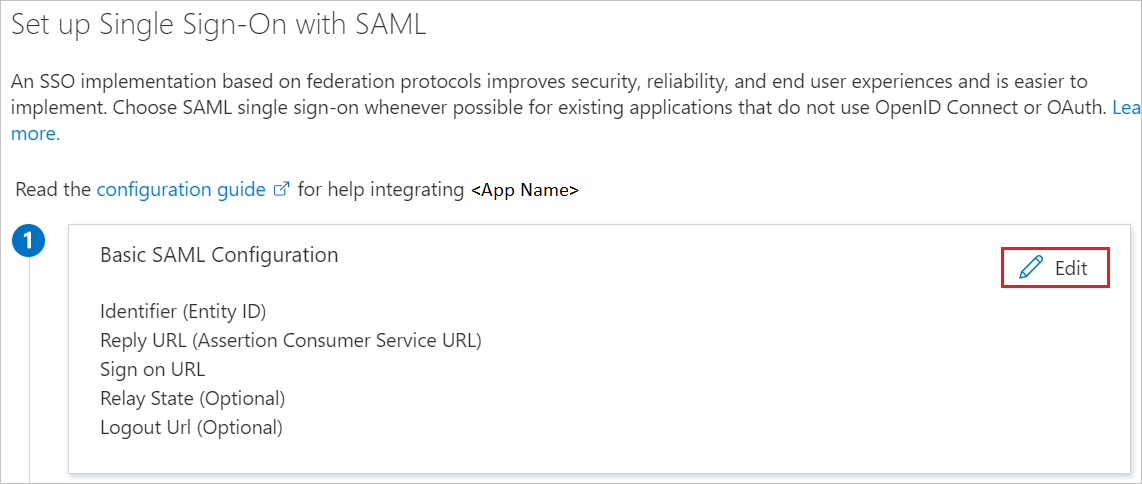
On the Basic SAML Configuration section, if you wish to configure the application in IDP initiated mode, enter the values for the following fields:
a. In the Identifier text box, type a URL using the following pattern:
https://<tenantname>.goskope.com/<customer entered string>b. In the Reply URL text box, type a URL using the following pattern:
https://<tenantname>.goskope.com/nsauth/saml2/http-post/<customer entered string>Note
These values aren't real. Update these values with the actual Identifier and Reply URL. You get these values explained later in the article.
Select Set additional URLs and perform the following step if you wish to configure the application in SP initiated mode:
In the Sign-on URL text box, type a URL using the following pattern:
https://<tenantname>.goskope.comNote
The Sign-on URL values isn't real. Update Sign-on URL value with the actual Sign-on URL. Contact Netskope User Authentication Client support team to get Sign-on URL value. You can also refer to the patterns shown in the Basic SAML Configuration section.
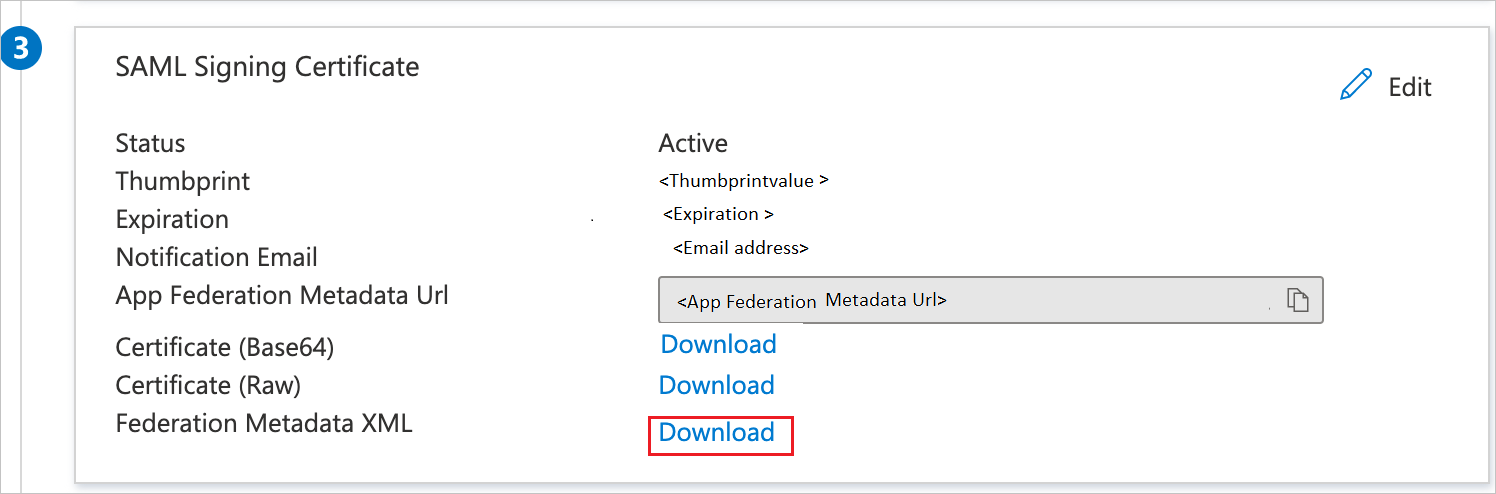
On the Set up Single Sign-On with SAML page, in the SAML Signing Certificate section, select Download to download the Federation Metadata XML from the given options as per your requirement and save it on your computer.
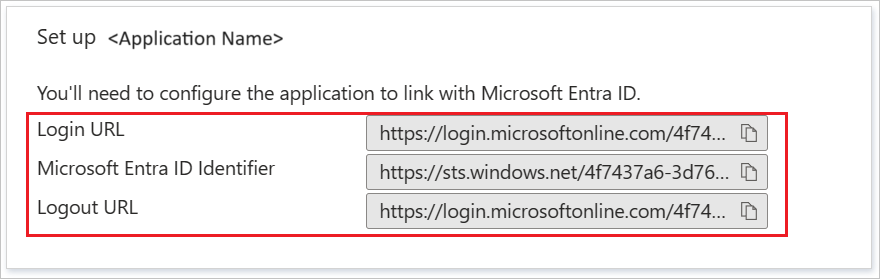
On the Set up Netskope User Authentication section, copy the appropriate URL(s) based on your requirement.
Create and assign Microsoft Entra test user
Follow the guidelines in the create and assign a user account quickstart to create a test user account called B.Simon.
Configure Netskope User Authentication SSO
Open a new tab in your browser, and sign in to your Netskope User Authentication company site as an administrator.
Select Active Platform tab.
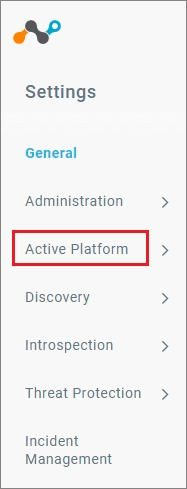
Scroll down to FORWARD PROXY and select SAML.
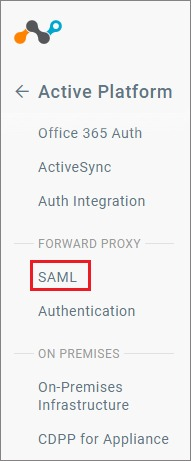
On the SAML Settings page, perform the following steps:
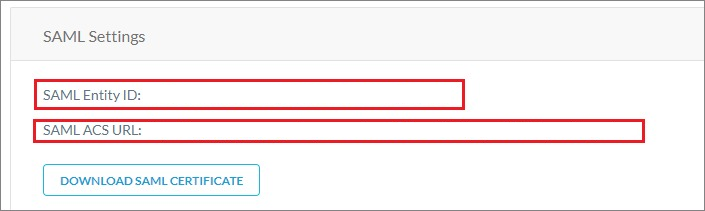
a. Copy SAML Entity ID value and paste it into the Identifier textbox in the Basic SAML Configuration section.
b. Copy SAML ACS URL value and paste it into the Reply URL textbox in the Basic SAML Configuration section.
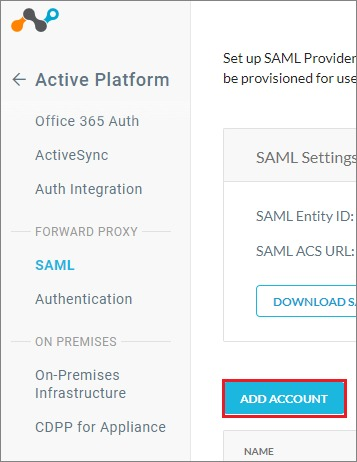
Select ADD ACCOUNT.
On the Add SAML Account page, perform the following steps:
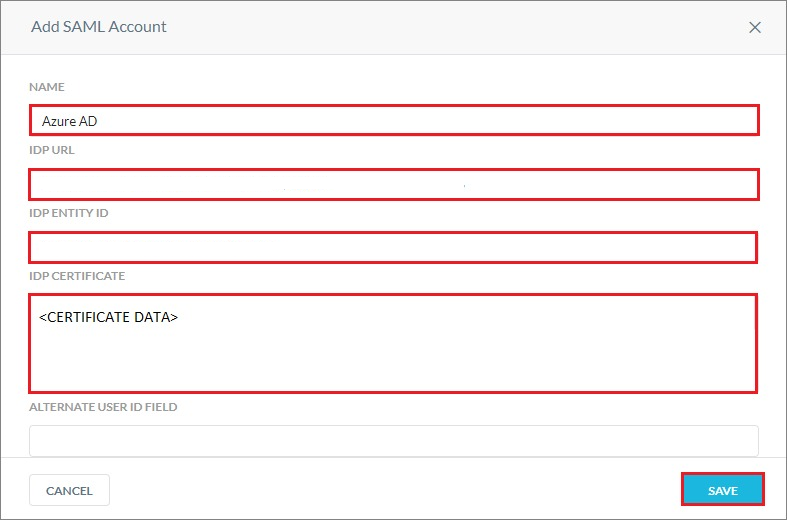
a. In the NAME textbox, provide the name like Microsoft Entra ID.
b. In the IDP URL textbox, paste the Login URL value, which you copied previously.
c. In the IDP ENTITY ID textbox, paste the Microsoft Entra Identifier value, which you copied previously.
d. Open your downloaded metadata file in notepad, copy the content of it into your clipboard, and then paste it to the IDP CERTIFICATE textbox.
e. Select SAVE.
Create Netskope User Authentication test user
Open a new tab in your browser, and sign in to your Netskope User Authentication company site as an administrator.
Select the Settings tab from the left navigation pane.
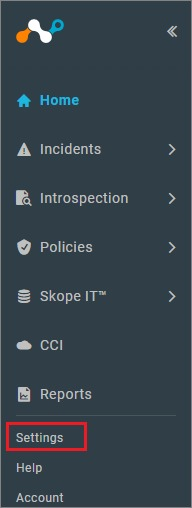
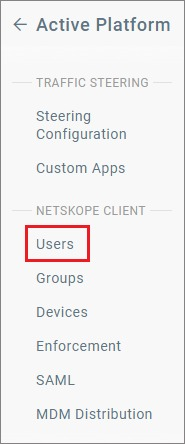
Select Active Platform tab.
Select Users tab.
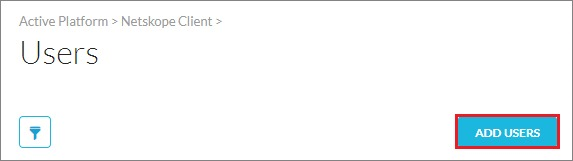
Select ADD USERS.
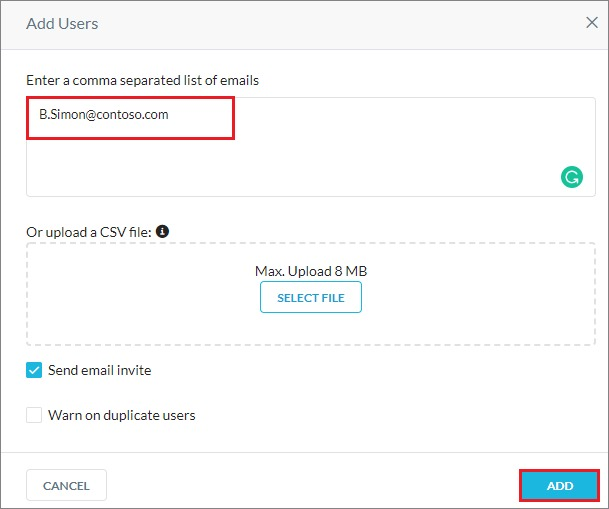
Enter the email address of the user you want to add and select ADD.
Test SSO
In this section, you test your Microsoft Entra single sign-on configuration with following options.
SP initiated:
Select Test this application, this option redirects to Netskope User Authentication Sign on URL where you can initiate the login flow.
Go to Netskope User Authentication Sign-on URL directly and initiate the login flow from there.
IDP initiated:
- Select Test this application, and you should be automatically signed in to the Netskope User Authentication for which you set up the SSO.
You can also use Microsoft My Apps to test the application in any mode. When you select the Netskope User Authentication tile in the My Apps, if configured in SP mode you would be redirected to the application sign on page for initiating the login flow and if configured in IDP mode, you should be automatically signed in to the Netskope User Authentication for which you set up the SSO. For more information about the My Apps, see Introduction to the My Apps.
Related content
Once you configure Netskope User Authentication you can enforce session control, which protects exfiltration and infiltration of your organization’s sensitive data in real time. Session control extends from Conditional Access. Learn how to enforce session control with Microsoft Defender for Cloud Apps.