opomba,
Dostop do te strani zahteva pooblastilo. Poskusite se vpisati alispremeniti imenike.
Dostop do te strani zahteva pooblastilo. Poskusite lahko spremeniti imenike.
Applies to: ✅ SQL database in Microsoft Fabric
This article outlines how to implement an operational data store (ODS) using SQL database in Fabric. It provides architectural guidance, design patterns, workload characteristics, and Fabric specific considerations for building a secure, performant, and governed ODS.
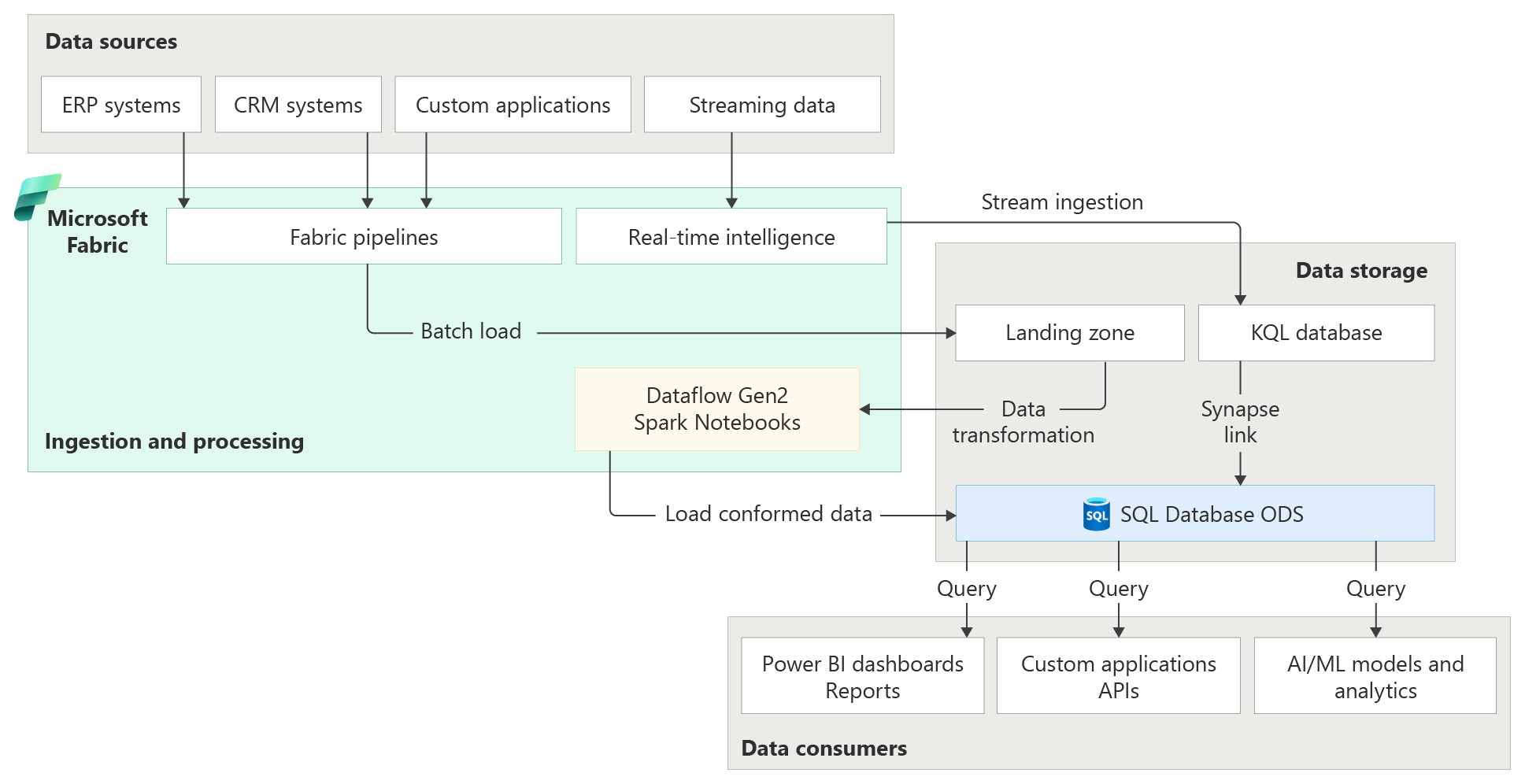
What is an ODS?
An operational data store (ODS) is a subject-oriented, integrated, and near real-time store that consolidates data from multiple operational systems into a lightly curated, normalized model - typically in normalized schemas. It supports operational reporting, lightweight analytics, API serving, and downstream propagation to analytical layers such as the Fabric Warehouse or Fabric Lakehouse.
An ODS is not a source online transaction processing (OLTP) system or a dimensional warehouse.
Instead, it serves as the "hot, harmonized truth" for the last N minutes, hours, or days, sitting between source systems and analytical platforms.
Key characteristics of an ODS
An operational data store (ODS) in Microsoft Fabric is designed to deliver a near real-time view of operational data with strong governance and performance guarantees.
- It ingests data from multiple source systems, with low latency.
- The schema is typically normalized in third normal form (3NF), to support flexibility and traceability.
- Data quality is enforced through deduplication, identity resolution, and handling of late-arriving or soft-deleted records, creating a reliable foundation for operational reporting and downstream analytics.
- Serving patterns include SQL-based queries, operational dashboards, alerts, and APIs, while Fabric governance features ensure compliance and security across the data lifecycle.
SQL database in Fabric serves as a secure and efficient conduit between operational data and analytical platforms.
Components
The following components are involved in using SQL database in Fabric as an operational data store:
- Constraints and keys: Enforce business logic and referential integrity (natural keys, surrogate keys, foreign keys).
- Identity resolution: Deduplicate across sources; apply survivorship rules.
- Serving: Expose GraphQL endpoints and/or build Power BI dashboards.
Ingestion and workload best practices
Building an ODS on SQL database in Fabric requires ingestion strategies that balance freshness, reliability, and performance.
- Batch and incremental loads are typically orchestrated through Fabric Data Pipelines using change data capture-enabled connectors, with watermarking and retry logic to ensure consistency.
- Tune pipeline concurrency to allow the SQL database to scale during peak loads while meeting service-level objectives for data freshness.
- Watermarking is an important concept in incremental copy processes. It helps you easily identify where an incremental load last stopped.
- Perform heavy transformations upstream in Dataflow Gen2 or Spark Notebooks. Reserve the SQL layer for final
MERGEoperations that enforce constraints and maintain OLTP-like performance. - Use idempotent design patterns that combine change detection, watermarking, T-SQL MERGE, and control tables for safe restarts and operational resilience.
Engine and environment
SQL database in Fabric is based on the same SQL Database Engine as Azure SQL Database, delivering a familiar T-SQL experience with full compatibility for standard client tools.
By using SQL database in Microsoft Fabric, you can create end-to-end workflows from ingestion to analytics by using other features in Microsoft Fabric:
- Data Pipelines
- Dataflow Gen2
- Notebooks
- Real-Time Intelligence
- Power BI
- All with streamlined DevOps by using Git-based CI/CD
Fabric SQL database use case stories
To learn more about the best use cases for Fabric SQL database, see:
- Use SQL database in reverse ETL
- Use SQL database as the source for translytical applications
- Use SQL database in AI applications