Kommentar
Åtkomst till den här sidan kräver auktorisering. Du kan prova att logga in eller ändra kataloger.
Åtkomst till den här sidan kräver auktorisering. Du kan prova att ändra kataloger.
The Azure Maps Java SDK can be integrated with Java applications and libraries to build maps-related and location-aware applications. The Azure Maps Java SDK contains APIs for Search, Route, Render, Geolocation, Traffic, Timezone, and Weather. These APIs support operations such as searching for an address, routing between different coordinates, obtaining the geo-location of a specific IP address etc.
Anmärkning
Azure Maps Java SDK is baselined on Java 8, with testing and forward support up until the latest Java long-term support release (currently Java 18). For the list of Java versions for download, see Java Standard Versions.
Förutsättningar
- Ett Azure Maps-konto
- A Subscription key or other form of authentication
- Java Version 8 or above
- Maven (any version). For more information, see Get started with Azure SDK and Apache Maven.
Tips/Råd
Du kan skapa ett Azure Maps-konto programmatiskt. Här är ett exempel med hjälp av Azure CLI:
az maps account create --kind "Gen2" --account-name "myMapAccountName" --resource-group "<resource group>" --sku "G2"
Skapa ett Maven-projekt
The following PowerShell code snippet demonstrates how to use PowerShell to create a maven project. First, run the maven command to create a maven project:
mvn archetype:generate "-DgroupId=groupId" "-DartifactId=DemoProject" "-DarchetypeArtifactId=maven-archetype-quickstart" "-DarchetypeVersion=1.4" "-DinteractiveMode=false"
| Parameter | Beskrivning |
|---|---|
-DGroupId |
Group ID uniquely identifies your project across all projects |
-DartifactId |
Project name. It's created as a new folder. |
-DarchetypeArtifactId |
project type.
maven-archetype-quickstart results in a sample project. |
-DinteractiveMode |
Setting to false results in a blank Java project with default options. |
Installera programvarupaketen
To use the Azure Maps Java SDK, you need to install all required packages. Each service in Azure Maps is available in its own package. The Azure Maps services include Search, Render, Traffic, Weather, etc. You only need to install the packages for the service or services used in your project.
Once the maven project is created, there should be a pom.xml file with basic information such as group ID, name, artifact ID. Next, add a dependency for each of the Azure Maps services, as the following example demonstrates:
<dependency>
  <groupId>com.azure</groupId>
  <artifactId>azure-maps-search</artifactId>
  <version>1.0.0-beta.1</version>
</dependency>
<dependency>
  <groupId>com.azure</groupId>
  <artifactId>azure-maps-route</artifactId>
  <version>1.0.0-beta.1</version>
</dependency>
<dependency>
  <groupId>com.azure</groupId>
  <artifactId>azure-maps-render</artifactId>
  <version>2.0.0-beta.1</version>
</dependency>
<dependency>
  <groupId>com.azure</groupId>
  <artifactId>azure-maps-traffic</artifactId>
  <version>1.0.0-beta.1</version>
</dependency>
<dependency>
  <groupId>com.azure</groupId>
  <artifactId>azure-maps-weather</artifactId>
  <version>1.0.0-beta.1</version>
</dependency>
<dependency>
  <groupId>com.azure</groupId>
  <artifactId>azure-maps-timezone</artifactId>
  <version>1.0.0-beta.1</version>
</dependency>
Run mvn clean install on your project, then create a java file named demo.java and import what you need from Azure Maps into the file:
cd DemoProject
New-Item demo.java
Tips/Råd
If running mvn clean install results in an error, try running mvn clean install -U.
Azure Maps-tjänster
Skapa och autentisera en MapsSearchClient
The client object used to access the Azure Maps Search APIs require either an AzureKeyCredential object to authenticate when using an Azure Maps subscription key or a TokenCredential object with the Azure Maps client ID when authenticating using Microsoft Entra ID. Mer information om autentisering finns i Autentisering med Azure Maps.
Använda en Microsoft Entra-autentiseringsuppgift
Du kan autentisera med Microsoft Entra-ID med hjälp av Azure Identity-biblioteket. To use the DefaultAzureCredential provider, you need to add the mvn dependency in the pom.xml file:
<dependency>
  <groupId>com.azure</groupId>
  <artifactId>azure-identity</artifactId>
</dependency>
Du måste registrera det nya Microsoft Entra-programmet och bevilja åtkomst till Azure Maps genom att tilldela den roll som krävs till tjänstens huvudkonto. For more information, see Host a daemon on non-Azure resources. The Application (client) ID, a Directory (tenant) ID, and a client secret are returned. Kopiera dessa värden och lagra dem på en säker plats. Du behöver dem i följande steg.
Set the values of the Application (client) ID, Directory (tenant) ID, and client secret of your Microsoft Entra application, and the map resource's client ID as environment variables:
| Miljövariabel | Beskrivning |
|---|---|
| AZURE_CLIENT_ID | Program-ID (klient) i ditt registrerade program |
| AZURE_CLIENT_SECRET | Värdet för klienthemligheten i ditt registrerade program |
| AZURE_TENANT_ID | Directory (tenant) ID in your registered application |
| MAPS_CLIENT_ID | Klient-ID:t i ditt Azure Map-konto |
Now you can create environment variables in PowerShell to store these values:
$Env:AZURE_CLIENT_ID="<client-id>"
A$Env:AZURE_CLIENT_SECRET="<client-secret>"
$Env:AZURE_TENANT_ID="<tenant-id>"
$Env:MAPS_CLIENT_ID="<maps-client-id>"
After setting up the environment variables, you can use them in your program to instantiate the AzureMapsSearch client:
import com.azure.identity.DefaultAzureCredential;
import com.azure.identity.DefaultAzureCredentialBuilder;
import com.azure.maps.search.MapsSearchClient;
import com.azure.maps.search.MapsSearchClientBuilder;

public class Demo {
    public static void main( String[] args) {
        MapsSearchClientBuilder builder = new MapsSearchClientBuilder();
        DefaultAzureCredential tokenCredential = new DefaultAzureCredentialBuilder().build();
        builder.credential(tokenCredential);
        builder.mapsClientId(System.getenv("MAPS_CLIENT_ID"));
        MapsSearchClient client = builder.buildClient();
    }
}
Viktigt!
The other environment variables created in the previous code snippet, while not used in the code sample, are required by are required by DefaultAzureCredential(). If you do not set these environment variables correctly, using the same naming conventions, you will get run-time errors. For example, if your AZURE_CLIENT_ID is missing or invalid you will get an InvalidAuthenticationTokenTenant error.
Använda en prenumerationsnyckel
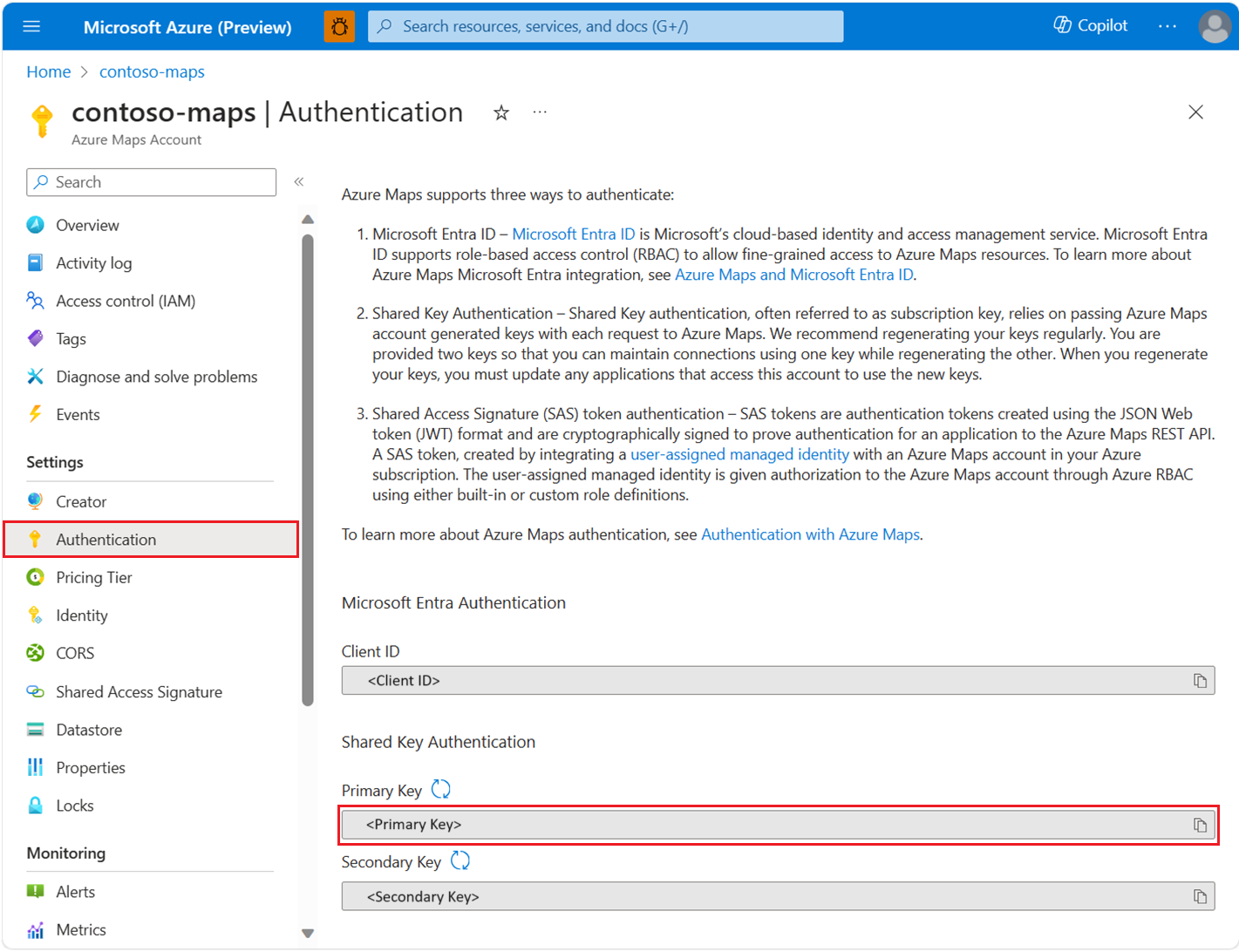
Du kan autentisera med din Azure Maps-prenumerationsnyckel. Din prenumerationsnyckel finns i avsnittet Autentisering i Azure Maps-kontot enligt följande skärmbild:
Now you can create environment variables in PowerShell to store the subscription key:
$Env:SUBSCRIPTION_KEY="<subscription-key>"
Once your environment variable is created, you can access it in your code:
import com.azure.core.credential.AzureKeyCredential;
import com.azure.maps.search.MapsSearchClient;
import com.azure.maps.search.MapsSearchClientBuilder;

public class Demo {
    public static void main( String[] args) {

        // Use Azure Maps subscription key authentication
        MapsSearchClientBuilder builder = new MapsSearchClientBuilder();
        AzureKeyCredential keyCredential = new AzureKeyCredential(System.getenv("SUBSCRIPTION_KEY"));
        builder.credential(keyCredential);
        MapsSearchClient client = builder.buildClient();
    }
}
Fuzzy search an entity
The following code snippet demonstrates how, in a simple console application, to import the azure-maps-search package and perform a fuzzy search on "Starbucks" near Seattle:
import java.io.IOException;
import com.azure.core.credential.AzureKeyCredential;
import com.azure.core.models.GeoPosition;
// Enable the 2 imports below if you want to use AAD authentication
// import com.azure.identity.DefaultAzureCredential;
// import com.azure.identity.DefaultAzureCredentialBuilder;
import com.azure.maps.search.MapsSearchClient;
import com.azure.maps.search.MapsSearchClientBuilder;
import com.azure.maps.search.models.FuzzySearchOptions;
import com.azure.maps.search.models.SearchAddressResult;
import com.azure.maps.search.models.SearchAddressResultItem;

public class Demo {
    public static void main( String[] args) throws IOException {
    MapsSearchClientBuilder builder = new MapsSearchClientBuilder();

    // Instantiate with key credential. Get SUBSCRIPTION_KEY from environment variable:
    AzureKeyCredential keyCredential = new AzureKeyCredential(System.getenv("SUBSCRIPTION_KEY"));
    builder.credential(keyCredential);

    // Or you can also instantiate with token credential:
    // DefaultAzureCredential tokenCredential = new DefaultAzureCredentialBuilder().build();
    // builder.credential(tokenCredential);
    // builder.mapsClientId(System.getenv("MAPS_CLIENT_ID"));
    MapsSearchClient client = builder.buildClient();

    // Fuzzy search with options:
    SearchAddressResult results = client.fuzzySearch(new FuzzySearchOptions("starbucks", new GeoPosition(-122.34255, 47.61010)));

    // Print the search results:
    for (SearchAddressResultItem item : results.getResults()) {
              MapsSearchAddress address = item.getAddress();
             GeoPosition coordinate = item.getPosition();
             System.out.format(
                 "* %s, %s\\n" +
                 "  %s %s %s\\n" +
                 "  Coordinate: (%.4f, %.4f)\\n",
                 address.getStreetNumber(), address.getStreetName(),
                 address.getMunicipality(), address.getCountryCode(), address.getPostalCode(),
                 coordinate.getLatitude(), coordinate.getLongitude());
        }
    }
}
This code snippet demonstrates how to create a MapsSearchClient object using Azure credentials. Start by instantiating AzureKeyCredential using your Azure Maps subscription key, then passes the credentials to instantiate MapsSearchClient.
MapsSearchClient methods such as FuzzySearch can use the point of interest (POI) name "Starbucks" and coordinates GeoPosition(-122.31, 47.61).
Execute the program from the project folder in the command line:
java .\demo.java
You should see a list of Starbucks address and coordinate results:
* 1912, Pike Place
  Seattle US 98101
  Coordinate: (47.6102, -122.3425)
* 2118, Westlake Avenue
  Seattle US 98121
  Coordinate: (47.6173, -122.3378)
* 2601, Elliott Avenue
  Seattle US 98121
  Coordinate: (47.6143, -122.3526)
* 1730, Howell Street
  Seattle US 98101
  Coordinate: (47.6172, -122.3298)
* 220, 1st Avenue South
  Seattle US 98104
  Coordinate: (47.6003, -122.3338)
* 400, Occidental Avenue South
  Seattle US 98104
  Coordinate: (47.5991, -122.3328)
* 1600, East Olive Way
  Seattle US 98102
  Coordinate: (47.6195, -122.3251)
* 500, Mercer Street
  Seattle US 98109
  Coordinate: (47.6250, -122.3469)
* 505, 5Th Ave S
  Seattle US 98104
  Coordinate: (47.5977, -122.3285)
* 425, Queen Anne Avenue North
  Seattle US 98109
  Coordinate: (47.6230, -122.3571)
Search an address
Call the SearchAddress method to get the coordinate of an address. Modify the Main program from the sample as follows:
import java.io.IOException;
import com.azure.core.credential.AzureKeyCredential;
import com.azure.core.models.GeoPosition;
// Enable the 2 imports below if you want to use AAD authentication
// import com.azure.identity.DefaultAzureCredential;
// import com.azure.identity.DefaultAzureCredentialBuilder;
import com.azure.maps.search.MapsSearchClient;
import com.azure.maps.search.MapsSearchClientBuilder;
import com.azure.maps.search.models.SearchAddressOptions;
import com.azure.maps.search.models.SearchAddressResult;
import com.azure.maps.search.models.SearchAddressResultItem;

public class Demo {
    public static void main( String[] args) throws IOException {
    MapsSearchClientBuilder builder = new MapsSearchClientBuilder();

    // Instantiate with key credential:
    AzureKeyCredential keyCredential = new
        AzureKeyCredential(System.getenv("SUBSCRIPTION_KEY"));
    builder.credential(keyCredential);

    // Or you can also instantiate with token credential:
    // DefaultAzureCredential tokenCredential = new DefaultAzureCredentialBuilder().build();
    // builder.credential(tokenCredential);
    // builder.mapsClientId(System.getenv("MAPS_CLIENT_ID"));

    MapsSearchClient client = builder.buildClient();
    client.searchAddress(new SearchAddressOptions("15127 NE 24th Street, Redmond, WA 98052"));

    // Search address with options and return top 5 results:
    SearchAddressResult results = client.searchAddress(new SearchAddressOptions("1
        Main Street").setCoordinates(new GeoPosition(-74.011454,
        40.706270)).setRadiusInMeters(40000).setTop(5));

    // Print results:
    if (results.getResults().size() > 0) {
        SearchAddressResultItem item = results.getResults().get(0);
        System.out.format("The coordinates is (%.4f, %.4f)",
            item.getPosition().getLatitude(), item.getPosition().getLongitude());
        }
    }
}
In this sample, the client.SearchAddress method returns results ordered by confidence score and prints the coordinates of the first result.
Batch reverse search
Azure Maps Search innehåller även några batchfrågemetoder. These methods return Long Running Operations (LRO) objects. The requests might not return all the results immediately, so users can choose to wait until completion or query the result periodically as demonstrated in the batch reverse search method:
import java.util.ArrayList;
import java.util.List;
import com.azure.core.credential.AzureKeyCredential;
import com.azure.core.models.GeoPosition;
// Enable the 2 imports below if you want to use AAD authentication
// import com.azure.identity.DefaultAzureCredential;
// import com.azure.identity.DefaultAzureCredentialBuilder;
import com.azure.maps.search.MapsSearchClient;
import com.azure.maps.search.MapsSearchClientBuilder;
import com.azure.maps.search.models.BatchReverseSearchResult;
import com.azure.maps.search.models.ReverseSearchAddressBatchItem;
import com.azure.maps.search.models.ReverseSearchAddressOptions;
import com.azure.maps.search.models.ReverseSearchAddressResultItem;

public class Demo{
    public static void main( String[] args) throws IOException {
        MapsSearchClientBuilder builder = new MapsSearchClientBuilder();

        // Instantiate with key credential:
        AzureKeyCredential keyCredential = new
        AzureKeyCredential(System.getenv("SUBSCRIPTION_KEY"));
        builder.credential(keyCredential);

        // Or you can also instantiate with token credential:
        // DefaultAzureCredential tokenCredential = new DefaultAzureCredentialBuilder().build();
        // builder.credential(tokenCredential);
        // builder.mapsClientId(System.getenv("MAPS_CLIENT_ID"));

        MapsSearchClient client = builder.buildClient();
        List<ReverseSearchAddressOptions> reverseOptionsList = new ArrayList<>();
        reverseOptionsList.add(new ReverseSearchAddressOptions(new GeoPosition(2.294911, 48.858561)));
        reverseOptionsList.add(new ReverseSearchAddressOptions(new GeoPosition(-122.34255, 47.61010)));
        reverseOptionsList.add(new ReverseSearchAddressOptions(new GeoPosition(-122.33817, 47.61559)).setRadiusInMeters(5000));
        BatchReverseSearchResult batchReverseSearchResult =
        client.beginReverseSearchAddressBatch(reverseOptionsList).getFinalResult();
        for (ReverseSearchAddressBatchItem item : batchReverseSearchResult.getBatchItems()) {
            for (ReverseSearchAddressResultItem result : item.getResult().getAddresses()) {
                System.out.println(result.getAddress().getFreeformAddress());
            }
        }
    }
}