หมายเหตุ
การเข้าถึงหน้านี้ต้องได้รับการอนุญาต คุณสามารถลอง ลงชื่อเข้าใช้หรือเปลี่ยนไดเรกทอรีได้
การเข้าถึงหน้านี้ต้องได้รับการอนุญาต คุณสามารถลองเปลี่ยนไดเรกทอรีได้
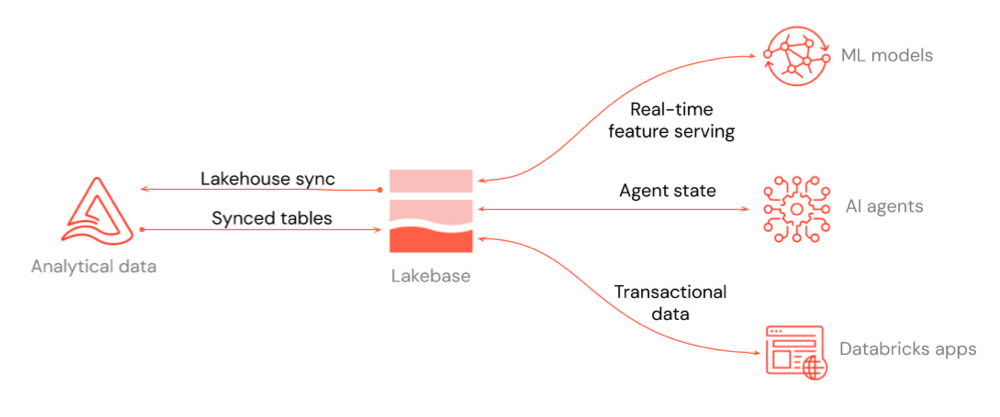
Lakebase is a fully managed Postgres database integrated into the Databricks platform. Build real-time transactional applications alongside your lakehouse data, with automatic scaling, instant branching, and native Unity Catalog integration.
- Build low-latency apps: Connect Databricks Apps or any application to Lakebase for transactional workloads.
- Serve lakehouse data: Sync Unity Catalog tables into Lakebase so applications can query them at low latency.
- Store Postgres changes: Store Postgres changes as Delta tables for downstream pipelines and audit.
- AI and ML: Use Lakebase as an online feature store for ML models, or as a state store for agents.
Get started
| Quickstart | Description |
|---|---|
| Get a Postgres database | Create a project, branch, and database. Connect with psql or any Postgres driver. |
| Serve lakehouse data | Sync Unity Catalog tables into Postgres for low-latency app reads. |
| Store Postgres changes in the lakehouse | (Public Preview) Store Postgres changes as Delta with full change history. |
| Build applications | Build apps backed by Lakebase using Databricks Apps, external integrations, or the Data API. |
Key features
Explore features that optimize performance, reduce costs, and enable flexible development workflows.
| Feature | Description |
|---|---|
| Autoscaling | Automatically adjust compute resources based on workload demand. |
| Scale to zero | Automatically suspend inactive computes to minimize costs. |
| Branches | Create isolated branches for development and testing. |
| Read replicas | Create read-only replicas to scale read operations. |
| Instant restore | Create a new branch from any point in time within your history window. |
| High availability | Configure automatic failover to keep your database available during compute failures. |
Connect and query
Use various tools and interfaces to connect to and query your database.
| Task | Description |
|---|---|
| Connect to your database | Learn different ways to connect to your Lakebase database. |
| Query with SQL Editor | Use the built-in SQL Editor to query and manage your database. |
| Tables editor | Use the visual interface to view, edit, and manage data and schemas. |
| Postgres clients | Connect using standard Postgres clients and tools. |
| Querying data at a point in time | Query data using point-in-time branches. |
Databricks integrations
Connect Lakebase with your existing Databricks data and workflows.
| Integration | Description |
|---|---|
| Register in Unity Catalog | Register your Lakebase database in Unity Catalog for unified governance. |
| Serve data with synced tables | Serve lakehouse data through your Lakebase database for low-latency applications. |
| Lakebase Change Data Feed | Store row-level changes from Lakebase Postgres tables as Unity Catalog Delta tables for downstream pipelines, audit, and external consumers. (Public Preview) |
| Databricks Apps | Build and deploy interactive applications with Lakebase as the managed Postgres backend. |
| Agent state and memory | Store durable short-term and long-term agent memory in Lakebase for agents built with LangGraph or the OpenAI Agents SDK. |
| Feature Store and Model Serving | Use Lakebase as a low-latency online feature store backend for ML models served with Model Serving. |
Additional resources
| Resource | Description |
|---|---|
| Use cases | Lakebase patterns: serve lakehouse data, replicate to the lakehouse, application backend, agents and ML. |
| Region availability | Supported regions for Lakebase Postgres. |
Note
Lakebase Postgres is also available on the Neon.com platform. For documentation on using Lakebase Postgres through Neon.com, see the Neon documentation.