Bemærk
Adgang til denne side kræver godkendelse. Du kan prøve at logge på eller ændre mapper.
Adgang til denne side kræver godkendelse. Du kan prøve at ændre mapper.
In this article, you learn how to integrate LinkedIn Elevate with Microsoft Entra ID. When you integrate LinkedIn Elevate with Microsoft Entra ID, you can:
- Control in Microsoft Entra ID who has access to LinkedIn Elevate.
- Enable your users to be automatically signed-in to LinkedIn Elevate with their Microsoft Entra accounts.
- Manage your accounts in one central location.
Prerequisites
The scenario outlined in this article assumes that you already have the following prerequisites:
- A Microsoft Entra user account with an active subscription. If you don't already have one, you can Create an account for free.
- One of the following roles:
- LinkedIn Elevate single sign-on (SSO) enabled subscription.
Scenario description
In this article, you configure and test Microsoft Entra SSO in a test environment.
- LinkedIn Elevate supports SP and IDP initiated SSO.
- LinkedIn Elevate supports Just In Time user provisioning.
- LinkedIn Elevate supports Automated user provisioning.
Add LinkedIn Elevate from the gallery
To configure the integration of LinkedIn Elevate into Microsoft Entra ID, you need to add LinkedIn Elevate from the gallery to your list of managed SaaS apps.
- Sign in to the Microsoft Entra admin center as at least a Cloud Application Administrator.
- Browse to Entra ID > Enterprise apps > New application.
- In the Add from the gallery section, type LinkedIn Elevate in the search box.
- Select LinkedIn Elevate from results panel and then add the app. Wait a few seconds while the app is added to your tenant.
Alternatively, you can also use the Enterprise App Configuration Wizard. In this wizard, you can add an application to your tenant, add users/groups to the app, assign roles, and walk through the SSO configuration as well. Learn more about Microsoft 365 wizards.
Configure and test Microsoft Entra SSO for LinkedIn Elevate
Configure and test Microsoft Entra SSO with LinkedIn Elevate using a test user called B.Simon. For SSO to work, you need to establish a link relationship between a Microsoft Entra user and the related user in LinkedIn Elevate.
To configure and test Microsoft Entra SSO with LinkedIn Elevate, perform the following steps:
- Configure Microsoft Entra SSO - to enable your users to use this feature.
- Create a Microsoft Entra test user - to test Microsoft Entra single sign-on with B.Simon.
- Assign the Microsoft Entra test user - to enable B.Simon to use Microsoft Entra single sign-on.
- Configure LinkedIn Elevate SSO - to configure the single sign-on settings on application side.
- Create LinkedIn Elevate test user - to have a counterpart of B.Simon in LinkedIn Elevate that's linked to the Microsoft Entra representation of user.
- Test SSO - to verify whether the configuration works.
Configure Microsoft Entra SSO
Follow these steps to enable Microsoft Entra SSO.
Sign in to the Microsoft Entra admin center as at least a Cloud Application Administrator.
Browse to Entra ID > Enterprise apps > LinkedIn Elevate > Single sign-on.
On the Select a single sign-on method page, select SAML.
On the Set up single sign-on with SAML page, select the pencil icon for Basic SAML Configuration to edit the settings.
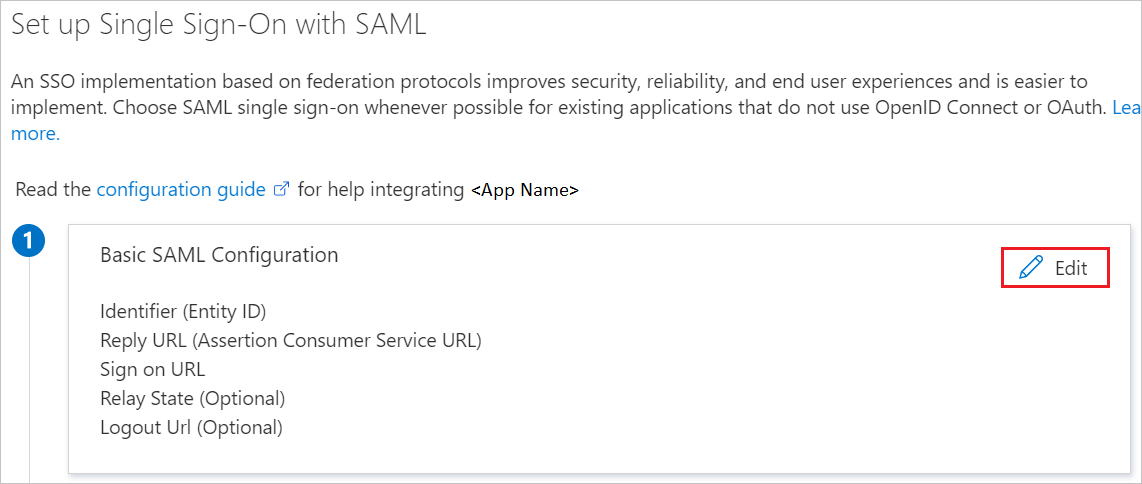
On the Basic SAML Configuration section, if you wish to configure the application in IDP initiated mode, perform the following steps:
a. In the Identifier text box, enter the Entity ID value, you copy Entity ID value from the Linkedin Portal explained later in this article.
b. In the Reply URL text box, enter the Assertion Consumer Access (ACS) Url value, you copy Assertion Consumer Access (ACS) URL value from the Linkedin Portal explained later in this article.
Select Set additional URLs and perform the following step if you wish to configure the application in SP initiated mode:
In the Sign-on URL text box, type a URL using the following pattern:
https://www.linkedin.com/checkpoint/enterprise/login/<ACCOUNT_ID>?application=elevate&applicationInstanceId=<INSTANCE_ID>LinkedIn Elevate application expects the SAML assertions in a specific format, which requires you to add custom attribute mappings to your SAML token attributes configuration. The following screenshot shows the list of default attributes, whereas nameidentifier is mapped with user.userprincipalname. LinkedIn Elevate application expects nameidentifier to be mapped with user.mail, so you need to edit the attribute mapping by selecting Edit icon and change the attribute mapping.
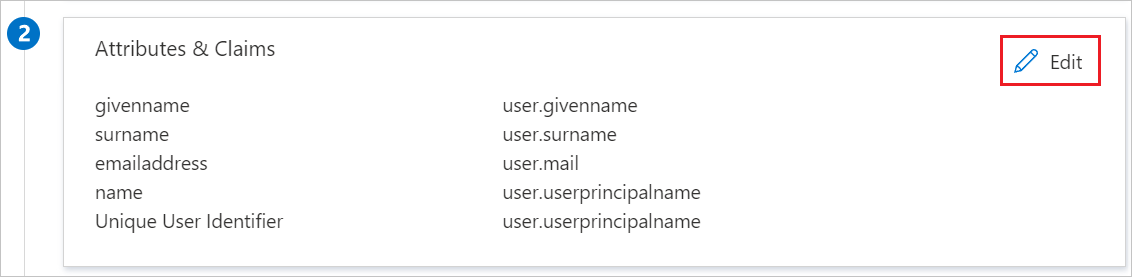
In addition to above, LinkedIn Elevate application expects few more attributes to be passed back in SAML response which are shown below. These attributes are also pre populated but you can review them as per your requirement.
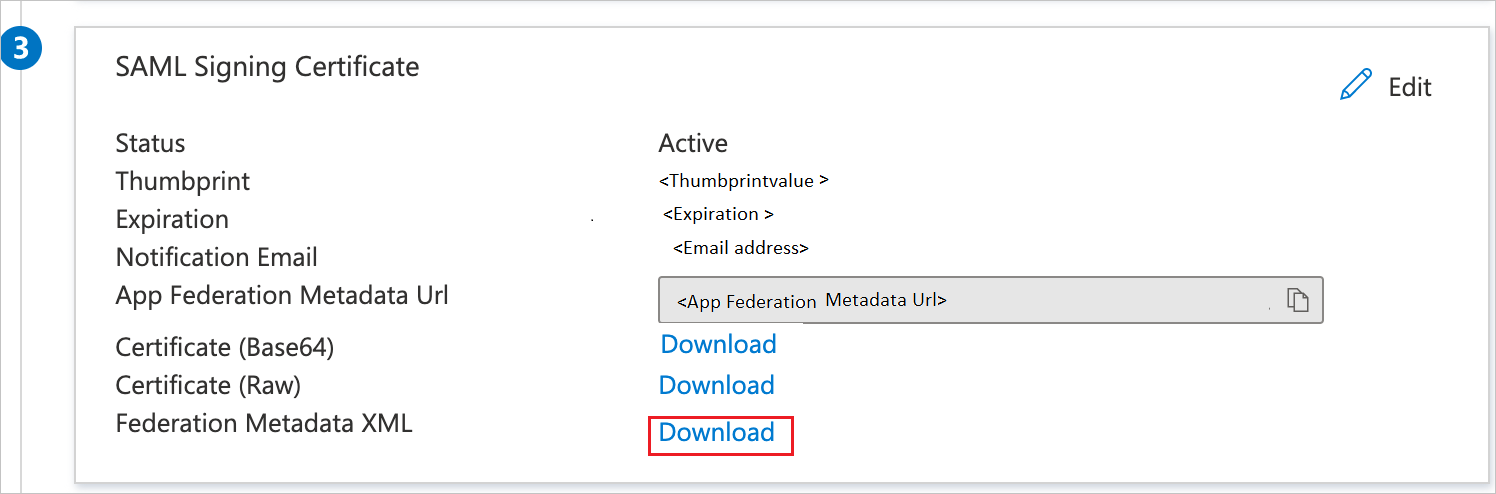
Name Source Attribute department user.department On the Set up single sign-on with SAML page, in the SAML Signing Certificate section, find Federation Metadata XML and select Download to download the certificate and save it on your computer.
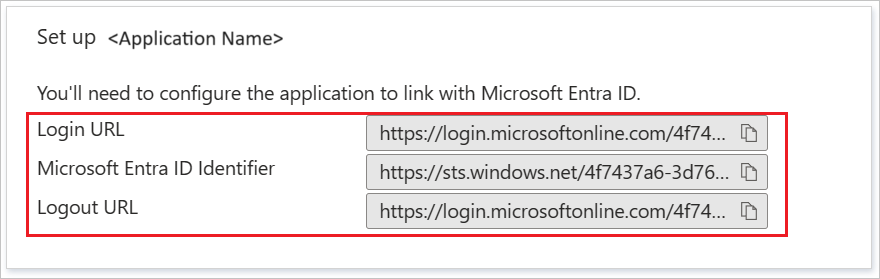
On the Set up LinkedIn Elevate section, copy the appropriate URL(s) based on your requirement.
Create and assign Microsoft Entra test user
Follow the guidelines in the create and assign a user account quickstart to create a test user account called B.Simon.
Configure LinkedIn Elevate SSO
In a different web browser window, sign-on to your LinkedIn Elevate tenant as an administrator.
In Account Center, select Global Settings under Settings. Also, select Elevate - Elevate Microsoft Entra ID Test from the dropdown list.

Select OR Select Here to load and copy individual fields from the form and perform the following steps:
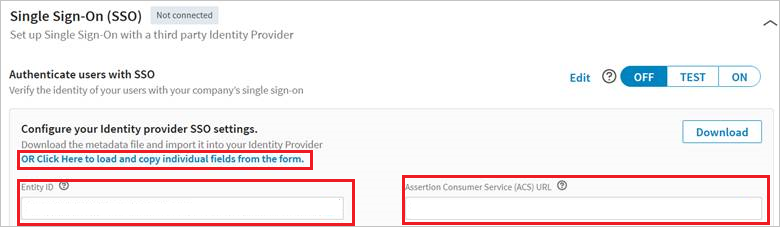
a. Copy Entity ID and paste it into the Identifier text box in the Basic SAML Configuration.
b. Copy Assertion Consumer Access (ACS) Url and paste it into the Reply URL text box in the Basic SAML Configuration.
Go to LinkedIn Admin Settings section. Upload the XML file that you have downloaded by selecting the Upload XML file option.
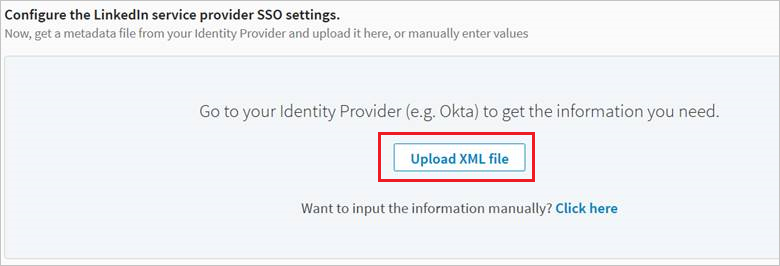
Select On to enable SSO. SSO status will change from Not Connected to Connected.

Create LinkedIn Elevate test user
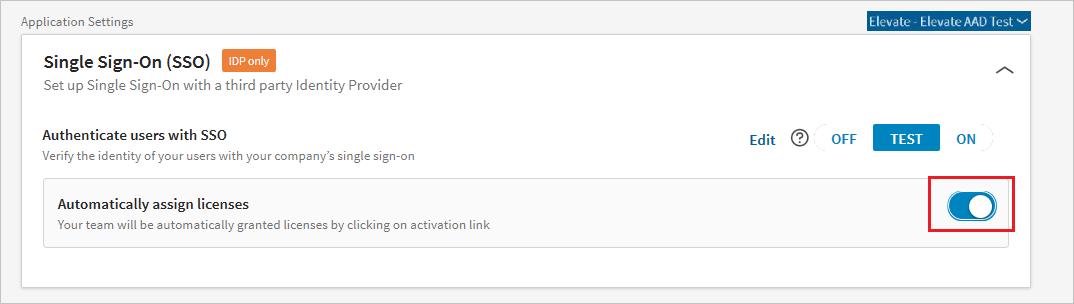
LinkedIn Elevate Application supports Just in time user provisioning and after authentication users are created in the application automatically. On the admin settings page on the LinkedIn Elevate portal flip the switch Automatically Assign licenses to active Just in time provisioning and this will also assign a license to the user. LinkedIn Elevate also supports automatic user provisioning, you can find more details here on how to configure automatic user provisioning.
Test SSO
In this section, you test your Microsoft Entra single sign-on configuration with following options.
SP initiated:
Select Test this application, this option redirects to LinkedIn Elevate Sign on URL where you can initiate the login flow.
Go to LinkedIn Elevate Sign-on URL directly and initiate the login flow from there.
IDP initiated:
- Select Test this application, and you should be automatically signed in to the LinkedIn Elevate for which you set up the SSO.
You can also use Microsoft My Apps to test the application in any mode. When you select the LinkedIn Elevate tile in the My Apps, if configured in SP mode you would be redirected to the application sign on page for initiating the login flow and if configured in IDP mode, you should be automatically signed in to the LinkedIn Elevate for which you set up the SSO. For more information about the My Apps, see Introduction to the My Apps.
Related content
Once you configure LinkedIn Elevate you can enforce session control, which protects exfiltration and infiltration of your organization’s sensitive data in real time. Session control extends from Conditional Access. Learn how to enforce session control with Microsoft Defender for Cloud Apps.