Note
Access to this page requires authorization. You can try signing in or changing directories.
Access to this page requires authorization. You can try changing directories.
Microsoft Fabric offers two enterprise-scale, open-format data stores for analytics: Warehouse and Lakehouse. Both store data in Delta Lake format in OneLake and share the same SQL engine, but they suit different development styles, data types, and workloads. This article compares them and describes the decision points for each.
This article compares the following options:
- Warehouse
- Lakehouse, including its SQL analytics endpoint
Choose a candidate service
This section helps you select the most likely service for your needs.
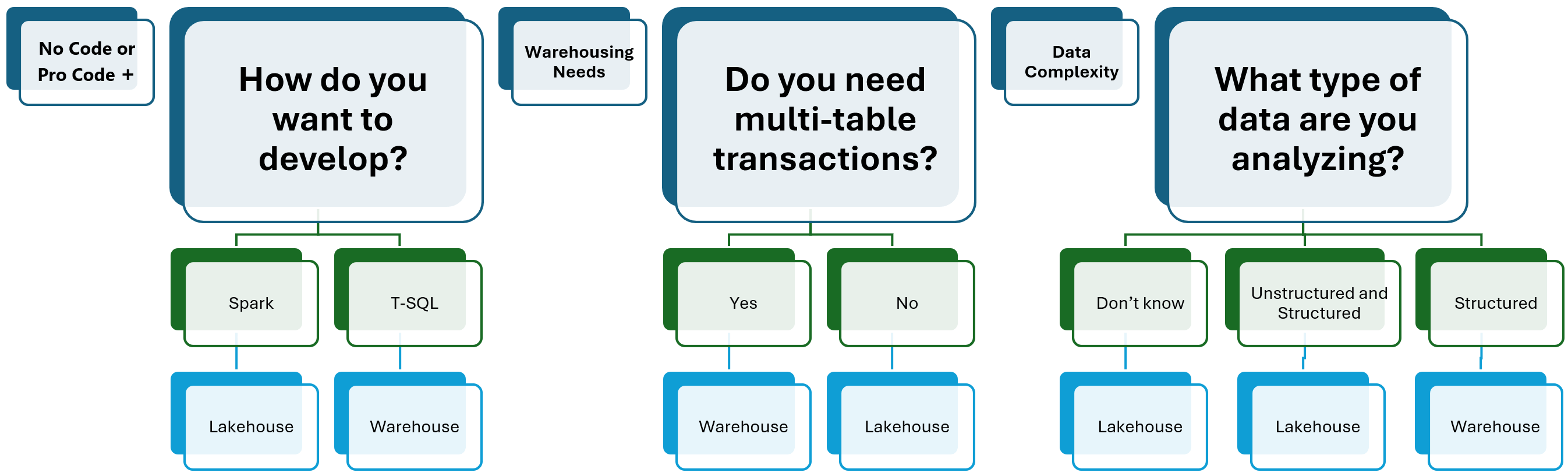
Development approach: How do you want to develop?
- Apache Spark (Python, Scala, Spark SQL, or R): Use Lakehouse.
- T-SQL: Use Warehouse.
Transactions: Do you need multi-table transactions?
- Yes: Use Warehouse.
- No: Use Lakehouse.
Data type: What type of data are you analyzing?
- Unstructured and structured data, or you're not sure: Use Lakehouse.
- Structured data only: Use Warehouse.
The result of this section is a starting point. Use the following sections to evaluate each service in detail.
Evaluate each service
Evaluate each service in detail to confirm it meets your needs.
The Warehouse item in Fabric Data Warehouse is an enterprise-scale relational warehouse on a data lake foundation, developed primarily with T-SQL.
- Stores data in OneLake in open Delta format, so data engineers and business users can share and collaborate without compromising governance.
- Provides full multi-table ACID transactions, views, functions, and stored procedures through the SQL engine.
- Applies autonomous workload management with no compute or storage configuration to tune, and scales storage and compute independently.
- Runs cross-database queries across warehouses and lakehouses with zero data duplication.
- Ingests, loads, and transforms data at scale through the
COPY INTOcommand, pipelines, dataflows, and cross-database queries. - Integrates with Power BI and all other Fabric workloads, and automatically replicates data to OneLake for external access.
The Lakehouse item in Fabric Data Engineering is a data architecture platform for storing, managing, and analyzing structured and unstructured data in a single location.
- Combines the scalability of a data lake with the querying capabilities of a warehouse, so you handle large volumes of data of all types and sizes.
- Uses Delta Lake for ACID transactions, schema enforcement, and time travel.
- Ingests data from many sources and unifies it in open Delta format, and provides live access to external data through shortcuts in OneLake without copying.
- Provides automatic table discovery and registration for a fully managed file-to-table experience for data engineers and data scientists.
- Supports both Apache Spark and SQL access, so data engineers work in notebooks while analysts query with T-SQL.
- Automatically provides a SQL analytics endpoint for read-only T-SQL querying of Delta tables in the lake.
Both Warehouse and Lakehouse are available in Fabric capacities.
Compare different warehousing capabilities
This table compares the Warehouse to the SQL analytics endpoint of the Lakehouse.
Microsoft Fabric offering
Warehouse
SQL analytics endpoint of the Lakehouse
Primary capabilities
ACID-compliant, full data warehousing with multi-table transaction support in T-SQL.
Read-only, system-generated SQL analytics endpoint for T-SQL querying and serving. Supports analytics on the Lakehouse Delta tables and the Delta Lake folders referenced through shortcuts in OneLake.
Developer profile
SQL developers or citizen developers
Data engineers or SQL developers
Data loading
T-SQL (COPY INTO, INSERT, CREATE TABLE AS SELECT), pipelines, dataflows
Apache Spark, pipelines, dataflows, shortcuts
Delta table support
Reads and writes Delta tables
Reads Delta tables
Storage layer
Open Delta format in OneLake
Open Delta format in OneLake
Recommended use case
- Enterprise data warehousing
- Departmental, business unit, or self-service warehousing
- Structured data analysis in T-SQL with tables, views, procedures, and functions, and advanced SQL support for BI
- Exploring and querying Delta tables from the lakehouse
- Staging and archival zone for analysis
- Medallion lakehouse architecture with bronze, silver, and gold zones
- Pairing with a warehouse for enterprise analytics
Development experience
- Warehouse editor with full support for T-SQL data ingestion, modeling, development, and querying
- Read/write support for first-party and third-party tooling
- Lakehouse SQL analytics endpoint with T-SQL support for views, table-valued functions, and queries
- UI experiences for modeling and querying
- Limited T-SQL support for first-party and third-party tooling
T-SQL capabilities
Full DQL, DML, and DDL T-SQL support with full transaction support
Full DQL, no DML, and limited DDL such as SQL views and table-valued functions