Note
Access to this page requires authorization. You can try signing in or changing directories.
Access to this page requires authorization. You can try changing directories.
This article explains how to secure and govern privileged access using Zero Trust principles, as part of the Microsoft security adoption model.
Use this guidance to achieve the following business outcome:
Secure privileged access as a key outcome of protecting critical assets
As a business leader, you must ensure that the systems, data, and access pathways that drive your organization are protected against targeted and high-impact threats. Not all assets carry equal importance. Some represent concentrated risk and require stronger, more focused protection.
A key outcome of protecting critical business assets is securing the privileged access that controls them. Privileged identities and access pathways represent concentrated risk because they provide administrative control over critical systems and data. If compromised, they can enable widespread impact across the organization.
This guidance helps your organization reduce risk by strengthening control over privileged access, ensuring that your most sensitive systems and data are only accessible through tightly governed and securely enforced access pathways.
How this guidance works
This article is part of a structured adoption model that connects security strategy to implementation:
Start with a business scenarios like this one to define the outcome you want to achieve.
Identity the security disciplines that apply to this scenario.
Use those disciplines to define the required strategy, architecture, processes, and controls for the scenario. Work through each discipline to understand what needs to be planned, designed, and implemented across the organization.
Use technical solutions to implement those requirements using Microsoft technologies, applying controls across technology pillars such as identity and data.
This approach ensures that security investments are focused on the assets that matter most to the business and that access to those assets is consistently controlled to reduce the risk of high-impact compromise.
Privileged access
Privileged access refers to administrative identities and roles that have elevated control over an organization's most critical systems.
A small number of highly trusted accounts are responsible for managing access to most or all business assets because they administer powerful systems such as identity platforms, cloud control planes, infrastructure, and security controls. These accounts can change configurations, grant access, and directly influence large portions of the organizational security posture.
These accounts can modify configurations, grant access, and directly impact the organization’s security posture.
Because of this level of control, privileged accounts are among the most valuable targets for attackers. If compromised, they allow adversaries to:
- Bypass security controls.
- Move laterally across systems.
- Take control of critical business assets.
Many modern cyberattacks, including ransomware and targeted intrusions, focus on gaining privileged access early.
Today’s hybrid and cloud-based environments increase both the likelihood and impact of compromise. To reduce this risk, organizations need a modern privileged access strategy that:
- Protects administrative identities.
- Secures administrative access paths.
- Applies Zero Trust controls consistently across identities, devices, infrastructure, and operations.
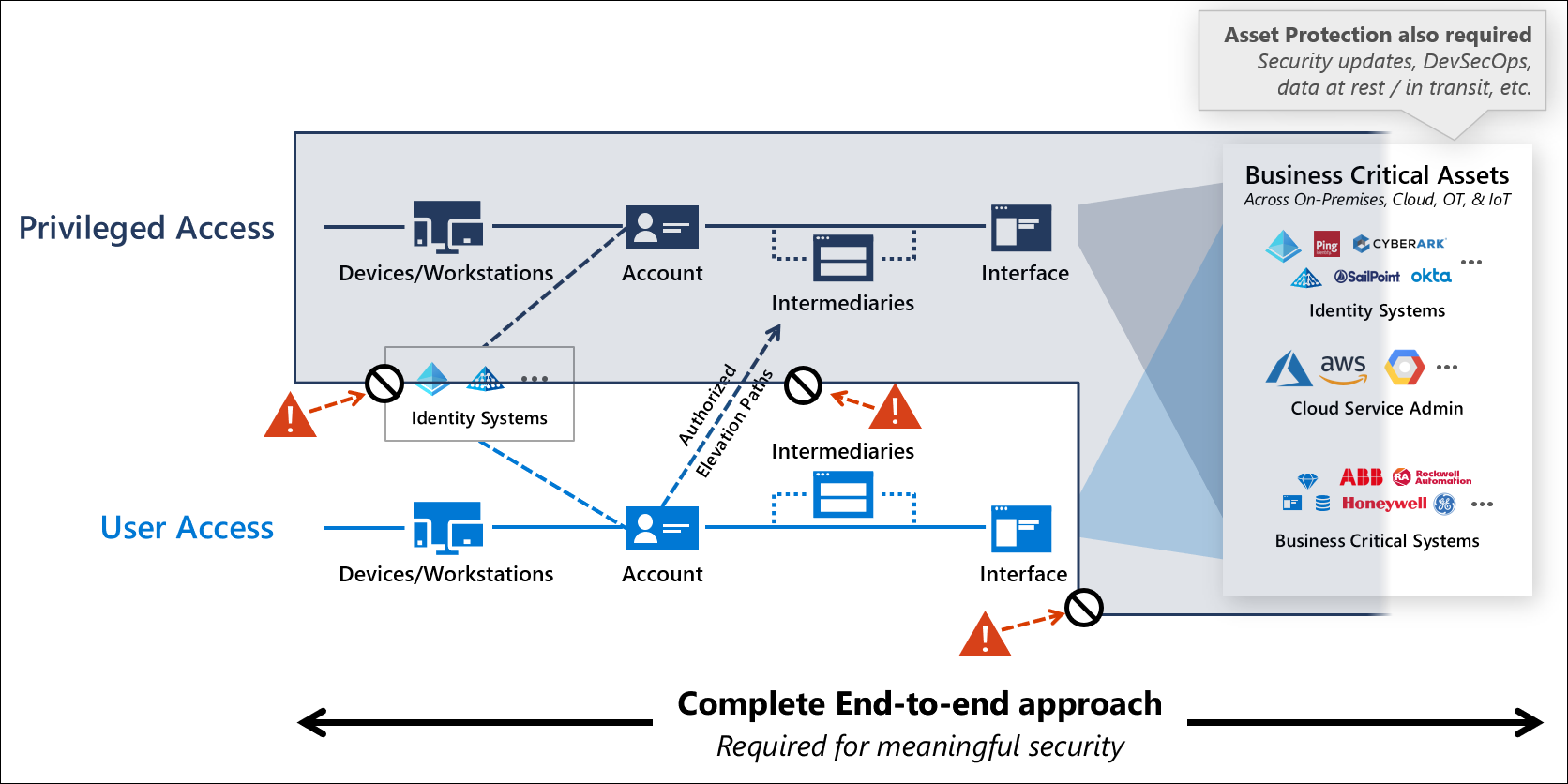
The following diagram illustrates how a privileged access strategy creates a separate access channel and secures it at a higher level for these privileged accounts, devices, and more.
Why privileged access requires a new approach
Privileged access underpins every other security control. If an attacker gains control of privileged accounts, they can undermine all other defenses.
Traditional assumptions, such as trusted networks or trusted devices, no longer hold in distributed, cloud‑centric environments. Attackers exploit multiple entry points, and escalate privileges across identities, devices, or access paths. Attacks have evolved from isolated data theft to rapid, multi‑stage incidents that disrupt core business operations.
At the same time, organizations operate across cloud services, on‑premises systems, remote work environments, and third‑party integrations. This complexity increases exposure when privileged access isn't tightly controlled.
Use a Zero Trust approach
Because privileged access attacks are both high‑impact and high‑likelihood, they must be treated as a top security priority.
A modern approach applies Zero Trust principles, where administrative access is tightly controlled and continuously verified:
- Least privilege – Administrators receive only the permissions required for specific tasks.
- Explicit verification – Access decisions validate the identity, device, and context of each privileged session.
- Assume breach – Security architecture limits the ability of attackers to move laterally or escalate privileges.
Rather than relying on individual tools, organizations must adopt a coordinated strategy that secures:
- Identities.
- Devices
- Access pathways
- Monitoring and response
Business outcomes
Implementing a modern privileged access strategy delivers measurable business outcomes.
Reduce the risk of high-risk breaches: Privileged accounts enable broad system access. Securing them significantly reduces the likelihood and impact of human-operated ransomware and large‑scale disruption.
Control administrative attack paths: Limiting and isolating privileged access paths makes it harder for attackers to escalate privileges. By strictly controlling administrative pathways, organizations make it more difficult and costly for attackers to move across the environment.
Protect high‑value systems and devices: Protecting identity and administrative systems, and securing devices reduces the risk of compromise from less secure devices and systems.
Strengthen governance and compliance: Privileged access controls provide visibility into privileged access use and risk management. This visibility support auditing, accountability, and alignment with compliance requirements.
Structured security levels simplify adoption, reduce configuration errors, and provide consistent control enforcement across the organization.
Improve detection and response: Privileged access monitoring enables faster detection of suspicious activity, reducing adversary dwell time and operational risk.
Implement consistently: Our adoption model provides simple security levels to reduce configuration errors and avoid operational gaps with consistent control enforcement across the organization.
Support secure digital transformation: A robust privileged access strategy enables secure cloud adoption, secure remote work, and modern platform architectures, without increasingly organizational risk.
Align security disciplines
Security disciplines represent the structured areas of accountability required to deliver the Secure critical business assets business scenario.
- Planning and oversight disciplines define the strategy, governance, and cross‑organization coordination required.
- Technical strategy disciplines define the architectural, operational, and control capabilities required.
- Operational disciplines ensure that security controls remain effective over time through monitoring, response, and continuous improvement. They detect misuse, respond to threats, and drive ongoing security posture improvements.
Planning and oversight disciplines
| Discipline | Action |
|---|---|
| Strategy, integration, and governance | Define the organizational strategy, policies, and governance processes that ensure privileged access controls are implemented consistently and aligned with business risk and compliance requirements. |
| End-to-end security architecture | Design an integrated security architecture that connects identity, devices, infrastructure, and monitoring controls to securely manage privileged access across the entire environment. |
Technical strategy disciplines
| Discipline | Action |
|---|---|
| Access and identities | Ensure privileged identities are tightly governed so that only authorized users can obtain elevated access, and only for the time and scope required. |
| Infrastructure security** | Protect the systems, devices, and management environments from which privileged access is performed to prevent compromise of administrative sessions. |
Operational disciplines
| Discipline | Action |
|---|---|
| SecOps | Monitor and investigate privileged activity to quickly detect, contain, and respond to misuse or compromise of administrative access. |
| Security posture management | Continuously assess privileged access configurations and exposure to identify risks, enforce best practices, and drive ongoing security improvement. |
Next steps
Learn how relevant disciplines work together to design a privileged access architecture.