Note
Access to this page requires authorization. You can try signing in or changing directories.
Access to this page requires authorization. You can try changing directories.
Containers have become the standard for packaging and deploying modern applications. Azure provides a comprehensive set of container services that range from fully managed Kubernetes clusters to serverless container platforms. Whether you're modernizing existing applications, building cloud-native microservices, or running stateful workloads, Azure container services offer the flexibility, portability, and scalability your organization needs.
Choosing the right container platform depends on your workload requirements, operational expertise, and business goals. Key considerations include orchestration complexity, scaling requirements, networking needs, and the level of control you want over the underlying infrastructure. Azure's container portfolio spans infrastructure as a service (IaaS), platform as a service (PaaS), and serverless models, allowing you to select the approach that best fits your architecture.
Architecture
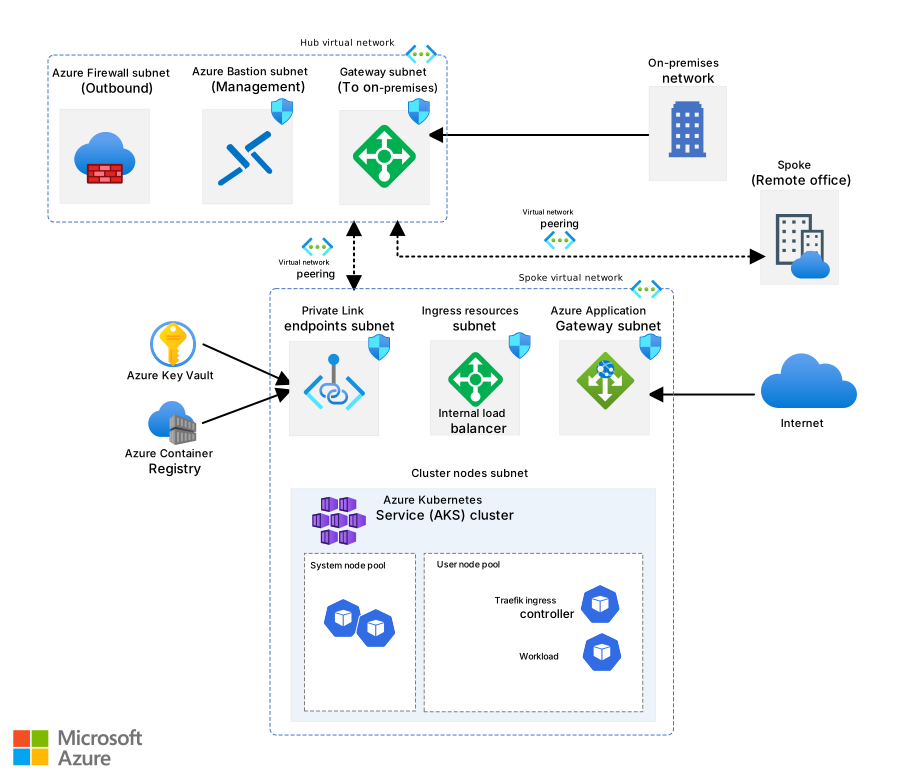
Download a Visio file of this architecture. Refer to the architectures provided in this section to find real-world solutions that you can build in Azure.
Explore container architectures and guides
The articles in this section include fully developed architectures that you can deploy in Azure and expand to production-grade solutions and guides. These can help you make important decisions about how you use container technologies in Azure. Solution ideas demonstrate implementation patterns and possibilities to consider as you plan your container implementation.
Container architecture guides
Technology choices - These articles help you evaluate and select the right container platform for your workload requirements:
- Choose an Azure container service - Decision tree for selecting the right container platform.
- Azure container service considerations - Detailed considerations for container service selection.
- Microservices architecture style - Design principles for microservices.
- Design a microservices architecture - Step-by-step guidance for microservices design.
AKS
Azure Kubernetes Service (AKS) is the most comprehensive container platform on Azure. See the following resources for AKS:
AKS guides - These articles provide detailed guidance for designing and implementing AKS solutions:
- Get started with AKS - Introduction to AKS architecture and design.
- Choose a Kubernetes at the edge option - Compare options for running Kubernetes at the edge.
- High availability for multitier AKS apps - Design patterns for highly available AKS applications.
- CI/CD for AKS apps via Azure Pipelines - Implement continuous integration and deployment for AKS.
- GitOps for AKS - Use GitOps practices to manage AKS deployments.
- Access an AKS API server - Secure access patterns for AKS API servers.
- Blue-green deployment of AKS clusters - Implement zero-downtime deployments with blue-green strategies.
- Firewall protection for an AKS cluster - Secure AKS clusters with Azure Firewall.
- Use Azure Kubernetes Service to host GPU-based workloads - Run GPU workloads on AKS for AI/ML scenarios.
AKS architectures - These production-ready architectures demonstrate end-to-end AKS solutions that you can deploy and customize:
- AKS baseline cluster - Production-ready baseline architecture for AKS.
- AKS baseline for multi-region clusters - Deploy AKS across multiple regions for high availability.
- Microservices architecture on AKS - Design and deploy microservices on AKS.
- Advanced microservices on AKS - Advanced patterns for complex microservices workloads.
- CI/CD for microservices on Kubernetes - Build robust CI/CD pipelines for Kubernetes microservices.
- Use Azure Red Hat OpenShift in the financial services industry - OpenShift for regulated financial workloads.
- Secure AKS workloads with Azure Front Door - Global load balancing and security for AKS.
- Multitenancy with AKS and AGIC - Multi-tenant architectures using Application Gateway Ingress Controller.
AKS solution ideas - These solution ideas demonstrate AKS implementation patterns and possibilities to explore:
- Data streaming with AKS - Real-time data streaming architectures using AKS.
PaaS container hosting
Azure Container Apps and Azure Container Instances provide serverless container platforms that abstract infrastructure management.
PaaS architectures - These architectures demonstrate serverless container solutions:
- Microservices with Container Apps - Build microservices using Azure Container Apps.
- Microservices with Dapr and KEDA - Event-driven microservices with Dapr and KEDA on Container Apps.
Learn about containers on Azure
Microsoft Learn provides free online training resources for Azure container technologies. The platform offers videos, tutorials, and hands-on labs for specific products and services, along with learning paths organized by job role.
The following resources provide foundational knowledge for container implementations on Azure:
- Introduction to Kubernetes on Azure
- Introduction to Azure Kubernetes Service
- Deploy a containerized application on Azure Kubernetes Service
- Introduction to Docker containers
- Deploy and run a containerized web app with Azure App Service
- Implement Azure Container Apps
Learning paths by role
- Solutions architect: Architect compute infrastructure in Azure
- Developer: Deploy containers by using Azure Kubernetes Service
- Developer: Implement containerized solutions
- DevOps engineer: Develop and deploy applications on Kubernetes
Organizational readiness
To help assure the quality of your container solution on Azure, we recommend following the Azure Well-Architected Framework (WAF). WAF provides prescriptive guidance for organizations seeking architectural excellence and discusses how to design, provision, and monitor cost-optimized Azure solutions.
For container-specific guidance, see the Azure Well-Architected Framework service guides for:
Operations guide
Deploying your workload on Azure is a significant milestone, and this is when day-2 operations become critical.
AKS operations
The AKS day-2 operations guide helps ensure you're ready to meet operational demands for Kubernetes workloads.
Key AKS operational areas:
- Triage practices - Systematic approach to troubleshooting AKS issues.
- Backup and recovery for AKS - Protect your cluster configuration and workloads.
- Patch and upgrade worker nodes - Keep clusters secure and up to date.
- Troubleshoot networking - Diagnose and resolve network issues.
- Monitor AKS with Azure Monitor - Collect and analyze telemetry from your clusters.
Container Apps operations
Azure Container Apps reduces operational overhead with managed infrastructure, but you still need to monitor and manage your applications:
- Monitor Container Apps - Use Azure Monitor, Log Analytics, and Application Insights for observability.
- Health probes - Configure liveness, readiness, and startup probes for container health.
- Revisions and traffic splitting - Manage application versions and implement blue-green deployments.
- Quotas and limits - Understand service limits and plan capacity accordingly.
Best practices
Following best practices helps ensure your container solution on Azure is reliable, secure, and cost-effective.
- Autoscaling best practices - Learn about dynamic scaling to right-size your infrastructure.
- Background jobs guidance - Implement background processing for long-running tasks.
- Caching guidance - Improve performance and reduce load on backend systems.
Cost optimization
Managing container costs on Azure requires understanding your usage patterns and selecting the right pricing models:
- Azure Reservations - Save up to 72% on AKS node VMs with 1-year or 3-year commitments.
- Azure Spot VMs for AKS - Use spot node pools for interruptible workloads at significant discounts.
- Azure Savings Plan for Compute - Flexible pricing across VMs, Container Instances, and other compute services.
- Right-size resources - Use Azure Advisor recommendations to identify underutilized nodes and optimize pod resource requests.
- Container Apps consumption plan - Pay only for resources consumed during request processing.
Stay current with containers
Azure container services are evolving to address modern application challenges. Stay informed about the latest updates and planned features.
Get the latest updates on Azure products and features.
To stay current with key container services, see:
Additional resources
Containers is a broad category and covers a range of solutions. The following resources can help you discover more about Azure.
Hybrid and multicloud
Many organizations need a hybrid approach to containers because they have workloads running both on-premises and in the cloud. Azure provides services to extend your container platforms across environments:
- Azure Arc-enabled Kubernetes - Manage Kubernetes clusters running anywhere with Azure Arc.
- AKS enabled by Azure Arc - Run AKS on Azure Local and Windows Server.
- Azure Arc hybrid management and deployment for Kubernetes clusters - Manage Kubernetes clusters across environments.
Key hybrid container scenarios:
- Hybrid architecture design - Overview of hybrid solutions on Azure.
- AKS on Azure Local baseline architecture - Production-ready AKS on Azure Local deployment.
AWS or Google Cloud professionals
These articles can help you ramp up quickly by comparing Azure container options to other cloud services:
- Containers and container orchestrators on Azure and AWS - Compare Azure and AWS container services.
- Azure for AWS professionals - Overview of Azure for those familiar with AWS.
- Google Cloud to Azure services comparison - Compare Azure and Google Cloud container services.